









A special launching method for the new A16 Rotterdam
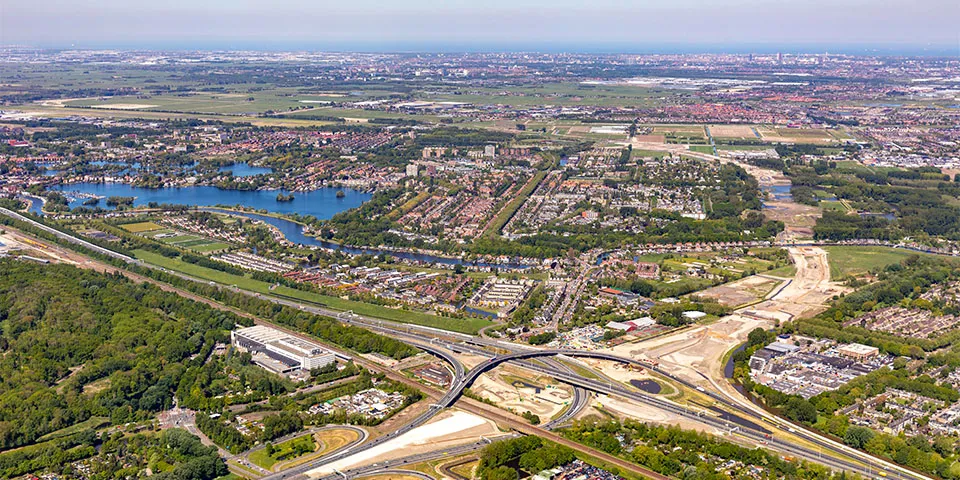
Rijkswaterstaat is building a new motorway between the A13 near Rotterdam The Hague Airport and the A16/A20 at Terbregseplein. The 11 km-long A16 Rotterdam will help traffic on the A13, A20 and surrounding local roads flow more smoothly. The new link will improve accessibility and quality of life in the region. The De Groene Boog construction consortium includes, among others, TBI companies Mobilis and Croonwolter&dros. Mobilis is responsible for the civil engineering works, while Croonwolter&dros is responsible for all installations, including the tunnel systems. We speak to Martijn Jansen, design lead at Mobilis.
Viaduct set to be a major engineering feat
“The viaduct over the existing infrastructure at Terbregseplein will be a major engineering feat. We are launching in-situ-cast box girders across Terbregseplein without disrupting traffic. This is also known as the Incremental Launching Method,” Jansen begins. “In civil engineering, this method involves building a complete bridge deck from just one side of the bridge, pushing the bridge superstructure in sections to the other side. Each girder will be 400 metres long in each direction. We are currently working on the piers, over which the box girders will later be launched. This method is unique in the Netherlands.” The girders are pushed at a speed of around 0.5 metres per hour. “It is completely safe, but it may be quite a sight for the traffic passing underneath. Launching starts from the north, where the construction facility is located.”
The crossing with the HSL is also a challenge: the works must not affect the existing infrastructure. The A16 Rotterdam will cross the HSL 8 metres above ground level. Jansen says: “The embankment is being built up using EPS. Micropiles provide the required foundation and function as ground anchors in compression. We isolate the micropiles from the HSL foundation layers by enclosing them in PVC sleeves. This means all load transfer takes place below the foundation layer of the HSL trough. The crossing of the Rotte also presents a construction challenge: we are building a tunnel beneath the river on site. It will be safe and watertight.”
Traffic heading for The Hague will no longer use the ring road
“The 11 km-long A16 Rotterdam will help traffic on the A13, A20 and surrounding roads move faster and more smoothly,” Jansen says. “As well as improving traffic flow, it will reduce disruption for residents along the A20 and A13 near Overschie, cut noise nuisance and reduce emissions.”
The A16 will cross the existing Terbregseplein and then continue through Terbregseveld in a tunnel beneath the Rotte. “After that, the A16 continues through a semi-sunken tunnel beneath Lage Bergse Bos. So you won’t hear, see or smell the new A16 here. This was one of Rijkswaterstaat’s requirements, as set out in the route decision. The semi-sunken tunnel will emerge from the ground to the north of Rotterdam. New railway overbridges will cross the HSL and Randstadrail, after which the A16 will run parallel to the N209 before connecting with the A13,” Jansen explains.
Energy-neutral concept wins Sustainable Pearl award
The A16 Rotterdam is carefully integrated into its surroundings, and in many places cannot be seen, heard or smelled. It is also the world’s first energy-neutral motorway with a tunnel. Jansen explains: “Much of the project is powered by solar farms, including the installations inside the tunnel. The A16 Rotterdam project received a ‘Sustainable Pearl’ award for this, recognising projects that apply the Sustainable GWW Approach in a unique way. Sustainable Pearls are awarded to client and contractor partnerships that have given above-average attention to applying the Sustainable GWW Approach, or elements of it, on a civil engineering project.”
The De Groene Boog construction consortium comprises BESIX, Dura Vermeer, Van Oord and TBI companies Croonwolter&dros and Mobilis. Jansen says: “During the tender phase, ambitious commitments were made on the use of materials and energy during the operational phase. The consortium also tendered at level 5 of the CO2 Performance Ladder, with a target of reducing CO2 emissions by at least 10 per cent. CO2 emissions are being kept to a minimum. As well as using solar farms and LED lighting, we are also deploying electric transport and hybrid equipment.” It is no coincidence, then, that the project slogan is ‘Groen en Groos’.
Three sections
The De Groene Boog construction consortium has divided the A16 Rotterdam project into three sections: the area north of Rotterdam, the tunnel and the area around Terbregseplein. After the contract was awarded, Jansen was responsible for all structures during the preliminary design phase. He is now responsible for designing the civil engineering structures in the area north of Rotterdam. “The tunnel can be seen as a single complex, integrated project, with extensive interaction with the surrounding area, residents, businesses and stakeholders such as Recreatieschap Rottemeren. The area north of Rotterdam presents a geotechnical challenge because of the soft ground and the large number of crossings. At Terbregseplein, we will use the Incremental Launching Method. It is a unique method in the Netherlands, which Mobilis is applying to build the A16 Rotterdam.”
Have a business enquiry for Mobilis? Get in touch
Who worked on A16 Rotterdam
- consortiumDe Groene BoogMentioned in Project A16 Rotterdam to become the first energy-neutral motorway, including a 2.2 km-long tunnel
- lifting and transport frame
 SarensMentioned in Reinforced underwater concrete floor for Rottemerentunnel
- supplier of reinforcing steelBCSMentioned in Reinforced underwater concrete floor for Rottemerentunnel
- construction consortium
 Van OordMentioned in De Groene Boog aims for maximum reduction in CO2 emissions
- construction consortiumDura VermeerMentioned in De Groene Boog aims for maximum reduction in CO2 emissions
- construction consortiumJohn LaingMentioned in De Groene Boog aims for maximum reduction in CO2 emissions
- construction consortiumDe Groene Boog construction consortiumMentioned in GPS-guided precision excavation in the wet cofferdam
- excavation workAannemingsbedrijf Verboon Maasland BVMentioned in GPS-guided precision excavation in the wet cofferdam
- foundation contractor consortium
 Voorbij FunderingstechniekMentioned in The foundation joint venture is De Groene Boog’s ‘invisible friend’
- foundation contractor consortiumFranki GrondtechniekenMentioned in The foundation joint venture is De Groene Boog’s ‘invisible friend’
- UO calculationsM.U.C.Mentioned in The foundation joint venture is De Groene Boog’s ‘invisible friend’
- UO calculationsHektecMentioned in The foundation joint venture is De Groene Boog’s ‘invisible friend’
- reinforcementDiepstraten WapeningstaalMentioned in Specialist reinforcement solutions for 33 structures
- ready-mixed concreteDyckerhoff BasalMentioned in Specially formulated mixes significantly reduce carbon footprint
- waterproofingBrabotechMentioned in Watertight construction with flexible joint seals and a liquid-tight layer
- construction consortiumDe Groene Boog construction consortiumMentioned in Watertight construction with flexible joint seals and a liquid-tight layer
- prefabricatedCiviele technieken deBoerMentioned in A leading name in heavy lifting and specialist transport
- Bonneveld Gewapende Grondconstructies
 BonneveldMentioned in One of the largest EPS structures ever built







Keep following this
Get an email when a new story is published. No account needed.
- ProjectA16 Rotterdam
- SubjectSpecials
- CompanyMobilis
- CompanyCroonwolter&dros
- CompanyVan Oord







