The invisible slowdown: digitising our underground infrastructure
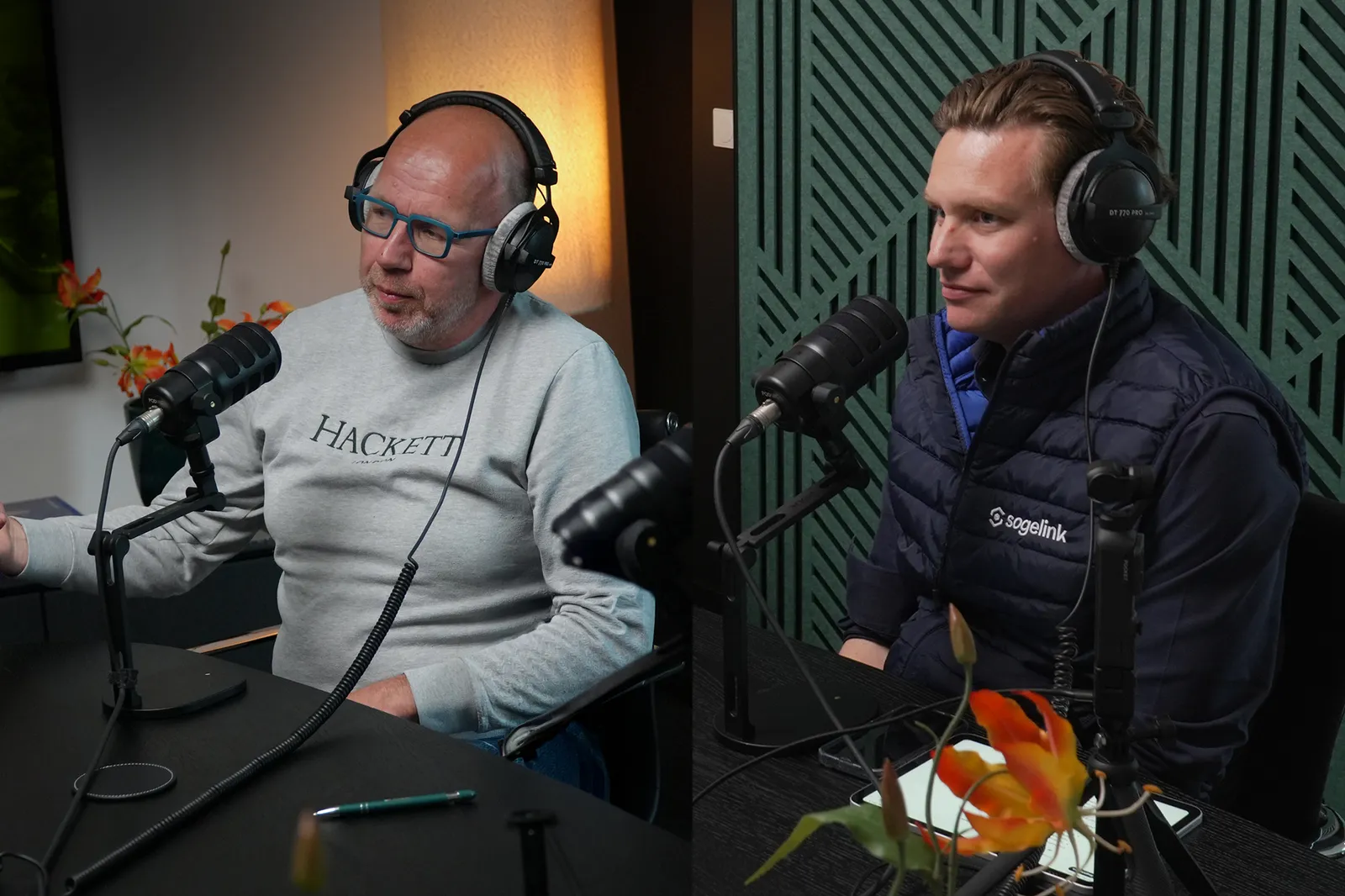
The Netherlands is a world leader in recording cables and pipelines, but the energy transition means we need to move even faster. How can we prevent ‘invisible delays’ in the data from holding back the physical construction of our energy network?
In this episode of the GWW-Bouwmat podcast, we get down into the trench with Victor van Baal (Managing Director) and Peter van Dijk (Head of Product) of Sogelink. We discuss the need for standardisation and the launch of their latest innovation: Registration in the trench.
What you’ll discover in this episode:
- The Closed Loop approach: Why data needs to be back with the network operator within 24 hours.
- First Time Right: How smart software reduces the cost of errors and eases the pressure on surveyors.
- A glimpse of the future: From Augmented Reality (AR) in the Klic app to object recognition using LiDAR scanning.
- Proud of the underground: Why the Netherlands is regarded internationally as a shining example of digital infrastructure.
Een zakelijke vraag aan Sogelink Nederland? Get in touch
Full transcript
00:18 Welcome to this episode of GWW-Bouwmat, the podcast. Today we’re looking at a subject that is crucial to the future of the Netherlands: digitising underground infrastructure. Joining me at the table are two guests from Sogelink.
00:31 You may know them for, among other things, the Klic App, and they have a new solution too. More on that later, of course. Peter and Victor, please introduce yourselves.
00:41 Yes, thank you. I’m Victor van Baal, Managing Director of Sogelink Nederland. I’ve been in the role since January this year.
00:50 Thank you.
00:51 I’m Peter van Dijk, Head of Product Nederland. I’ve been working in this field for almost 15 years.
00:58 There you go. Let’s start at the macro level. First, why should we be talking about the Klic app and your new solution now? Why is it so important?
01:09 Yes, it will come as no surprise that we need to talk about the energy transition and all the challenges it brings with it in the Netherlands. This is a huge physical undertaking: upgrading the infrastructure.
01:24 And, of course, that brings all kinds of challenges we often hear about in the news, along with everything that is going wrong across the country. People who can’t get a connection, businesses that can’t expand.
01:39 When you look at the context, you often focus on the number of people we don’t have to carry out the work, and the number of transformer kiosks that need to be installed, which is happening far too slowly.
01:53 The permit applications are all taking a long time too. That’s all true, but digitisation is often an overlooked issue.
Read the full transcriptCollapse transcript
02:09 And it’s something I think we can be very proud of. Before taking on this role, I worked on the same subject in France and the Netherlands. When you see how things are done in other countries, you realise that we have something really good here, something that works very well.
02:22 So things are already a bit better in the Netherlands than in the surrounding countries.
02:26 Absolutely. We should be really proud of that. There have been lots of examples in our company and in my work over the past two years where I’ve been able to present the system built in the Netherlands,
02:41 the whole database, as cutting-edge. It’s seen as cutting-edge around the world. But with the energy transition in mind, we now need to take the next step. And that doesn’t often get
02:57 the attention it deserves. We’re glad to talk about it here. Okay, but the common thread is that things need to move faster.
03:02 They certainly do, yes. As Victor said, for example, I went to America on behalf of Socialink last year to present what we’re doing in Europe in this area: digitising and standardising underground infrastructure.
03:16 I explained both the French and the Dutch situation. When you talk about the Netherlands, we’re way ahead. But given the challenges we face, we need to move even faster. And that applies not only to the capacity of our infrastructure, particularly electricity,
03:32 but also water. That’s another issue that gets overlooked, but will undoubtedly play a much bigger role. The infrastructure needs to be expanded, and renewed too, because some of it is too old.
03:47 So we need more standardisation. Another key point is getting it right first time. I think our company has a proven track record in that area too, built over the past 15 to 20 years. We focus very strongly on standardisation, but also on getting it right first time. And you’re known for the Klic app.
04:06 I’ve just been told you’re also the Klic expert.
04:10 Yes, I suppose I’m known for that. When you look at Klic, it has two sides: the excavation contractors and the network operators. The network operators own the underground infrastructure, while the excavation contractors are the ones who work on it. Sometimes they’re network operators too. The Klic App is designed to make the underground data you receive
04:38 easy to consult in a consistent way, and to report information back where necessary. That helps prevent excavation damage. And we’re going to build on that, of course.
04:51 We’ve actually been doing this for years for service connections to homes. The idea is that the new connection you build, once it’s been installed and all the details have been surveyed, is back with the network operator within 24 hours.
05:06 That gives you what we call a closed-loop approach, which is very important. The information then flows back via the network operator to the land registry. So if you submit a new Klic request a day or a few days later,
05:20 it’s already included. And that’s soon going to become standard for new infrastructure on the main network too.
05:27 I think we’ll come back to that shortly.
05:28 We’ll come back to that shortly.
05:30 Victor, why is this an issue now?
05:34 We always call it the invisible slowdown. I mentioned the main issues that often make the news, but the data and processes involved in all this also cause a lot of delays. Peter has explained some of that.
05:52 Without the right software and the right flow of data, you can’t scale up, and so you can’t speed things up. You make mistakes that then have to be corrected later, which holds up the network.
06:05 That brings us back to getting it right first time. You’re talking about manual handovers between departments. Without standardisation, it just won’t work.
06:15 And, of course, there’s also the scale of the energy transition. It’s a lot,
06:19 there’s a lot happening at once. We’re talking about a huge scale, with an enormous amount of work to be done. That’s why we need standardisation.
06:30 It’s also very important to keep things simple. There’s pressure to build this infrastructure, and in the past, partly because of the need to scale things up, surveyors had to be brought in at an early stage.
06:46 The idea now, and I’m getting a little ahead of where we’ll be going into more detail shortly, is that the people building the infrastructure also survey it and send the data back, with validation carried out directly
06:59 in the field. Yes, and by that you also mean NLCS++? Yes, that’s the NLCS++ standard, together with what we call the NLCS++ exchange standard. There’s also a digital collaboration platform, the DSP, which has been in place for service connections for years. It’s now in production and in use for the
07:19 main network too, although NLCS++ isn’t being exchanged yet. But we’re getting closer. That makes it very quick to send back what you’ve actually built.
07:34 You can quickly send it back to the network operator. The network operator processes it, and it then flows back into Klic. That gives you the closed loop.
07:43 NLCS++ is now on version 12, I believe?
07:46 Yes, but don’t forget, it’s not fully in production yet. A number of network operators are involved. The three major electricity and gas network operators, Stedin, Alliander and Annexes, are driving this forward.
08:01 That was already the case back when the service connection process was being developed. They quickly recognised the need to move fast. The challenge is getting the whole chain up and running.
08:15 That’s quite a challenge internally for those organisations. But it also means a major change for excavation contractors. We’re going to help them
08:26 speed things up. That brings us to an interesting point. What role do public bodies play,
08:30 such as the land registry, for example? Yes, a very important one, of course. I think what we need as a market player above all is coordination. Different organisations can provide that, but certainly
08:45 the land registry has a very important role to play. The Netherlands is strong precisely because there’s such good coordination, as you were saying. The land registry’s Klic database, for example, is well regarded internationally, but…
09:04 What we do see is a lot of experimentation by many different parties, with many different approaches, including the commercialisation of public data. We wouldn’t necessarily be in favour of that,
09:19 not so much for our own interests, but because of the need to speed things up across the market. What we need is for everyone to be free to choose which solutions they use.
09:31 And I think, although this is more from the perspective of a taxpayer, it’s good for everyone to play their own part. You need to do what you’re best at. Exactly. And we, as a commercial company,
09:48 along with many others, are well placed to build software on top of what public organisations develop and create, to help the
10:01 market move forward. What this really comes down to is governance. For standardisation, particularly if you want to roll it out widely, it’s important that an independent organisation manages it. In this case, there is such an organisation in the sector,
10:18 DSP-MA, mijn aansluitingen, and the plan is for it to take full responsibility for governance
10:26 of this. And if we zoom in on the market, what’s happening on the ground? There’s an enormous amount of demand for work. All our customers say they have work in the order book for the coming years, but not enough people.
10:43 The question they always ask is: how can I get more work done with the same number of people, or fewer? How can I work smarter?
10:55 There’s also huge demand for simplicity, for making things easier, I think. As you say, working smarter.
11:00 Yes. Our customers who work in the field didn’t necessarily choose that work because they love using software.
11:09 No, I understand.
11:10 Or filling in forms. Or making sure that locations are surveyed accurately. They want to get on with the actual work. So our role is to make sure we develop software that
11:24 that helps them do the work. I mentioned this earlier too, the simplicity of it.
11:31 I sometimes get that comment internally: it looks so simple, why did it take so long? I say, yes, because making something really simple can take a lot of time. And over the years, because we’ve been in this domain for a long time and support a great many groundworks projects with it,
11:52 I think we’ve come up with a really good solution. And we’re building on that. You can still see that this is a challenge for some parties. Not just for potential competitors, but also for contractors trying to make the right choices.
12:12 We’ve always been one of the parties they naturally turn to,
12:17 but we also advise them. Let’s make this more concrete, then. When will Sojalink
12:25 Netherlands come into the picture? We’re already very much on the radar. It’s not a question of whether we’ll come into the picture or get started. If we’re talking specifically about this solution, we’ll launch it in the coming
12:38 month. You mean trench-side recording. Trench-side recording, yes. And perhaps you could also introduce Socialink Nederland. The name may not be familiar to everyone yet.
12:47 I think it is by now. We’ve obviously done a lot to raise our profile. Socialink consists of two established names in the Dutch market: GoConnected and Geodan.
13:00 We’ve brought them together as a group. We help construction and infrastructure contractors do exactly that: work smarter with good software.
13:12 And of course, people know you from the Klic App.
13:16 Yes, and we also have a large business focused on permit management. In that area, our clients are local authorities.
13:23 So you’re active in a much wider range of areas too.
13:25 Definitely.
13:27 And now your new solution comes into the picture: trench-side recording.
13:33 Yes, it’s a natural extension of what we already do. We offer a tool for the person requesting a Klic notification, both in the field and, well, not just in the field, but also in the office during work preparation. You need to have the underground information with you,
13:48 because the law requires it. For years, we’ve also offered a digitised process for service connections, which has been working successfully for ten years, and
14:03 now we’re doing the same thing on a larger scale, but for the main network. As I said earlier, standardisation plays a part here too, along with the exchange model, which is integrated into our Klic App and our
14:19 office software. So in our case, it doesn’t mean using separate tools or anything like that. It’s simply a matter of adding some extra functionality, and therefore value, for our customers to an existing app that has already been rolled
14:34 out. OK, so in that sense, little changes for customers. Although it makes things much more efficient, of course.
14:41 But we offer more than before. The foundation remains the same, and customers can expect the same quality we’ve been delivering for years.
14:55 We’ve proved ourselves in that respect too.
14:57 So contractors can digitally record the main network during construction?
15:03 Yes, but one important aspect is that the main network is properly designed. The parts that have already been designed are carried through to the field. What you get in the field is a final design that you take with you and can adjust to reflect how it is actually laid. That’s the as-built record,
15:26 and it can also be submitted back easily. Another important point is that you don’t build a main network in a day. These are long-term projects,
15:39 so the process also allows you to submit as-built records in stages. That means you can also invoice for the work in stages.
15:52 So contractors get paid sooner too. And what makes this solution unique? I think it’s
15:57 what I mentioned earlier: it’s an addition to an existing app that has already been widely rolled out, with an existing office component that customers know. I think that’s what makes it unique. It’s also not a combination of, for example,
16:15 external GIS tools, as you see with other solutions. We control the whole process ourselves, from start to finish. What also makes it attractive to contractors is that it builds on
16:31 integrations they already know through our existing external integrations via our API. We try to minimise the impact on our contractor customers.
16:43 And is the solution already working at scale?
16:46 We’ll run the first pilots in June. There will undoubtedly be improvements to make after that. But we’re also seeing that this whole area is not yet in production.
17:04 Network operators are preparing to be ready for it. They have their own roadmaps. It will take time to get going, but I expect that once it’s up and running, things will move very quickly.
17:17 So the pilots are coming up?
17:19 Yes, the pilots are coming up. We’re already talking to contractors who are existing customers about setting them up, and we’ll run them in cooperation with the network operator.
17:31 Standardisation has a role to play here too. The standard needs to reach a point where it no longer changes. Only then can you really scale up. Once that’s in place, you’ll see the acceleration. And if you were to
17:48 sum up why this solution makes a difference, what does it deliver in practical terms?
17:55 Faster turnaround times and lower costs. I think the key point is that the person building the infrastructure also effectively does the work that a surveyor used to come in and do.
18:09 You can already see that with service connections. A surveyor used to come out, but in future the person doing the work won’t be a surveyor. They’ll use surveying equipment and techniques to record it. The challenge, once again, is to keep it as simple as possible,
18:27 because this is someone building infrastructure, not a surveyor. I understand you’re
18:33 going to present trench-side recording at InfraNext? That’s right, yes. I’ve
18:39 already let the surprise out of the bag, but that’s right. We’ve been very enthusiastic about InfraNext from the outset and have high expectations, so this is a great opportunity. And what can visitors expect? We have high expectations, so this is a great opportunity.
18:51 And what can visitors expect?
18:53 We’ll be there to show what we’ve developed. We expect many of our customers to be there too, so we’ll be able to demonstrate it to them.
19:08 And looking a little further ahead, what’s the roadmap? Where are you going?
19:14 How will the solution evolve? We’re focused on simplifying all processes in construction and infrastructure. We want to serve the entire value chain of the construction process, as it’s called in software terms.
19:33 Our solutions currently cover part of that. We’re looking in both directions, towards maintenance and management, as well as construction and design.
19:45 What else can we offer in those areas?
19:49 When it comes to innovation, for example, the Klic App lets you view underground information. Before long, you’ll also be able to use it to record newly constructed infrastructure. One of the extensions we’re working on is the ability to view Klic data in augmented reality.
20:06 We already have a version of that available, but it lets you see where cables and pipes are in the camera view on your mobile device. The next step for trench-side recording is to start with the traditional approach, using high-accuracy GPS surveying.
20:23 Over time, we’ll also invest in point cloud scanning with the LiDAR on your phone, so that object recognition and surveying can be done using your point cloud. We’re not there today or tomorrow, but we will be in due course.
20:40 Once you’ve captured a point cloud, you can combine it with augmented reality. If you visualise the data and return to a place where you previously captured a point cloud, you can actually look underground straight away.
20:55 Because you can retrieve that information.
20:57 Will we soon see someone in a trench wearing smart glasses?
20:59 That could happen eventually, but when you’re in a trench, you can already see things for real. The use case is really when you’re walking along the road: you can view the data and see it visualised based on Klic data, and once everything has been captured in a point cloud,
21:13 you’ll actually be able to look underground.
21:19 And to add one very concrete point, we’re working hard to add more data layers and map layers to the Klic App. The Netherlands is also ahead in this area. Just last
21:34 week, on a project at the Lekdijk with an American, I was able to explain clearly that a lot has happened there over the years, and we have all the archaeological data. That will
21:45 be added to the Klic App, so you can see where there may be unexploded ordnance and archaeological remains. We’re really ahead of the curve in that area. That’s surprising, I imagine. Absolutely.
21:58 And building on that, trench-side recording is primarily about working at the trench. But legislation and regulations are making it increasingly important to carry out soil investigations too. Is the soil contaminated? We can also
22:16 let users request that kind of information directly through our portal. We’ll also add information about tree roots. Tree roots pose a threat to cables
22:28 and pipes, but we also need trees, including to support the energy transition. You can look at it the other way round too: where are you going to plant trees, so they don’t threaten cables and pipes? Those are the kinds of things
22:39 we’ll keep adding. So it’s becoming more comprehensive? More and more comprehensive, and almost a one-stop shop with everything integrated. It intelligently
22:52 uses data from different sources to help you carry out a sound risk analysis and assessment, which is becoming increasingly important. And as a user,
23:00 I assume you don’t need to be a computer scientist to use it all, because… No, because
23:04 that’s something you see quite often. There’s a lot of GIS, or geographic information systems, technology behind it. You use it, but you don’t need to be a GIS expert to operate all of this. That wouldn’t work.
23:20 It remains intuitive and user-friendly. Yes. And to sum up, where does that leave us as a sector,
23:28 What should we focus on in the coming period? Well, I think a lot of things have already come up in this discussion. Make sure we tackle these major societal challenges together, with public and private sector organisations pulling together by
23:45 investing in innovation. Make sure we don't get carried away by all the marketing stories about AI, and make sure we stay realistic about how software is built.
24:01 How stable software is built. I think that's really important, and it's also an area where I might be able to play a role myself. We need to make sure people in the market stay realistic about it, while recognising that it can also help us move faster.
24:15 But we need to move faster in a stable way, too. Those are just a few of the things we need to focus on in the coming period.
24:24 And, of course, speeding up standardisation as well.
24:26 That's been mentioned.
24:27 That's been mentioned, yes. Finally, what message would you like to leave us with?
24:33 Well, I'm not really one for messages, to be honest. Advice? Well, no. Look, we have a very clear plan. We know what we want, we know who we are, and
24:46 we work on it every day with a great deal of energy, alongside a fantastic group of people. I think the main message for the listener, for this audience, is that a lot is already going well in the Netherlands. And we know, we can see, and we know from the past
25:03 where things could be even better. But above all, let's take pride in how well things are going, and in how well the whole system is organised. Yes, and to add to that, which is
25:16 perhaps a bit of a message, I think we're not proud enough of what we've already achieved in the Netherlands in this area. I notice it myself too. I do tend to go along with it myself.
25:25 There's a lot of complaining.
25:26 There's a lot of complaining, but that's part of it too. We could be a bit prouder of how everything is organised in this little country, with so many people and so much underground infrastructure.
25:39 There you go, brilliant. Well, thank you for these insights and for coming to the studio. Thanks for listening to this podcast by GWW Bouwmat. Live from the Louwers Mediagroep studio in Weert.
Companies in this story
Keep following this
Get an email when a new story is published. No account needed.
- ThemeUnderground construction
- SubjectDigitalisation & software
- CompanySogelink Nederland