









Prinses Marijkesluis: renovation while keeping the operation running
Text Armand Landman Images Rijkswaterstaat
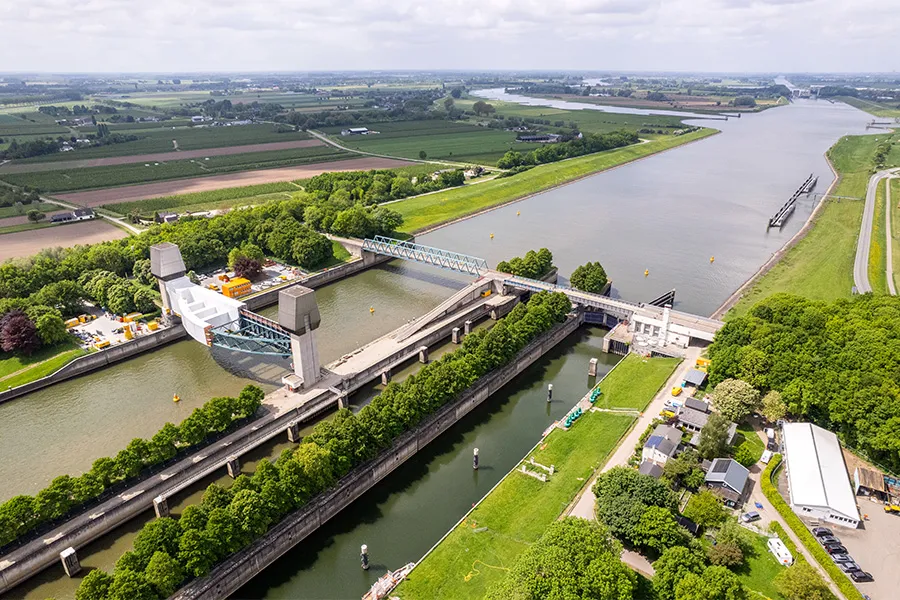
Rijkswaterstaat and Mourik Infra are renovating the Prinses Marijkesluis while shipping on the Amsterdam-Rhine Canal continues and the flood barrier remains operational. The schedule is governed by flood safety: work takes place during the low-water season, with the ability to close the complex if water levels rise. “It’s renovation while keeping the operation running,” says René Diks, contract manager at Rijkswaterstaat.
The renovation is being carried out under a two-phase contract. Phase 1 (March 2022 to November 2023) focused on investigation, design and risk management; phase 2 (from 1 January 2024) is the construction phase. The final milestone is scheduled for March 2027. “We’ve drawn up a robust schedule,” says Sake Hemstra, project manager and contract manager at Mourik Infra. “Some activities simply cannot withstand high water, and that sets the pace.”
A robust risk register is at the heart of the collaboration. In phase 1, around forty investigations were carried out to reduce uncertainties, including investigations into the condition of the lock gates underwater. The remaining 40 to 50 quantified risks have been allocated to the contractor or client, with a budget set aside for them. Diks: “This avoids unnecessary risk premiums in the price and leaves room to deal with unexpected situations professionally, without setting us against one another.” Hemstra: “It takes the pressure off the project and makes working together very pleasant.”
Safety dictates the schedule
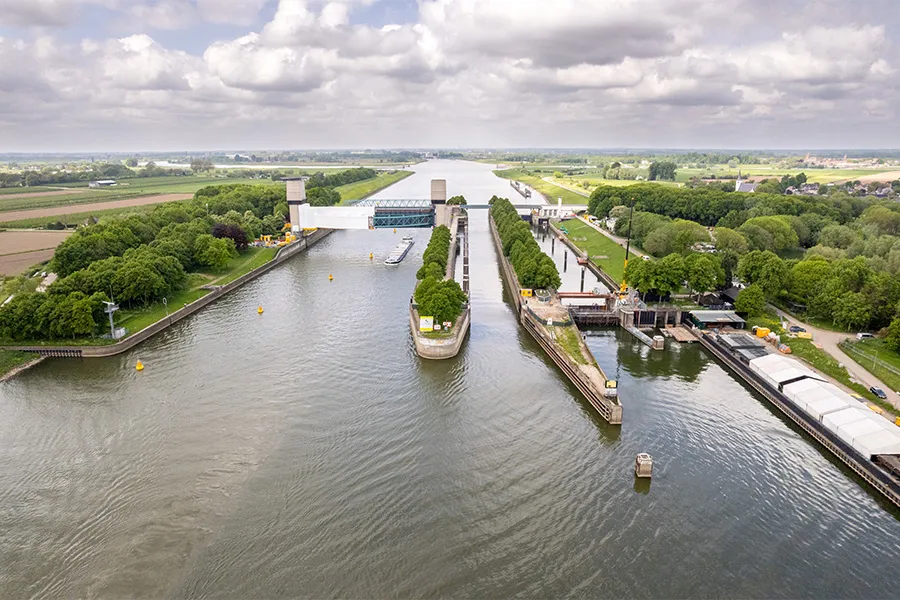
The lock also serves as a primary flood defence. Work on the flood defence may only be carried out during the low-water season. At the same time, if high water is approaching, the movable barrier gate, an 80-metre-wide movable water-retaining gate, and the lock must be capable of being fully closed within three days. “Among other things, we monitor water levels at Lobith,” says Diks. “If a flood wave is forecast, the temporary structure must be removed from the barrier gate and the complex closed. That is a firm requirement.” Hemstra calls this one of the most challenging aspects of the work: protocols are in place to enable the works to be brought to a safe, accelerated close. So far, high water has not required the temporary structure to be dismantled from the barrier gate.
An additional challenge is the barrier gate spanning the Amsterdam-Rhine Canal: its protective coating must be applied above water and the work cannot be completed in a single low-water season. “That’s why we’re splitting the barrier gate and the lock chambers over two years: this year, one half and one chamber, and next year, the other half and the other chamber,” says Hemstra.
Taking the lock out of the water
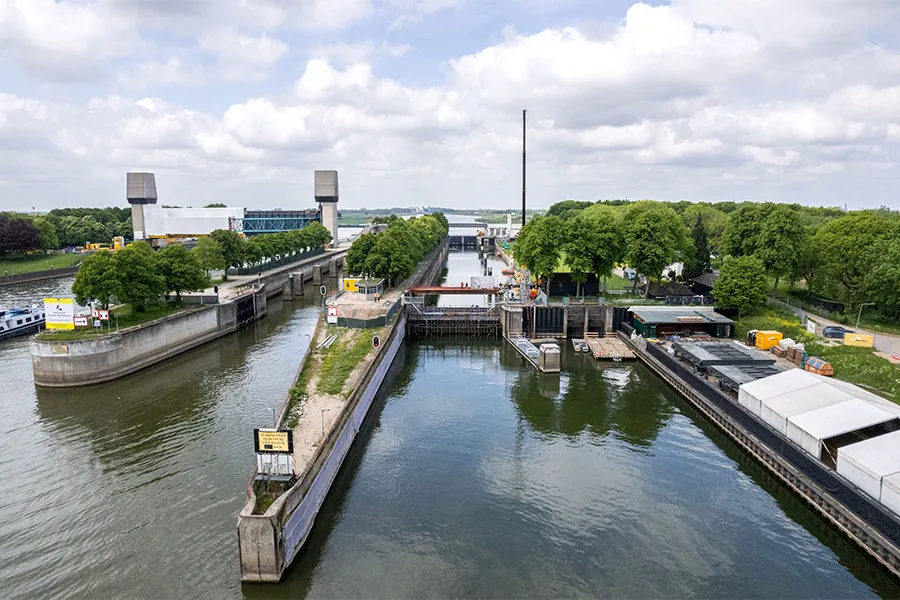
Rijkswaterstaat and Mourik opted to take the lock sections and heads out of the water rather than work in wet conditions with divers. Diks: “Working dry reduces safety risks and makes it demonstrably easier to check quality.” Hemstra: “It requires substantial temporary works, but you can get close to the components, see what you’re doing and properly assess how they function.” To take the lock out of the water, Mourik produced heavy-duty stoplogs at its own steelworks, weighing around 40 tonnes each. “Making many of the critical components ourselves gives us speed and control. The client can then talk directly to the people who make them,” says Hemstra.
Work above the navigation channel is also subject to environmental requirements. Strict measures apply during blasting and coating above the canal to prevent emissions into the water. “We work closely together on this, with carefully prepared work plans and supervision,” says Diks.
Milestone
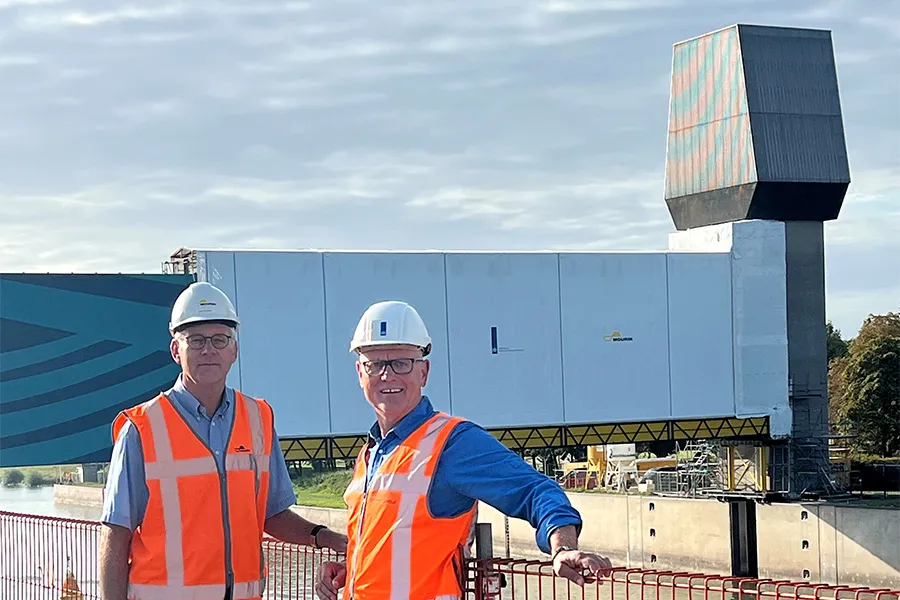
This year, the focus is on major maintenance to the east lock chamber and applying protective coating to the first half of the barrier gate. “We aim to bring the refurbished east lock chamber into service in November, with new control cabins, equipment, lock gates and drive systems,” says Hemstra. “That will be an important milestone. The work is repetitive in nature, so success this year will give us confidence for next year.” In parallel, the team is carefully installing and dismantling the temporary structure on the barrier gate: “It must be possible to dismantle it completely as soon as the high-water season begins.”
The project involves some impressive lifting operations. Hemstra: “Floating sheerlegs, lock gates and temporary works for taking the lock out of the water: it’s fascinating work. You see almost the entire spectrum of civil engineering coming together here.”
Learning in the ‘sluiceyard’
The Prinses Marijkesluis is one of the first projects in Rijkswaterstaat’s so-called ‘sluiceyard’, which brings together several sluice teams to tackle the renewal of Rijkswaterstaat’s sluice assets. Projects are grouped into portfolios, and sluice teams develop and learn together. Experience is shared, reused and scaled up. “There are 86 lock complexes on the programme nationwide,” says Diks. “We want to learn from projects like this and provide the market with a recognisable, attractive package of work, with continuity and synergies.” Hemstra says teams become more attuned to one another more quickly, especially when the starting points are clear from the outset. “Give yourselves a few months during preparation to get to know one another better and embed processes, tools and working methods. It pays off many times over.”
An important lesson for future projects is to develop the starting points and requirements a little further in advance, without stifling innovation. Diks: “If you start with a minimal set of requirements, it takes a lot of time to work out together, ‘What exactly do we want?’ That could be improved.” Hemstra: “With a stronger foundation, you can move more quickly on to design and construction.”
Working together across the supply chain
Mourik works with a trusted team of partners that has also proved a winning formula on previous lock renovations. “Where possible, we choose the same proven partners; you know what to expect from one another,” says Hemstra. “And as a family business with our own steelworks, we can engineer and manufacture critical components ourselves.” Diks: “You can see the difference. A main contractor with regular partners who know one another acts as a single team. That improves predictability and quality.”
Construction in the spotlight
The renovation of the Prinses Marijkesluis will feature in four episodes of RTL 4’s ‘De bouw maakt het’, starting at 17.00 on Saturday 6 September. “It’s great to show everything that goes into a project like this,” says Hemstra. “Complex, varied and, above all, important work.
A business enquiry for Mourik? Get in touch
Who worked on it
Prinses Marijkesluis, renovation
- main contractor
 Mourik
- clientRijkswaterstaat
Keep following this
Get an email when a new story is published. No account needed.
- ProjectPrinses Marijkesluis
- SubjectWater infrastructure
- CompanyMourik
- CompanyRijkswaterstaat







