From design school to infrastructure
Text Roel van Gils Beeld Rain(a)Way
‘For the technical side, you need to talk to Fien’
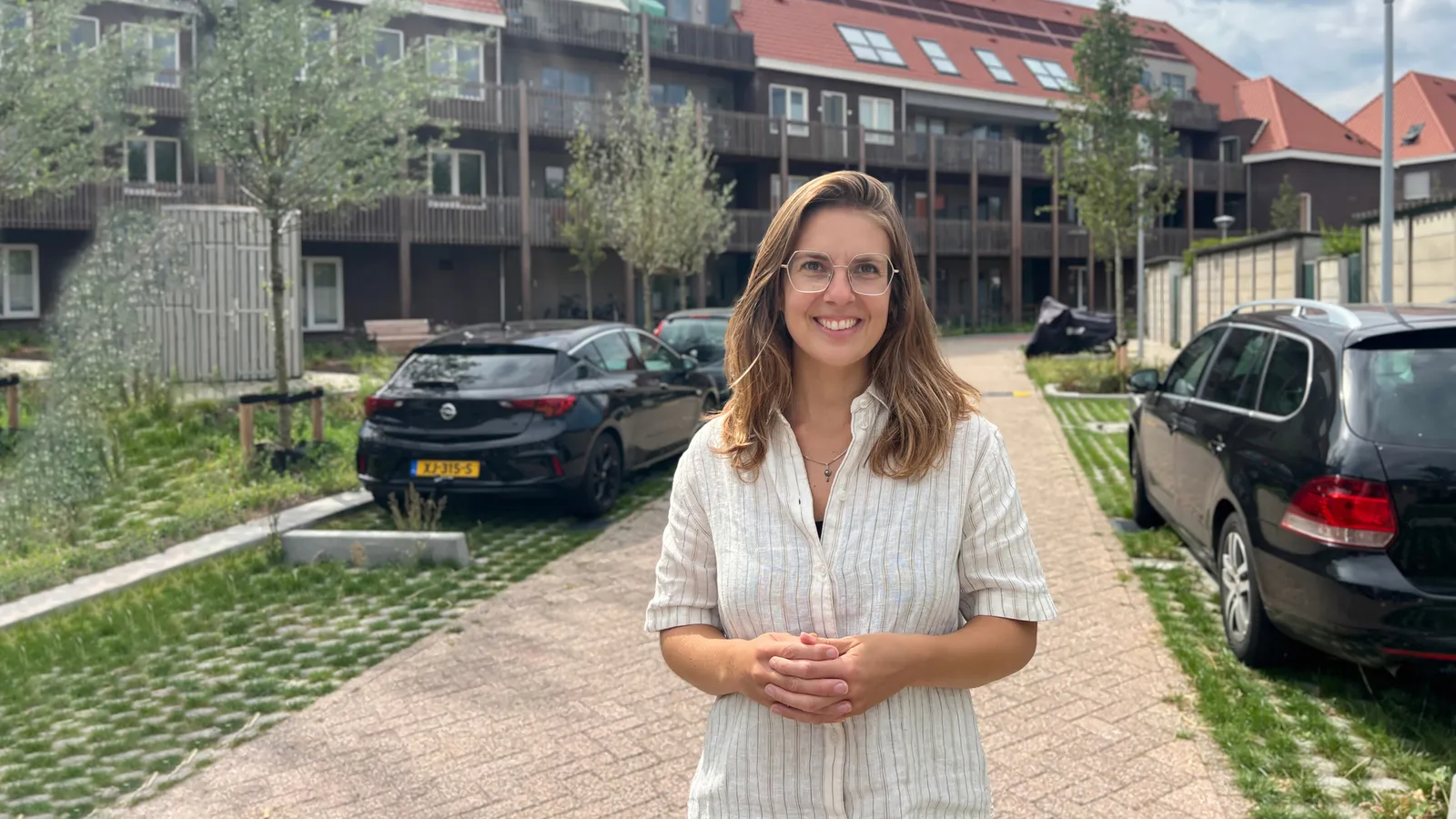
What if you want not only to design what public spaces look like, but also to understand how water, soil, greenery and technology work together in them? For Fien Dekker of Rain(a)Way, that combination became the foundation for her work on Park Positive. Her mission: to turn the traditional grey street into an ecosystem where rainwater is not drained away as quickly as possible, but can instead soak into the ground where it falls.
Fien studied at Design Academy Eindhoven and later specialised in climate adaptation and urban areas at Wageningen University. Her graduation project, Rain(a)Way, was the first step: a paving slab that gives rainwater a visible place in the street. She now works on Park Positive through her company, a concept for green-blue paving that brings design and technology together.
From design to technology
The technical side was exactly what she had missed during her design studies. “I’ve always had both a spatial and a technical perspective. At Wageningen, I was able to bring those two worlds together.” The result is a range of green-blue paving solutions that are not only visually appealing, but also work technically.
At first, she strongly felt that she had to prove herself as a woman in a predominantly male sector. “You try to justify yourself. You use technical terms to show that you really know what you’re talking about.” That has changed over time. She has more confidence in her own knowledge and abilities. And when technical questions come up in a meeting, everyone now knows: for the technical side, you need to talk to Fien.
Making room for women
Fien sees opportunities for other women in this. In her view, infrastructure is much broader than heavy machinery, asphalt and concrete. “Public space belongs to everyone. If you change something there, it has a direct impact on a great many people.”
That is what makes her work special. Water is both visible and tangible, and technically complex. How many millimetres of rain will fall? How many cubic metres can the soil absorb? And how do you design a street where traffic, pedestrians, trees, water and nature all work together?
Park Positive seeks answers that can be put into practice. Not by radically turning the entire street green, but by combining existing paving more intelligently with an open structure and healthy soil. The new Polder klinker is one example: a solution that can be integrated with standard concrete paving blocks, making green carriageways possible too.
A new standard
Fien has a clear ambition: within ten years, a green street should be the norm and a grey expanse of concrete the exception. “When you start to see the street as an ecosystem, you create cooling, space for greenery and a place for rainwater.”
Her story shows that infrastructure needs a range of perspectives. Designers, researchers, engineers and people willing to challenge existing systems.
So, what does Fien say to women considering a career in infrastructure? Her advice is clear: “Go for it. Curiosity, knowledge and a willingness to claim your space will take you just as far. Trust in what you know, and people will soon realise you’re not the tea lady,” she says with a laugh.
Question about this story? Ask your question
Keep following this
Get an email when a new story is published. No account needed.
- SubjectWomen in construction