









Project A16 Rotterdam to become the first energy-neutral motorway, including a 2.2 km-long tunnel
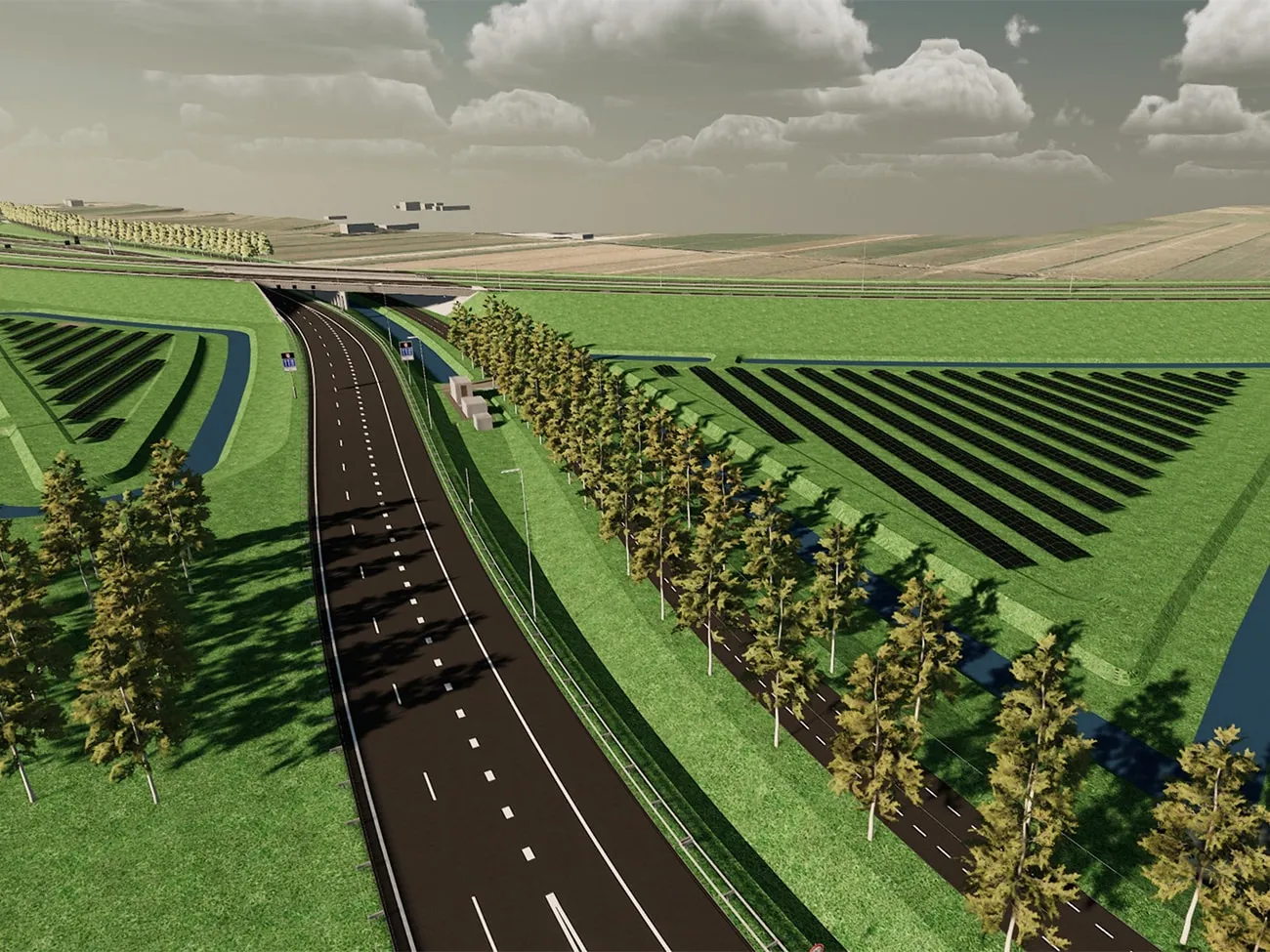
There is plenty of activity on the A16 Rotterdam project. Commissioned by Rijkswaterstaat, the De Groene Boog consortium, comprising BESIX, Dura Vermeer, Van Oord, TBI (Mobilis, Croonwolter&dros), Rebel and John Laing, is building the new A16 Rotterdam, an 11-kilometre national motorway between the A16/A20 at Terbregseplein and the A13 at Rotterdam The Hague Airport. This project is highly innovative in every respect, particularly when it comes to sustainability. The route includes a 2.2 km-long tunnel, which, like the road itself, will be energy-neutral. We spoke to Stefan van der Voorn, contract manager at Rijkswaterstaat, and Hans Pos (Croonwolter&dros), designer and test manager at De Groene Boog.
De Groene Boog consortium guarantees 20 years of energy neutrality
Highly energy-efficient design
Van der Voorn opens the conversation: “The energy consumption of the motorway, including the Rottemerentunnel, was part of the MEAT tender. Rijkswaterstaat was aiming for a 50% reduction in energy consumption compared with a standard tunnel and road. De Groene Boog came up with a design that will be energy-neutral for the next 20 years.” Pos says: “During the tender phase, we looked at what would genuinely be effective solutions. If you look at most of the installations in the Rottemerentunnel, you’ll see that they are powered by DC (direct current), rather than AC (alternating current). That led to the innovative idea of using a DC network. To avoid wasting energy, we mapped the tunnel’s energy consumption and drew up a power balance.”
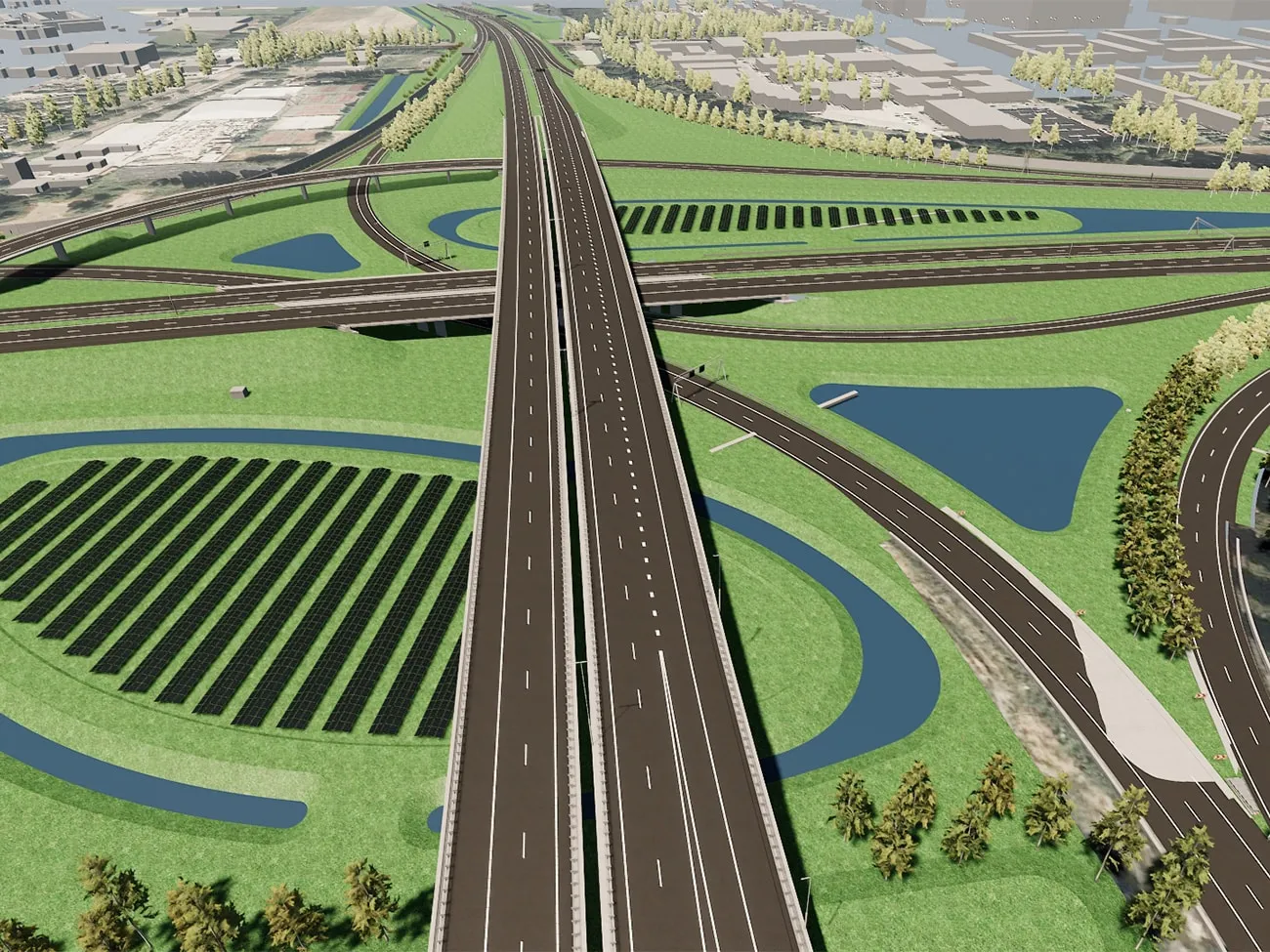
“The energy for the motorway and the tunnel will be generated by solar panels,” Van der Voorn continues. “The tunnel’s design is so energy-efficient that this is feasible. Using a DC network, extra-light walls, asphalt with a reflective coating and LED lighting, and configuring the lighting to use less energy, will dramatically reduce energy consumption. Trials are currently under way to establish the best way to configure the LED lighting, what effect this has on road users and whether everything meets safety standards.” Pos explains: “By adding up all the savings, we were able to establish how many kW we would need, and investigate whether solar panels could supply that amount of electricity. It turned out they could. The study covered the energy consumption of both the road and the tunnel, so the entire route.”
Verification phase
At the time of this interview, tests are being carried out in several tunnels, including the Gaasperdammertunnel and the Rijnlandtunnel. Pos says: “We are in the verification phase. Lighting has also been examined by the COB (Centre for Underground Construction). They created 13 tickets listing potential measures, 9 of which we were able to apply to the A16 Rotterdam. Our colleague Dennis Makkus of Croonwolter&dros took charge of these tickets and became project leader for the study. A dedicated working group was set up for each ticket, with someone from Rijkswaterstaat, De Groene Boog and an external specialist organisation taking part in each group.”
The difference between LED and traditional lighting
Along the 11 km route, the road requires lighting and roadside systems, while the tunnel (2.2 km) has 54 systems that need to be powered. “That is why the tunnel is our main focus,” says Van der Voorn. “But we have included absolutely everything that consumes energy. The tunnel fans run on alternating current, but the rest can be powered by direct current. That offers enormous savings.”
However, switching from traditional lighting to LED has proved far from straightforward. Pos explains: “The human eye perceives LED differently. The beam is directional rather than diffuse. This means LED lighting can quickly be perceived as dazzling. We are therefore investigating how far we can ‘turn down’ the light intensity while still meeting tunnel lighting requirements, without straining the human eye. Live trials have been carried out in the Gaasperdammertunnel and Ketheltunnel, among others, with drivers from different age groups. We are using the data to see whether it is possible to write an addendum to the NSVV (Dutch Foundation for Lighting Science) guidelines, or whether the NSVV can make amendments. We are also looking at the L20 cameras, which record how brightly the tunnel entrance needs to be lit. In addition, for the transition from light to dark at the tunnel entrances, we are looking for a solution using louvres that let in daylight, which requires no energy at all. The COB tickets are helping us identify where lighting can be improved and made more energy-efficient.”
One more big ambition…
The tunnel concept fully complies with the National Tunnel Standard. “This is mainly concerned with availability and safety. We have added sustainability,” says Van der Voorn. “A useful blueprint will soon be available for new tunnel projects. One important lesson from this whole process is that, from the planning stage onwards, you need to give full consideration to where the electricity will come from and how you will generate it. The location could then have been included in the route decision.”
There is one major ambition still outstanding in the overall plan: energy storage. “The solar panels will feed electricity back into the grid, whereas we would very much like to use the energy generated directly. To do that, the energy needs to be stored at suitable locations along the road and tunnel. You need to find suitable sites of around 10 m2. We can’t let the idea go and have really dug into it. Who knows, we may manage to make it happen. That would be the icing on the cake,” Van der Voorn concludes.
A business enquiry for Croonwolter&dros? Get in touch
Who worked on A16 Rotterdam
- consortiumDe Groene BoogIn this story
- lifting and transport frame
 SarensMentioned in Reinforced underwater concrete floor for Rottemerentunnel
- supplier of reinforcing steelBCSMentioned in Reinforced underwater concrete floor for Rottemerentunnel
- construction consortium
 Van OordMentioned in De Groene Boog aims for maximum reduction in CO2 emissions
- construction consortiumDura VermeerMentioned in De Groene Boog aims for maximum reduction in CO2 emissions
- construction consortiumJohn LaingMentioned in De Groene Boog aims for maximum reduction in CO2 emissions
- construction consortiumDe Groene Boog construction consortiumMentioned in GPS-guided precision excavation in the wet cofferdam
- excavation workAannemingsbedrijf Verboon Maasland BVMentioned in GPS-guided precision excavation in the wet cofferdam
- foundation contractor consortium
 Voorbij FunderingstechniekMentioned in The foundation joint venture is De Groene Boog’s ‘invisible friend’
- foundation contractor consortiumFranki GrondtechniekenMentioned in The foundation joint venture is De Groene Boog’s ‘invisible friend’
- UO calculationsM.U.C.Mentioned in The foundation joint venture is De Groene Boog’s ‘invisible friend’
- UO calculationsHektecMentioned in The foundation joint venture is De Groene Boog’s ‘invisible friend’
- reinforcementDiepstraten WapeningstaalMentioned in Specialist reinforcement solutions for 33 structures
- ready-mixed concreteDyckerhoff BasalMentioned in Specially formulated mixes significantly reduce carbon footprint
- waterproofingBrabotechMentioned in Watertight construction with flexible joint seals and a liquid-tight layer
- construction consortiumDe Groene Boog construction consortiumMentioned in Watertight construction with flexible joint seals and a liquid-tight layer
- prefabricatedCiviele technieken deBoerMentioned in A leading name in heavy lifting and specialist transport
- Bonneveld Gewapende Grondconstructies
 BonneveldMentioned in One of the largest EPS structures ever built







Keep following this
Get an email when a new story is published. No account needed.
- ProjectA16 Rotterdam
- ThemeUnderground construction
- SubjectRoad construction
- CompanyDe Groene Boog
- CompanyCroonwolter&dros
- CompanyBESIX Nederland BV
- CompanyVan Oord
- CompanyMobilis







