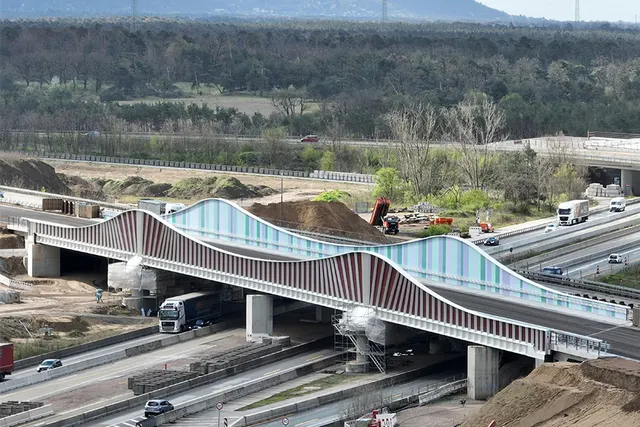
Papendrechtsebrug renovation calls for an exceptional approach
Text Carolien Klees Beeld Mobilis/Paul Poels Fotografie/Vivo Fotografie
Bridge renovation is a 4D puzzle in which engineering, logistics and safety come together
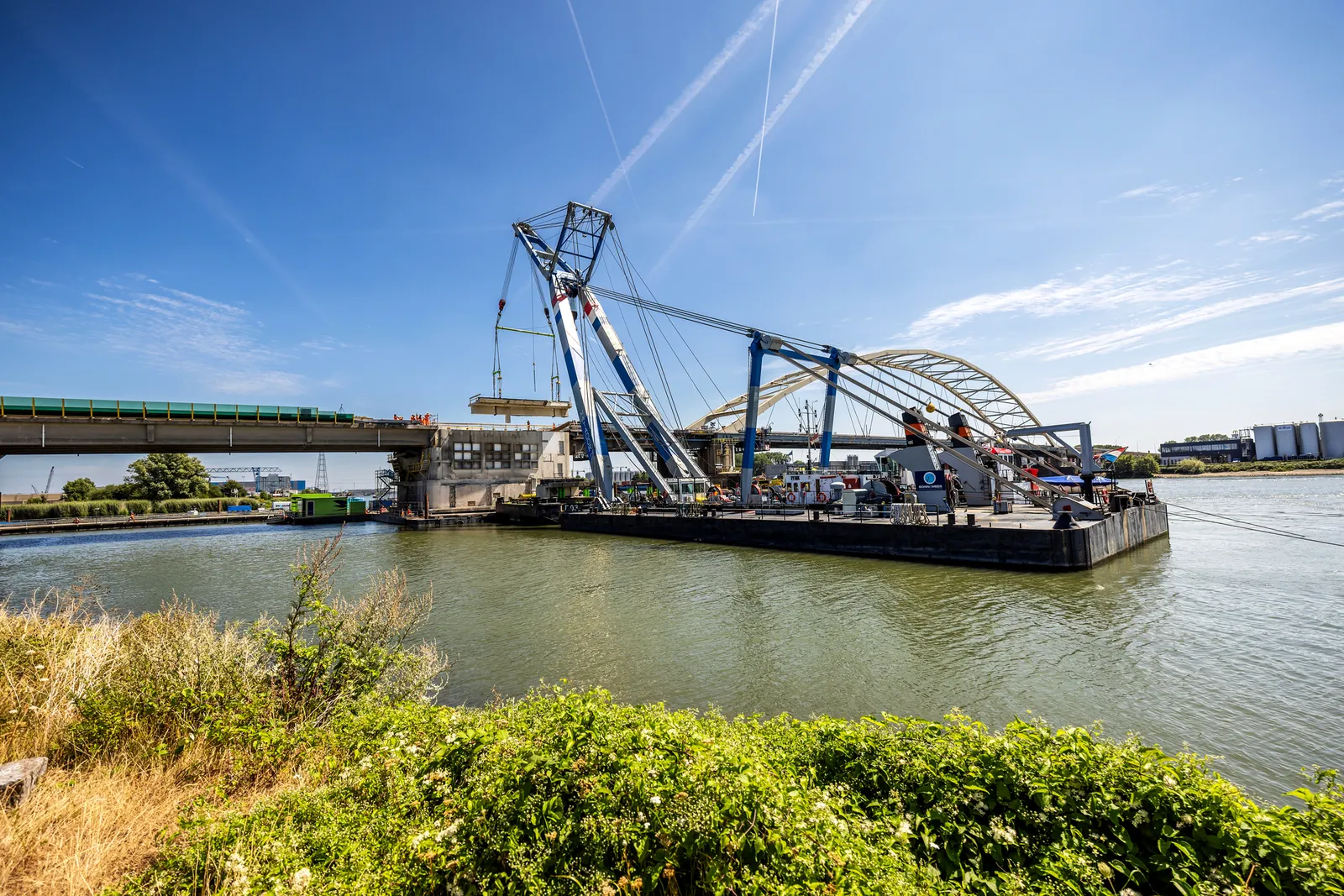
To remove the old bascule leaf of the Papendrechtsebrug, the Mobilis and Croonwolter&dros contracting consortium (CMCP) and its partners Hollandia Infra and Machinefabriek Rusthoven used a unique method. Because the water is shallow near the flood defence, the consortium chose to jack the 900-tonne leaf vertically before floating it out horizontally. This differs from the usual method of lifting it out with floating sheerlegs. “As far as I know, this method has never been used in the Netherlands before, and possibly not at this scale anywhere in Europe,” says Rick van Lent, project manager at Mobilis. But this is not the only unusual feature of the renovation of this 1967 bridge.
The Papendrechtsebrug carries the N3 over the Beneden-Merwede. Commissioned by Rijkswaterstaat, Combinatie Mobilis en Croonwolter&dros Papendrechtsebrug (CMCP) is renewing the bridge’s movable section, operating machinery and technical installations. The consortium previously renovated the Haringvlietbrug. Under the portfolio approach, lessons from that project could be applied directly.
The bridges are similar, but there is more activity on and beneath the Papendrechtsebrug, both on the road and on the water, and the area is more built-up. “One major advantage is that many supply-chain partners had already worked together on the Haringvlietbrug renovation. Good collaboration is vital on projects like these,” says Rick.
An exceptional method
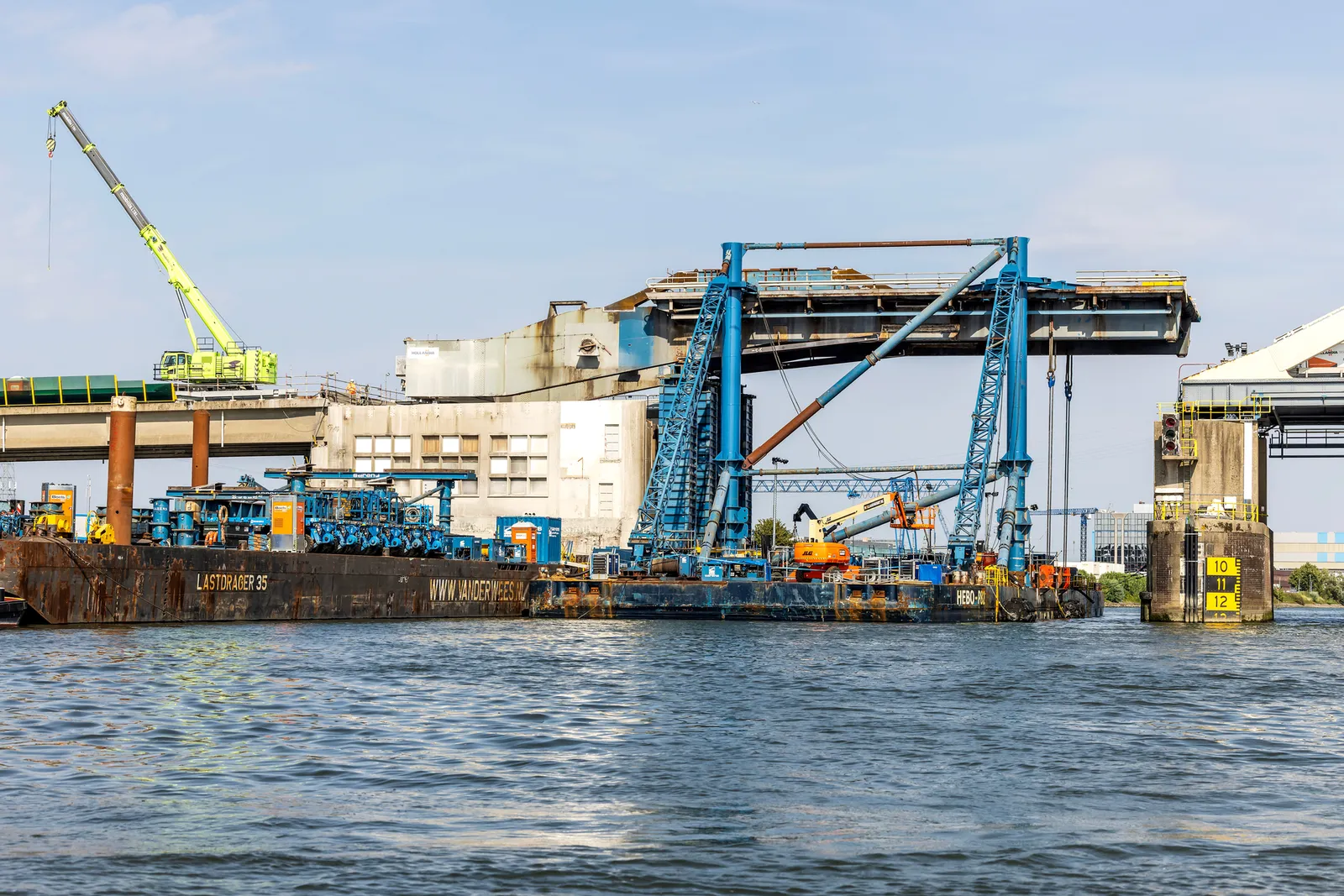
The shallow water dictated the choice of the exceptional method used to remove the old bridge leaf. “The conventional approach, using floating sheerlegs, would have required a great deal of dredging. And we could not rule out the possibility that dredging would affect the stability of the dike.”
This method placed high demands on both the structural condition of the bridge leaf and the stability of the pontoons. The leaf was therefore reinforced at several points in advance to withstand the unusual loads during dismantling.
During jacking, the jacks pushed the bridge leaf upwards while strand jacks kept it level. Since the ballast box extended several metres beyond the pontoon, it also created a substantial asymmetric load. Ballast tanks filled with water kept the assembly balanced. A vertical support frame absorbed the horizontal forces, while guides kept the bridge deck in place.
Once it had been raised by seven metres, the bridge leaf was floated out and lowered by ten metres. SPMTs were then used to turn the deck through a quarter turn and prepare it for transport.
Making room
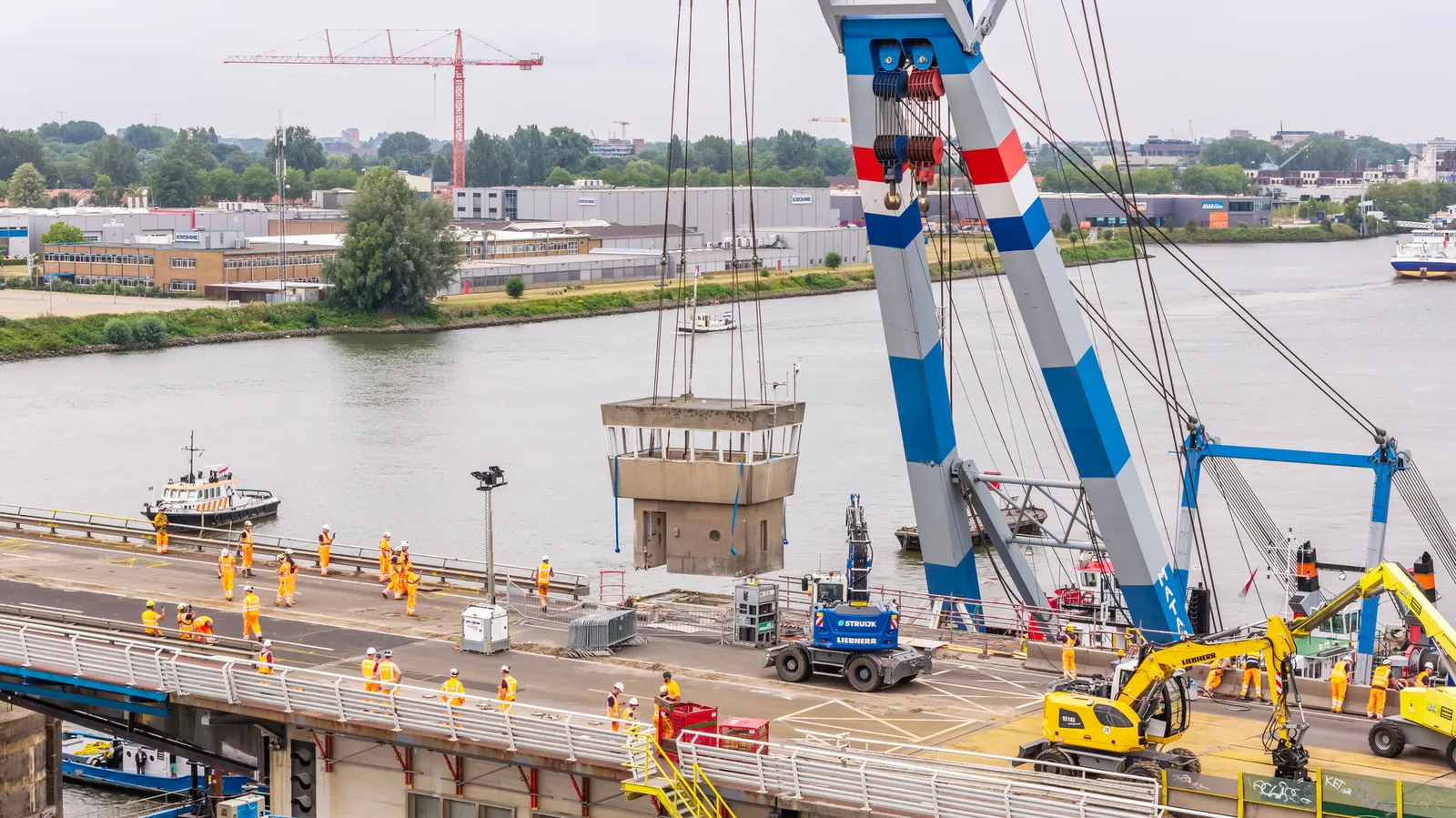
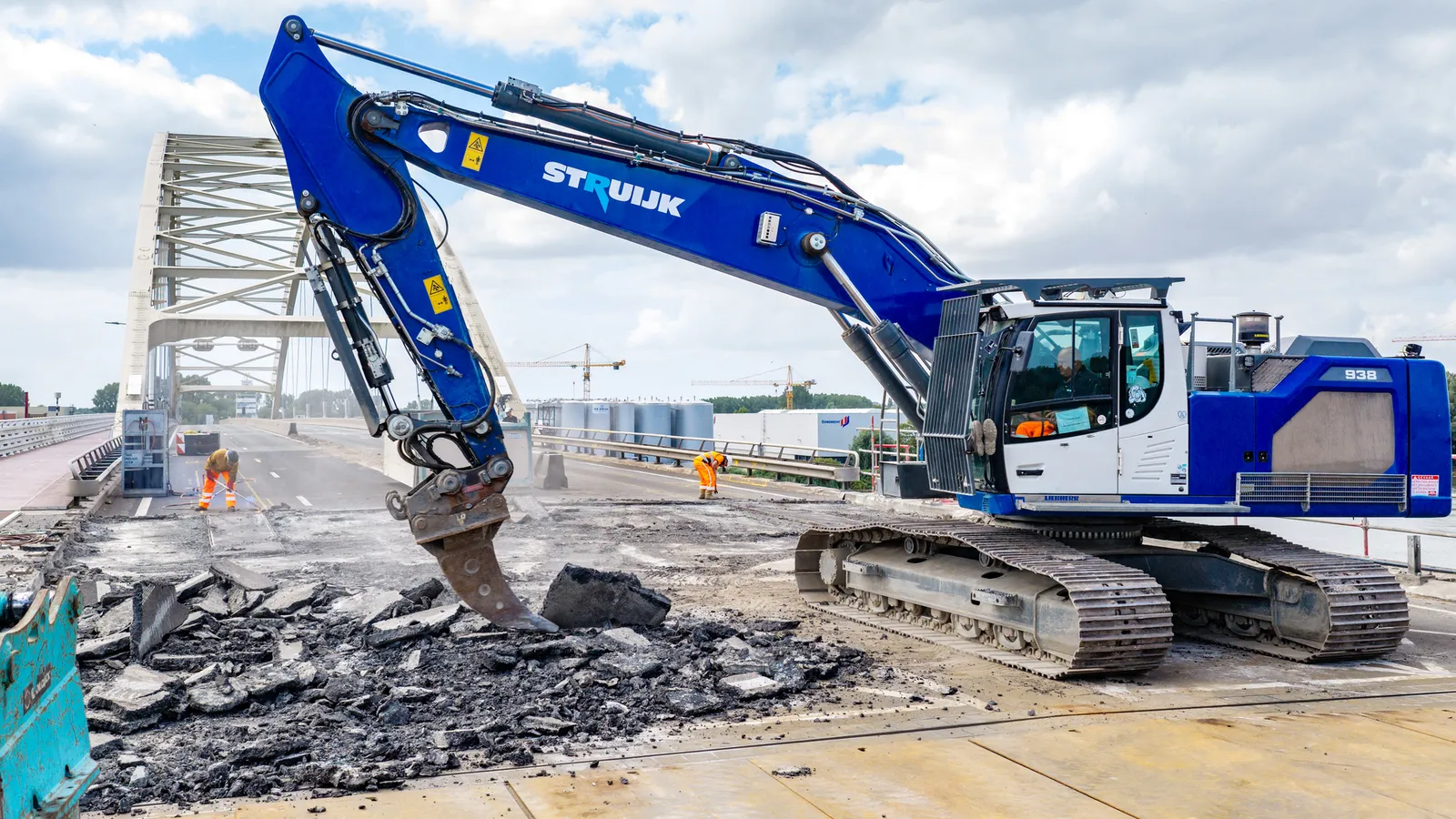
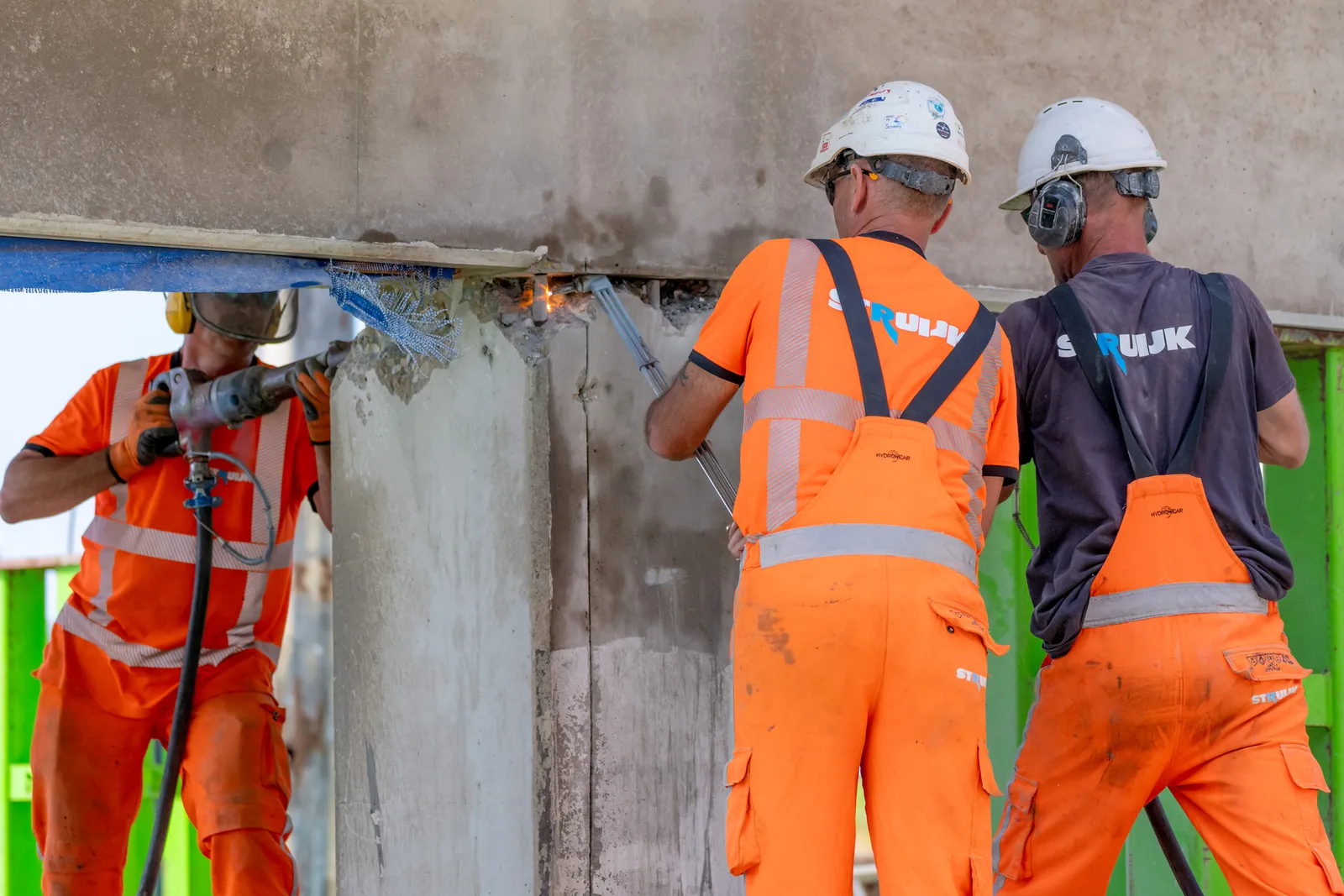
A substantial amount of demolition work had to be completed before the bridge leaf could be removed. Struijk Sloop- en Grondwerken Nederland’s expertise was brought in to safely remove the basement roof and carry out various demolition works inside the basement. Corstian van Hartingsveldt, director of Struijk, says: “We made a large opening in a wall about 1.7 metres thick and saw-cut the roof of the bascule chamber into sections. This freed the bascule leaf and the ballast box attached to it.”
Rick adds: “Struijk was involved early in the preparation, advising on the sequence of work, access and the services that had to be removed or reinstated. Early involvement is especially important in renovation projects. Drawings do not always show how a bridge was actually built. And over nearly sixty years, changes may have been made that were not fully documented. It is like restoring an old house: when you remove something, you do not always know what you will find. Here, it just happens on a much larger scale.”
Preparation
The operation to remove the old bridge leaf finished ahead of schedule. “Thorough preparation pays off many times over during execution,” Corstian stresses. “Finishing early was thanks to good collaboration and careful planning.
›
We identify possible scenarios in advance and make sure we can respond quickly. When the roof was lifted out, for example, it became clear that an additional section had to be demolished because it was not shown on the old drawings. Since we had already arranged for Struijk personnel to be on standby for surprises like this, they could carry out the additional demolition work straight away.”
Reuse
Struijk sends the recovered concrete rubble to an emissions-free hub, where it is recycled into high-quality sand, gravel and cement. The 13-tonne historic “shell” from the quarter-circle rack, which ensures that the closing leaf meets its bearings very gently and in a controlled manner, was no longer suitable for the new bridge but escaped the smelting furnace. Mobilis project coordinator Corné Laurijssen could not bring himself to have the unusual component melted down, and arranged for the shell to be given a second life as an art object in Dordrecht.
Safety in 4D
According to Rick, the confined worksite makes the renovation a “4D puzzle”. Different disciplines work in close proximity above, below and alongside one another. “By adding the time dimension to the 3D model, we map how the situation changes over time. This makes the work sequence, safety measures and interface risks visible in advance. At each start-of-day briefing, we put up a large board and used symbols and markings to show who would be working where. That prevented people from cutting at the top while others were working below.”
For the 24 most critical hours, the Beneden-Merwede was completely closed to shipping because even waves could disrupt the operation. The consortium provides a monthly passage for vessels with high air draught during the project. “Part of the worksite is then dismantled and floated away, allowing tall vessels to pass within a few hours. Afterwards, the worksite is set up again.”
Control system built in the factory
Another notable operation is planned for early November. In Papendrecht, project partner Gebr. de Koning will assemble and fully fit out a prefabricated concrete bridge control building. This will include control cabinets, an operating room, sanitary facilities, cameras and systems for the barriers and waterway signalling. Prefabrication allows work to proceed more smoothly, makes advance testing possible and reduces the risk of damage.
All systems will be tested in advance using a scale model. Are the cameras and signals working correctly? Do the barriers open and close at the right time? After testing, the building will be moved to the bridge and installed against the bascule chamber in a single day. “We are placing the complete control system against the bridge as a plug-and-play package,” Van Lent explains.
Enjoyment
According to Rick and Corstian, the key to success lies not in equipment or models. “You can see, at this stage of the operation too, that the different companies really became one project organisation. People helped each other, even beyond their formal scope of work. Some even came in at night, although they had not been asked to,” says Corstian.
Rick concludes: “A project like this can only be carried out safely and responsibly if all disciplines work together actively and as an integrated team. Ultimately, it is people who make the difference: skilled people who enjoy their work, take responsibility for their craft and are proud of what they achieve together. That is the strength of TBI companies Mobilis, Croonwolter&dros and Struijk.”
Combinatie Mobilis en Croonwolter&dros Papendrechtsebrug (CMCP)
The Mobilis and Croonwolter&dros Papendrechtsebrug contracting consortium (CMCP), commissioned by Rijkswaterstaat, is replacing the leaf, operating machinery and systems for the operation, control and monitoring of the Papendrechtsebrug. It has partnered with Hollandia Infra, Machinefabriek Rusthoven and Struijk on the steel bascule leaf, operating machinery and demolition work.
Een zakelijke vraag aan Mobilis? Get in touch
Who worked on it
Papendrechtsebrug in Papendrecht
- contractors' joint venture
 Mobilis
- contractors' joint venture
 Croonwolter&dros
- demolition workStruijk Sloop- en Grondwerken Nederland
- betonnen prefab bruggebouwGebr. de Koning
Keep following this
Get an email when a new story is published. No account needed.
- ProjectPapendrechtsebrug
- ThemeFlood protection and climate-resilient water management
- SubjectBridge construction
- CompanyMobilis
- CompanyCroonwolter&dros
- CompanyStruijk Sloop- en Grondwerken Nederland
- CompanyGebr. de Koning