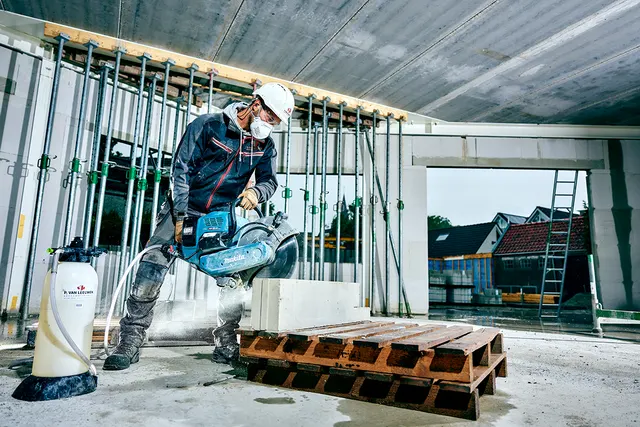
Biobased geotextile in civil engineering: pilot with Jogetex HV on the Neder-Betuwe dike reinforcement project
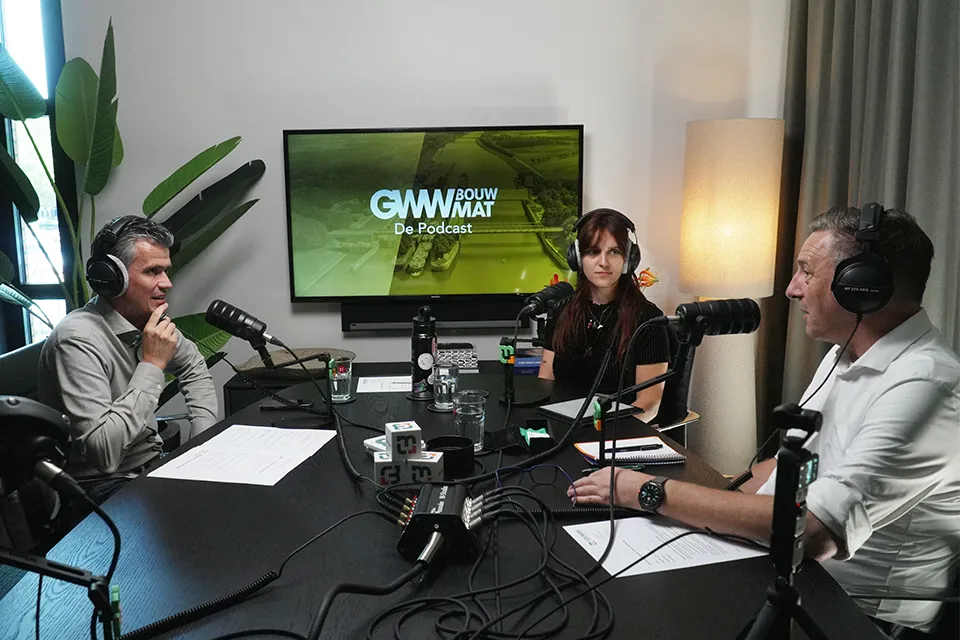
Temporary construction roads often use synthetic geotextiles with a service life far longer than necessary. Joosten Groep is therefore exploring Jogetex HV, a biobased, biodegradable alternative made from wood fibres. In this episode, Marco Hazenkamp and Sophie Pakvis discuss the development of the geotextile, its technical requirements, its rate of degradation and the pilots on projects including Dijkversterking Neder-Betuwe and Rilland. They also discuss what it will take to make biobased geotextiles more widely applicable in civil engineering, from certification and regulation to circularity and scaling up.
Guests: Marco Hazenkamp and Sophie Pakvis
Host: Roel van Gils
A business enquiry for Joosten Groep? Get in touch
Full transcript
All chapters (23)
- Sustainability and the service life of geotextiles
- Introductions
- What does a geotextile do?
- Loads and service life
- Temporary construction roads
- The demand for biodegradable geotextile
- Developing Jogetex HV
- Geotextile composition
- From raw material to production
- Technical specifications
- Rate of degradation
- Pilots at two locations
- Impact on the soil
- Jogetex HV versions
- Duration of the pilot
- Other applications
- Circular economy
- Regulation and recycling
- Wood fibre where possible
- What does this require of clients?
- Where do they want to be in five years?
- A call to the market
- Closing
Sustainability and the service life of geotextiles
Roel van Gils Welcome to another episode of GWW Bouwbad, the podcast. For years, the standard in construction and infrastructure has been that materials should last as long as possible. A hundred years is often the starting point. But is that always the smartest choice? What happens when a material is removed from the ground after just five years? Suddenly, sustainability means something very different. We’re discussing that today with Marco Hazenkamp and Sophie Pakvis from Joosten Groep. Biodegradable geotextile is currently being piloted on several projects. Welcome.
Sophie Pakvis Thank you.
Introductions
Roel van Gils Perhaps you could briefly introduce yourself. Just a few words.
Sophie Pakvis My name is Sophie Pakvis. I’m sustainability manager at Joosten Groep.
Roel van Gils There you go. Thank you.
Marco Hazenkamp I’m Marco Hazenkamp, technical specialist at Joosten Groep and manager of the IDNA department, which covers innovation, sustainability and consultancy.
Roel van Gils So you’re always working on new developments across the group?
Marco Hazenkamp That’s part of it. We also deal with the day-to-day work. Projects come to us through our commercial department, and we handle those as IDNA, but we certainly work on new developments too.
What does a geotextile do?
Roel van Gils Today we’re talking about geotextiles. Most people in civil engineering are probably familiar with them. But what does this kind of product do? What is it, exactly? Could you explain?
Marco Hazenkamp In short, geotextiles have two functions: they separate different soil layers or structural layers from one another. They can also provide a certain tensile strength to resist deformation. To put it in very technical terms, they make the ground stiffer, so you can drive over it or build on it, for example. Geotextiles, and sometimes geogrids, are mainly used when the subgrade has poor bearing capacity. If the ground itself cannot support certain loads or traffic, you add a geotextile to provide greater resistance to deformation. That’s basically what a geotextile does. Then it disappears underground. The geotextile is installed in a particular way. It can also be filled with different materials: sand, mixed aggregate, rubble, including recycled rubble, making the structure you build with it climate-adaptive as well. It can store water and allow it to infiltrate. In general, the most important function of a geotextile is to separate different structural soil layers.
Read the full transcriptCollapse transcript20 more chapters
Loads and service life
Roel van Gils What loads does it need to withstand? That varies, of course.
Marco Hazenkamp If you look at the projects we work on extensively, such as TenneT projects and high-voltage substation sites, the loads generally come from vehicle movements, lorry traffic and vans, as well as the construction work itself. That includes the equipment used to build the structure and construct the access road. For higher loads, you’re looking at crane standing areas, where a mobile crane is positioned, with its outriggers bearing on the ground. To support those loads, you use a geotextile or geogrid that can withstand them. For a mobile crane, you’re talking about around 250 tonnes per square metre. That’s a substantial load, so you need to install a suitably robust geotextile or geogrid. And as you said at the beginning, the service life is often a hundred years. For structural works, when you prepare a design and run the calculations, you assume a functional service life of a hundred years. It’s a requirement, and a rather extreme one. On the other hand, when you do those calculations, you also apply reduction factors and safety factors. So the hundred-year figure is a kind of theoretical functional service life, but once you account for the reduction factors and risks, you arrive at a much more realistic service life.
Roel van Gils So it’s not as if you’d still be putting a crane on it in year 98, for example.
Marco Hazenkamp No, quite apart from whether the structure would still be there, so to speak. It’s really a calculated service life. If you do the calculations and include reduction factors, safety factors and RC factors from a structural perspective, starting with a high figure and ending up around halfway is the most realistic scenario.
Temporary construction roads
Roel van Gils But often the service life can be much shorter, can’t it?
Marco Hazenkamp These days, quite a few structures don’t need to last much longer than that. Their functional service life may be just three to five years. TenneT projects are a good example, where you lay a temporary construction road. It’s temporary, as the name suggests. The road has only a temporary functional service life. So it seems a waste to install synthetic geotextile designed to last a hundred years. It’s rather wasteful to install geotextile for a hundred years when it is then removed after five. And at present, it goes to an incinerator.
Roel van Gils Can’t it be reused?
Marco Hazenkamp It can be reused, but the reality is that you can take it up, roll it up and unroll it once. If you want to reuse geotextile, you have to recalculate everything. When you first use it, as I said, you factor in reductions. You account for installation damage and removal damage, chemical conditions, pH and all sorts of other things. You would have to do those calculations again for geotextile that has already been used, removed from the ground and is being reused. And then you find that its specifications no longer meet your needs. You can’t apply the loads that will actually be imposed on it.
Sophie Pakvis Yes, and in addition, if we’ve laid the geotextile at location A and want to install it somewhere else, we would first need to investigate it thoroughly. We would need to establish whether it is still fit for use, so that we don’t damage the soil life at the new location either.
The demand for biodegradable geotextile
Roel van Gils Right, so you’d take it from one location to another. But the request you received was for geotextile with a shorter service life, or for an application lasting five years or so. What’s the situation now?
Marco Hazenkamp The initial request was for something biodegradable. Biobased, biodegradable. That was the research question, more or less. It came from TenneT. TenneT has sustainability ambitions, as do the contractors working for it. In this case, that was BAM, a BAM contractor. They also have sustainability targets, and can use this in tender submissions for work awarded by TenneT or by a wind farm owner, in other words, an operator. Sustainability ambitions are now part of tenders.
Roel van Gils Yes.
Marco Hazenkamp EMVI plans, meaning the most economically advantageous tender. Sustainability is often a major part of those. Nowadays, some projects aren’t awarded purely on price, or to the lowest bidder, but on a notional lowest price that also takes sustainability into account.
Developing Jogetex HV
Roel van Gils When did you realise there was an opportunity here for geotextile, or specifically for Jogetex HV?
Marco Hazenkamp It started with TenneT’s request to BAM. BAM came to us with it. We’re a supply partner to BAM for geotextiles. BAM doesn’t make geotextiles, and neither do we, but we do sell and develop them. So BAM passed the request on to Joosten, to us. We then took on the development together with BAM. Let’s just say that a wood-fibre geotextile wasn’t the first idea that came to mind when we started looking into it.
Roel van Gils The request was really to make a geotextile that would serve for a specific period. That was basically it, yes?
Marco Hazenkamp Yes, biobased, biodegradable, and for a specific period. Wood fibre wasn’t the first material we thought of. We considered all sorts of raw materials in a trade-off matrix. We assessed several factors: the availability of the fibre or raw material, and whether it was genuinely biodegradable. Various materials claim to be, but when you look at the research, it turns out they simply aren’t. Availability at scale was also important. We looked at, for example, fibres from shellfish. You can make fibres from seaweed, for instance, and from bamboo. But we’re talking about TenneT projects that need millions of square metres of geotextile, on every project. You also need enough raw material to make those millions of square metres. If you have to fish half the North Sea to get enough shellfish to make geotextile, well, that obviously isn’t the answer either. So we looked at which raw materials are available and sustainable, and which ones can be used to make a product that meets the technical specifications we need for a construction road or a crane standing area.
Sophie Pakvis The origin of the raw materials. We wanted to see whether we could source them closer to the Netherlands. So we looked carefully at what was available in Europe, and also at how sustainably the raw material could be obtained. We obviously don't want to strip a forest just to make a little geotextile for civil engineering. So we looked at particular production sites where our raw materials are sourced from wood offcuts. The large blocks are used for timber construction, for example, and we can use the leftover wood fibres in our geotextile.
Geotextile composition
Roel van Gils So what does the composition look like? What's the recipe? Or is that a trade secret, of course?
Sophie Pakvis Wood.
Roel van Gils Just wood.
Sophie Pakvis Yes. 99.9 per cent wood?
Marco Hazenkamp I'd say it's 100 per cent wood.
Sophie Pakvis Yes.
Marco Hazenkamp Nothing else is added. You do have to turn a wood chip, produced by peeling the bark off the log, into a fibre. Those logs are turned into wood chips, which then have to be processed into a kind of powder. We call it cellulose, or cellulose powder. You can make fibres from the cellulose powder. We call them something like cotton wool, for want of a better description. The fibres can then be spun into yarn. It's literally like the way Grandma used to do it. You weave the yarn to make a fabric, which is then the geotextile you use.
From raw material to production
Roel van Gils How long did that process take?
Marco Hazenkamp Well, we've been working on it for roughly two years now. Since the initial enquiry, we've kept BAM and TenneT informed over those two years through a pilot project, which has now been running for a year. How quickly you can find a suitable raw material depends, of course, on the circumstances. In our case, we found it fairly quickly, and even within the Netherlands. So it wasn't so much the raw material itself, but the company able to process it into the product. We work with Zwartz in Oldenzaal for that. Zwartz in Oldenzaal is a company that's been around for, and forgive me if I get this wrong, I think 138 years. It's one of the oldest textile companies in the Netherlands. Zwartz is at the helm of the company. And they've been making textiles from jute, flax and linen for as long as anyone can remember.
Roel van Gils Very sustainable too, aren't they?
Marco Hazenkamp Very sustainable indeed. But they're less suitable for civil engineering. Jute is the most suitable of them. But initially, we wanted a raw material that might be of Dutch origin. That proved quite a challenge, so we quickly had to switch to sourcing from Europe: from European-certified forests, from FSC-certified forests. But there are a lot of steps before you get to that point, before you can even make a textile. If you have a manufacturer that can make a textile from a biobased material, a biobased raw material, you're already 70 to 80 per cent of the way there. Not every manufacturer, not every weaving mill can process a biobased material. Synthetic material is easier to work with, and the machinery is designed for it. Biobased is a different discipline. It involves all kinds of dust formation during production. If you have a company set up to handle that, as Zwartz is, you're already 70 to 80 per cent of the way there. If you can also bring on board a spinning mill that can turn your wood fibres into yarn, to specs you know well from civil engineering, then you're 99 per cent of the way there. It has to meet certain specs for strength and elongation. If you know those specs and can translate them into the production process, you're 99 per cent of the way there.
Roel van Gils Yes.
Marco Hazenkamp That last part in particular went very quickly. We got it done in six months, really.
Technical specifications
Roel van Gils And those specs aren't comparable with those of a synthetic geotextile?
Marco Hazenkamp We worked towards the technical specs, to keep the textile metaphor going. But based on your experience, and ours, with synthetic geotextiles, you know what the technical specs need to be. You know the requirements and the reduction factors, the tensile strength and the elongation percentage. So we gave Zwartz that as a model and said: ‘This is what we need to achieve.’ How many grams of yarn per square metre or per linear metre of width do you need to use to meet these specs? They have the expertise to work that out. In the end, they matched a synthetic spec using a biobased material.
Roel van Gils Right, but was it a hit straight away?
Marco Hazenkamp The first product was a hit straight away. In terms of technical specs, the four requirements for a geotextile used for a temporary construction road, for example, are tensile strength, elongation, sand retention and water permeability. But there was one thing we didn't know: its service life, or how quickly it would break down. That's now being studied extensively: how can we extend it? We knew how quickly the base material breaks down. We have a number of pilots with Dura Vermeer, De Dijkalliantie. So we know exactly what the different stages of the product are, how long each lasts and how quickly it breaks down. The challenge now is to slow that process down, in other words, to extend its functional service life.
Rate of degradation
Roel van Gils Yes, but I understood from you that that's relatively easier than the other way round, right?
Marco Hazenkamp Yes, extending the service life is easier than shortening it.
Roel van Gils So the fact that it broke down quickly was actually good news, in a way.
Marco Hazenkamp That sounds strange to a lot of people. We made the pilot using the first version, and it had disappeared after three months. It had literally disappeared. We went to inspect it after removal. In some places, we couldn't find the fabric at all.
Roel van Gils You couldn't find it?
Marco Hazenkamp No. And that was good news for us. Other people were there for the inspection too and said, ‘Well, is that a good thing?’ I explained that it's easier to extend the service life than shorten it. If you need to shorten it, you have to take material out of the product and make it lighter, which means you might no longer meet the technical spec. So it's better to extend the service life, by making sure water and bacteria do their work more slowly, rather than shorten it.
Sophie Pakvis Biodegradation is very much dependent on the season and the location. So we're really pleased that we can now test our fabric in different places. In Zeeland it's simply laid on the ground, and we're testing it in different applications there, so to speak. Our site with De Dijkalliantie is particularly interesting because the fabric has also been underwater there. Wood degrades differently when it's underwater. So you can imagine that during a colder period, and after being underwater, the fabric stays in place better than at sites where it was installed in the summer, for example. That's because soil life is more active in warm weather. It's really great that our Jogetex HV is now installed at two different sites, where we're seeing different rates of degradation.
Pilots at two locations
Roel van Gils Are they two different projects, or at least two different applications?
Sophie Pakvis I think they're both for temporary construction roads. But they are very different projects. Absolutely.
Roel van Gils One was Dijkversterking Neder-Betuwe, wasn't it?
Sophie Pakvis Yes, Neder-Betuwe. And the other is for TenneT in Rilland.
Roel van Gils And the TenneT one has been there longer?
Sophie Pakvis Yes, I think it's been there for a year now.
Marco Hazenkamp Yes, nearly a year. That's right.
Sophie Pakvis And it's been at De Dijkalliantie for about six months now.
Roel van Gils And is it being monitored continuously?
Sophie Pakvis Yes, we try to visit the site every four months. The track mats are then removed, and we can literally cut out and dig up pieces. We go there with a spade and scissors, and take a bin bag to collect the material. We look at where it's lying and what we find. In some places it had completely broken down and had no technical properties left. In other places, we found it still intact.
Roel van Gils Yes.
Sophie Pakvis And in those places, we really had to cut through it. It was still difficult to find, but there was still a bit more textile left than where we had installed it. So those are really exciting discoveries.
Roel van Gils Right, I see. But does it no longer have any function, technically speaking, or does it?
Sophie Pakvis Both. Yes, the separation function was a bit more challenging. Imagine it's laid on the ground and then, say, sand is tipped on top and folded over. The edges have sand on one side, while the other side is still lying on the ground. So composting, or degradation, happens more slowly there than in places where it's in contact with the soil and sand has also been laid on top.
Impact on the soil
Roel van Gils It was still there at the edges. And it also enriches the soil, I understand, Sophie?
Sophie Pakvis We hope so. We're testing that now too, comparing the soil quality before installation and again afterwards. Sometimes we're on farmland, for example, so we obviously don't want our product to damage the soil. We're testing for that too, but we don't have any results yet.
Jogetex HV versions
Roel van Gils Which generation of Jogetex HV are we on? Where have you got to so far? The product is being continually developed, isn't it?
Marco Hazenkamp We're on version 3, but we've installed up to version 2.
Roel van Gils Okay.
Marco Hazenkamp The first version is the true virgin material, just pure wood. It's completely white, and no additives have been included that alter the service life in any way. That's our baseline model, so to speak. What's the soil pH? How much soil life is there? But it lasts around three to four months on average. We'd already tested that in our own garden, and it turns out to be the same in the real world, on a large scale. The second version is a kind of hydrophobised version. We tried to make it harder for soil water, along with the fungi and bacteria that cause it to break down, to do their work. It's also water-repellent to soil water. We hope that will make the bacteria less active and extend the service life. We'll inspect that one this month or after the holiday. It depends on how our schedule works out.
Roel van Gils At some point this year, anyway.
Marco Hazenkamp In any case, definitely this year. But while we’re taking it out, we also want to install version three straight away, particularly at Rilland for BAM. Version three contains a kind of antibacterial agent that prevents bacteria and soil fungi from doing their work.
Roel van Gils For a certain period, then.
Marco Hazenkamp For a certain period. Yes, we’re very hopeful that this will extend the service life by a substantial amount. We’re talking years. Ultimately, the aim is three to five years. That’s what we’re working towards.
Duration of the pilot
Roel van Gils That’s what you’re aiming for. And when do you expect to get there? Well, it’s obviously difficult to predict the future.
Marco Hazenkamp Yes, that’s the downside of a pilot.
Roel van Gils How long will it remain a pilot?
Marco Hazenkamp We’ve just been given access to the site at Rilland. And if it were up to us, it would be for a very long time. Ultimately, it will remain a pilot until we’ve demonstrated that the geotextile has a service life of between three and five years.
Sophie Pakvis Yes, and I think another thing that helps is that we’re part of the Innovation Impact Challenge run by Building Balance. This was set up to help deliver the National Approach to Biobased Construction for civil engineering. And you can imagine that, when it comes to temporary construction roads or the use of geotextiles in civil engineering more generally, there are quite a few guidelines and standards we have to meet before a product can be sold and trusted. Through the Innovation Impact Challenge, we’re also working on developing Dutch technical agreements that provide an exception to the current standards. This will enable our product, and not just ours, but other biobased geotextiles too, to obtain standards compliance and the right certificates. That gives the market confidence that these products can be used and will retain their functionality. I think it’s speeding up our innovation considerably, because we’re already aligned with the guidelines. The process takes about a year. The expectation is that the agreements will be in place by September 2027. We hope to have made similar progress by then with other tests we can carry out, for example on degradation, to demonstrate that the product lasts longer than we’ve shown so far.
Other applications
Marco Hazenkamp Yes, building on that, we’ve also started looking at how to scale up the product. So far, we’ve made a flat geotextile, but there are many other types of geotextile, suitable for different applications. In water engineering, for example, loop fabrics are often used. A mattress can be made from a loop fabric. The name says it all: a geotextile with loops in it. Willow branches are tied onto it, essentially bundles of willow. We tow them out onto the water by ship. Finally, they are sunk with stone materials to prevent erosion of the riverbed. Until now, a synthetic geotextile has always been used for this. Its functional life is, let’s say, ten days. In a mattress, it simply stops the stones from falling through, thanks to the large grid of willow branches tied onto it. Once it’s on the riverbed, it stays there and has no further function. So how great would it be to make Jogetex HV into a loop fabric and use it to make a mattress? That’s one of the applications it could have in water engineering structures. You could also think of non-wovens: a separation function, but a temporary one. In other words, making a non-woven product, a fleece, from the fibres, so it can be used in other civil engineering applications. But it would still be made from the same fibre. This is also one of the elements of phase two of the IEC, Building Balance’s Innovation Impact Challenge. We’re looking at scaling up the product itself, not so much in terms of volume, width or length, but more by expanding the range of applications for the base material.
Marco Hazenkamp So when will the pilot be over? Well, never. No, but that also has to do with what Sophie just said: we’re part of Building Balance’s Innovation Impact Challenge. An innovation like this, I wouldn’t say it never stops, but new possibilities keep coming up. You think, ‘Hey, you could use a wood-fibre geotextile for this too.’ And I hope that keeps developing. Of course, that also applies to service life. We want to get the service life spot on, between three and five years. That will take a little more time. But ultimately, we also want to have a product ready for when the project is finished and the material is still there. It will need to be removed, though. Imagine we’re not allowed to leave it in place. We also need to know where we can take it. So far, everything goes to the incinerator. How great would it be to take it to the Groen Depot? But before you can take your residual material to the Groen Depot, you need a particular certification. We’re now trying to obtain that certification through the Innovation Impact Challenge, as part of scaling up.
Roel van Gils Yes, a kind of afterlife.
Marco Hazenkamp Yes, the idea is: what do we do when the service life is over?
Circular economy
Roel van Gils Yes, that’s a good segue, Sophie. Why is this innovation such a good fit for the circular economy?
Sophie Pakvis Well, the circular economy often focuses on the end of a product’s life, for example. But it’s also about the beginning, the design stage, and rethinking your raw materials, so they’re right for the application. That’s very important in the circular economy. The focus is on what is needed and how long it needs to last, rather than asking what is available and whether we can just install it quickly. This helps prevent us from using products with a service life of a hundred years for something that only needs to be in place for three to five years. So it’s about choosing the right application for the product, while ensuring it still has the functionality to be used. When synthetic geotextiles are currently removed from the ground, they’re damaged. As we’ve already explained, they may contain soil-borne diseases. But above all, they’re very dirty. Turning them into new geotextile again takes quite a bit of work. We have to clean and shred them. And even when we’ve finally turned them into a recycled raw material, we’re finding that we can only use about five per cent of it in new geotextile, because the guidelines require 95 per cent virgin material. What’s really helpful about these innovations is that we’re already in talks with the people developing those guidelines, so we can avoid running into these kinds of issues at the end of the life cycle.
Regulation and recycling
Marco Hazenkamp What you really notice is that regulation is lagging behind developments. That’s often the case with innovations. And one of the requirements of the IEC is that we should also focus on updating the guidelines. There are guidelines for biomass materials, but they’re hopelessly out of date. On the other hand, you can see that our clients are also beginning to look ahead. TenneT is another example. We’re involved in another project, recycling geotextiles into new raw materials. In this case, PP. We’re talking about synthetic geotextiles made from PP, or polypropylene. TenneT now requires 95 per cent of the geotextile to be removed, and that 95 per cent must be recycled into new geotextile. Technically, in terms of polymers, installation and raw materials, that’s simply not possible at the moment. We at Joosten have managed to make geotextile from it, but that geotextile then can’t be used for the application on which TenneT, and other clients, base their projects. So you can see that we’re trying very hard to accelerate the process. But it is a process. We mustn’t forget that synthetic geotextiles have been in use for sixty or seventy years. They’ve proved themselves, including over the long term. We mustn’t forget that synthetic geotextiles have also helped bring the Netherlands to where it is today: in dikes, groynes, dike reinforcement and storm surge barriers. I mentioned it earlier, but they’re also used in roads and reinforced soil structures. Synthetic materials are used in all of these, for the long term.
Wood fibre where possible
Roel van Gils Could all of that be made from wood fibre? No, of course not.
Marco Hazenkamp Not technically, no. We want that bridge to remain standing for fifty years. Would you use wood fibre?
Roel van Gils Yes, then you’d be…
Marco Hazenkamp You can fill in the rest yourself. So we need to use it where possible. And it certainly is possible. We have evidence of that now, and we have products for it. Well, we’re developing them. But we have a good understanding of what’s possible at the moment. Let’s use natural materials wherever we can and wherever they’re needed.
What does this require of clients?
Roel van Gils Yes. And what does that require of clients?
Sophie Pakvis Like us, we were fortunate to sit down with two parties who were willing to install it as a pilot. But I think people are quite hesitant because it’s still unfamiliar. That’s simply human nature. But the market has now reached a point where a lot has been thought up and developed. There are many innovations, particularly in biobased and biodegradable products. We need to test them. Things may go wrong. That’s how we learn. But what we need from the market most of all is the courage to give it a go.
Roel van Gils Okay.
Marco Hazenkamp Yes, and a little more investment. We all know what synthetic geotextile costs. Its raw material is also widely traded, as we were just saying. It’s become a bit more expensive recently because of various geopolitical circumstances. But ultimately, it remains by far the cheapest product. Synthetic materials. Biobased products are made from biobased materials. At the moment, producing them and processing the raw material into something suitable for manufacturing simply involves a lot more work. It’s done on a smaller scale, which automatically makes it much more expensive. So ultimately, what we… And of course, it’s helpful that the Innovation Impact Challenge has brought in all the key stakeholders. They understand how much time and effort it actually takes to develop something like this. A synthetic geotextile per square metre.
Roel van Gils Yes.
Marco Hazenkamp And what we really hope is that these kinds of fantastic developments are not immediately shut down on financial grounds. You see that happening very often with pilots and developments. We nearly let ourselves be tempted to quote a price in the first phase of development too. We deliberately did not, because it would of course have been sky-high. But when you scale up to millions, and these days you look at your phone and see something costing a thousand euros, there is a whole development behind it. The same really applies to these kinds of materials. Once you scale up, you can start thinking about the price too. But before you scale up, you are already several years into the process before you have something technically relevant.
Where do they want to be in five years?
Roel van Gils Yes, looking a few years ahead, where do you hope to be in five years?
Sophie Pakvis Well, I hope that in five years we will have a certified product on the market, but that we will have gone further than that. As well as developing Jogetex HV, I hope we will have looked at other applications too. We are already thinking about the applications Marco mentioned just now. But I also hope we will have taken that next step. That we will have amazed people with applications for our geotextile or other products. Joosten is strong precisely because we have so much knowledge of the civil engineering and infrastructure sectors. I also hope that Joosten will have developed further in that respect over the next five years, and will have shown our sustainable side in a real way.
A call to the market
Roel van Gils Market, are we going to respond commercially now?
Sophie Pakvis Are we going to respond sustainably?
Roel van Gils Sustainably, of course.
Marco Hazenkamp I think the call is to the market, but certainly also to us at Joosten. And where did Joosten come from? We are, of course, a distributor of synthetic geotextiles. So if I am to make that call, I want to make sure that we at Joosten are the first to keep our eyes open for biobased materials. Not just when they are requested in a specification, but also when we see an opportunity. That is easier now through IDNA. As part of Joosten, we generally work more closely on specifications in the areas of innovation, sustainability and consultancy. So we may spot an opportunity and think: this is actually a temporary structure. Could you consider using a biobased material? We can involve our colleagues in that more too. That is my ideal. Having those references will give our clients the confidence to specify it. Ask for it and challenge the market. There are several suppliers. Joosten is not the only provider of biobased geotextile, nor the only developer. So challenge us, challenge the market, and simply ask for it. And accept that it may cost a little more than synthetic geotextile.
Sophie Pakvis Yes, and I would also like to challenge the rest of the market, perhaps product developers and developers of what might be the next Jogetex HV, to come and talk to us. To see whether we can... Sometimes it takes an unconventional idea, something you think is impossible, to make it possible. Ideally, of course, from a sustainability perspective. That is why I am here. But we need to think differently about materials. Look at nature. What does it do in terms of water storage or raising ground levels? We should apply those structures too. We would also like to get people from that part of the market around the table to work together on solutions.
Closing
Roel van Gils Okay, great. Excellent. Thank you for your insights.
Sophie Pakvis Thank you.
Roel van Gils And thank you for listening.
Companies in this story
Keep following this
Get an email when a new story is published. No account needed.
- ThemeFlood protection and climate-resilient water management
- SubjectSpecials
- CompanyJoosten Groep