Foundations / Site investigation
One of the largest EPS structures ever built
Text Roel van Gils Images Bonneveld
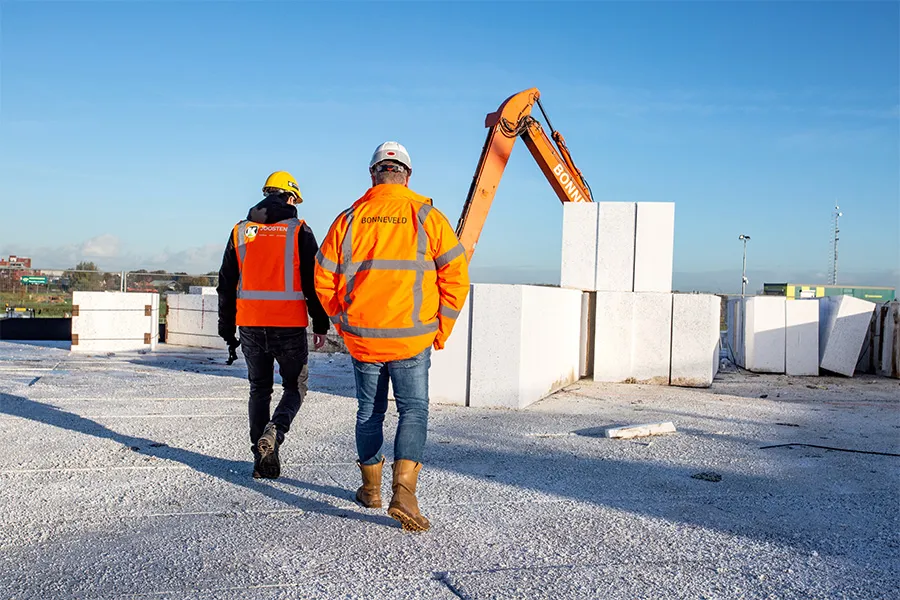
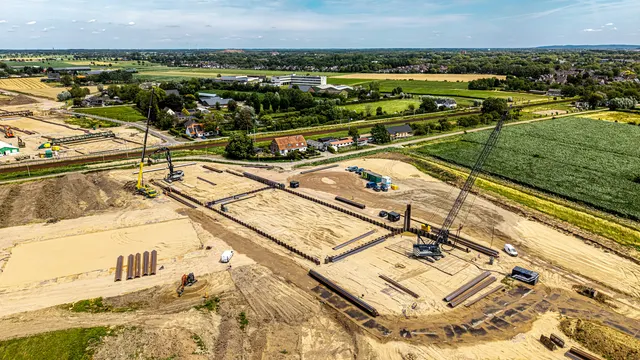
Because of the soft subsoil and the short construction period, a number of structures on the new A16 Rotterdam are founded on EPS. Over the past few years, Bonneveld Gewapende Grondconstructies has used more than 80,000 m3 of EPS on the project, on behalf of construction consortium De Groene Boog. The new KW22 viaduct over the High-Speed Line HSL is the largest of them all. With around 30,000 m3 of EPS beneath each abutment, it is one of the largest EPS structures in the country.
We started work shortly after Rijkswaterstaat awarded the A16 Rotterdam contract to De Groene Boog, says Leon van der Heiden, estimator at Bonneveld Gewapende Grondconstructies BV. “That meant we began laying the foundations for KW22 over the HSL as early as November 2022. EPS was deliberately chosen here because the subsoil could not withstand conventional preloading. It would have caused too much settlement on the HSL, which was undesirable.” De Groene Boog first excavated the ground at both abutments to 1 metre below ground level. Bonneveld then levelled the area and began ‘stacking’ the blocks.
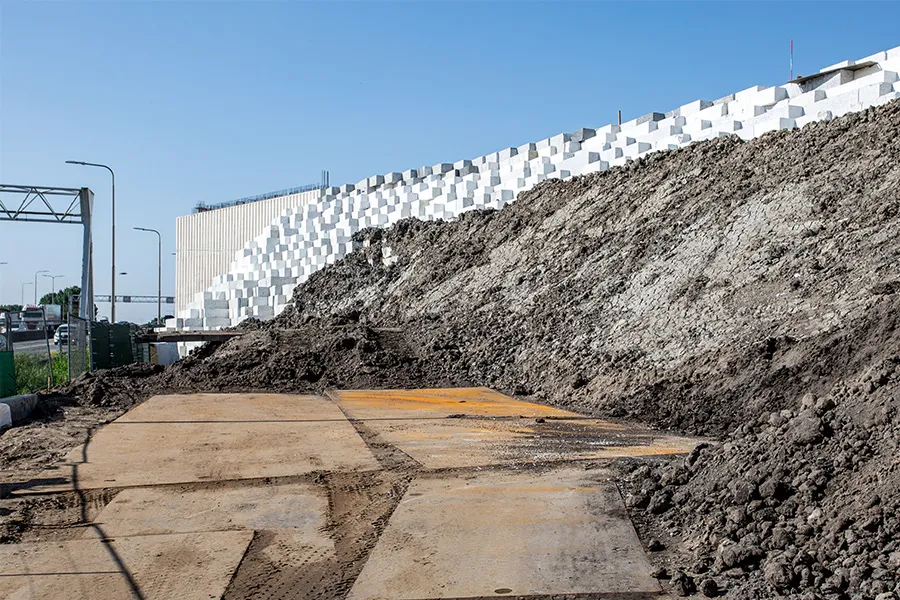
20 layers high
Beneath both abutments of KW22 is an EPS structure measuring 20 layers high and covering an area of 47 by 32 metres on each side. “When you consider that we were working with EPS blocks measuring 4 by 1.25 metres and 50 centimetres high, you can imagine it was quite a job,” says Hans van Beek, project manager at Bonneveld Gewapende Grondconstructies. The company, based in Bunschoten-Spakenburg, spent around 25 weeks on this structure alone. “We could install around 600 m3 a day, while having to coordinate with the other work on the project. Access was also a bit of a challenge. We had to build the structure over our own work. That is why, among other things, we used a long-reach 45-tonne tracked excavator with an 18-metre boom fitted with a specially developed EPS clamp. The machine places the blocks on the structure, after which a team using small plant positions them correctly and secures them with fastening plates.”
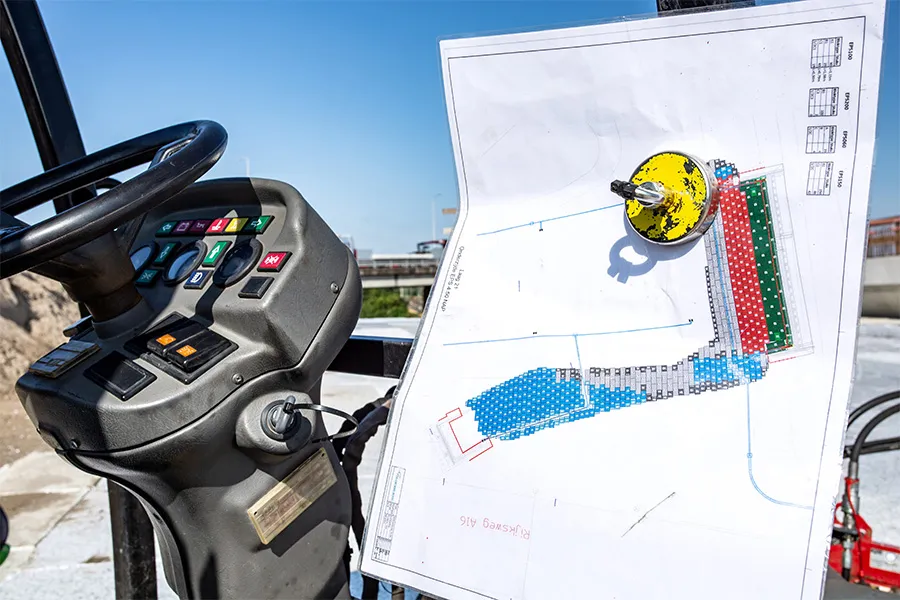
Labour-intensive
Bonneveld Gewapende Grondconstructies is an expert in building EPS structures. “Over the years, we have also developed our own equipment to install the blocks as efficiently as possible.” As well as the clamp mentioned earlier, Leon is referring to a cutting blade developed in-house to cut the blocks precisely to size on site, without producing polystyrene dust that could then spread into the surrounding area. After KW22, Bonneveld built several smaller EPS structures for De Groene Boog. “For KW25, a small viaduct over a service road, we used a total of 2,500 m3 of EPS in the approach roads. This structure was somewhat more labour-intensive and involved a considerable amount of cutting. We then moved on to KW52, which required 15,000 m3, followed later by a further 6,000 m3 of EPS, which had to be laid along a curve. That was labour-intensive too.” More recently, Bonneveld built the EPS structure for the temporary TK58 structure over the Hoofdweg. This required a total of 1,600 m3, with a further 8,500 m3 in the approach and exit roads.
Because of the enormous quantities of EPS required for this project, we had to build up substantial stockpiles to maintain the pace of work, says Hans. “So much EPS was needed that the factories could not keep up. That is why a stockpile was established on the project in advance, which we could draw on.” Both men look back on a successful project and a positive working relationship with the construction consortium. “Unfortunately, none of our structures can be seen once the project is complete,” Leon concludes with a laugh.
A business enquiry for Bonneveld BV? Get in touch
Who worked on A16 Rotterdam
- consortiumDe Groene BoogMentioned in Project A16 Rotterdam to become the first energy-neutral motorway, including a 2.2 km-long tunnel
- lifting and transport frame
 SarensMentioned in Reinforced underwater concrete floor for Rottemerentunnel
- supplier of reinforcing steelBCSMentioned in Reinforced underwater concrete floor for Rottemerentunnel
- construction consortium
 Van OordMentioned in De Groene Boog aims for maximum reduction in CO2 emissions
- construction consortiumDura VermeerMentioned in De Groene Boog aims for maximum reduction in CO2 emissions
- construction consortiumJohn LaingMentioned in De Groene Boog aims for maximum reduction in CO2 emissions
- construction consortiumDe Groene Boog construction consortiumMentioned in GPS-guided precision excavation in the wet cofferdam
- excavation workAannemingsbedrijf Verboon Maasland BVMentioned in GPS-guided precision excavation in the wet cofferdam
- foundation contractor consortium
 Voorbij FunderingstechniekMentioned in The foundation joint venture is De Groene Boog’s ‘invisible friend’
- foundation contractor consortiumFranki GrondtechniekenMentioned in The foundation joint venture is De Groene Boog’s ‘invisible friend’
- UO calculationsM.U.C.Mentioned in The foundation joint venture is De Groene Boog’s ‘invisible friend’
- UO calculationsHektecMentioned in The foundation joint venture is De Groene Boog’s ‘invisible friend’
- reinforcementDiepstraten WapeningstaalMentioned in Specialist reinforcement solutions for 33 structures
- ready-mixed concreteDyckerhoff BasalMentioned in Specially formulated mixes significantly reduce carbon footprint
- waterproofingBrabotechMentioned in Watertight construction with flexible joint seals and a liquid-tight layer
- construction consortiumDe Groene Boog construction consortiumMentioned in Watertight construction with flexible joint seals and a liquid-tight layer
- prefabricatedCiviele technieken deBoerMentioned in A leading name in heavy lifting and specialist transport








Keep following this
Get an email when a new story is published. No account needed.
- ProjectA16 Rotterdam
- SubjectFoundations / Site investigation
- CompanyBonneveld BV