









Building a viaduct over a live motorway?
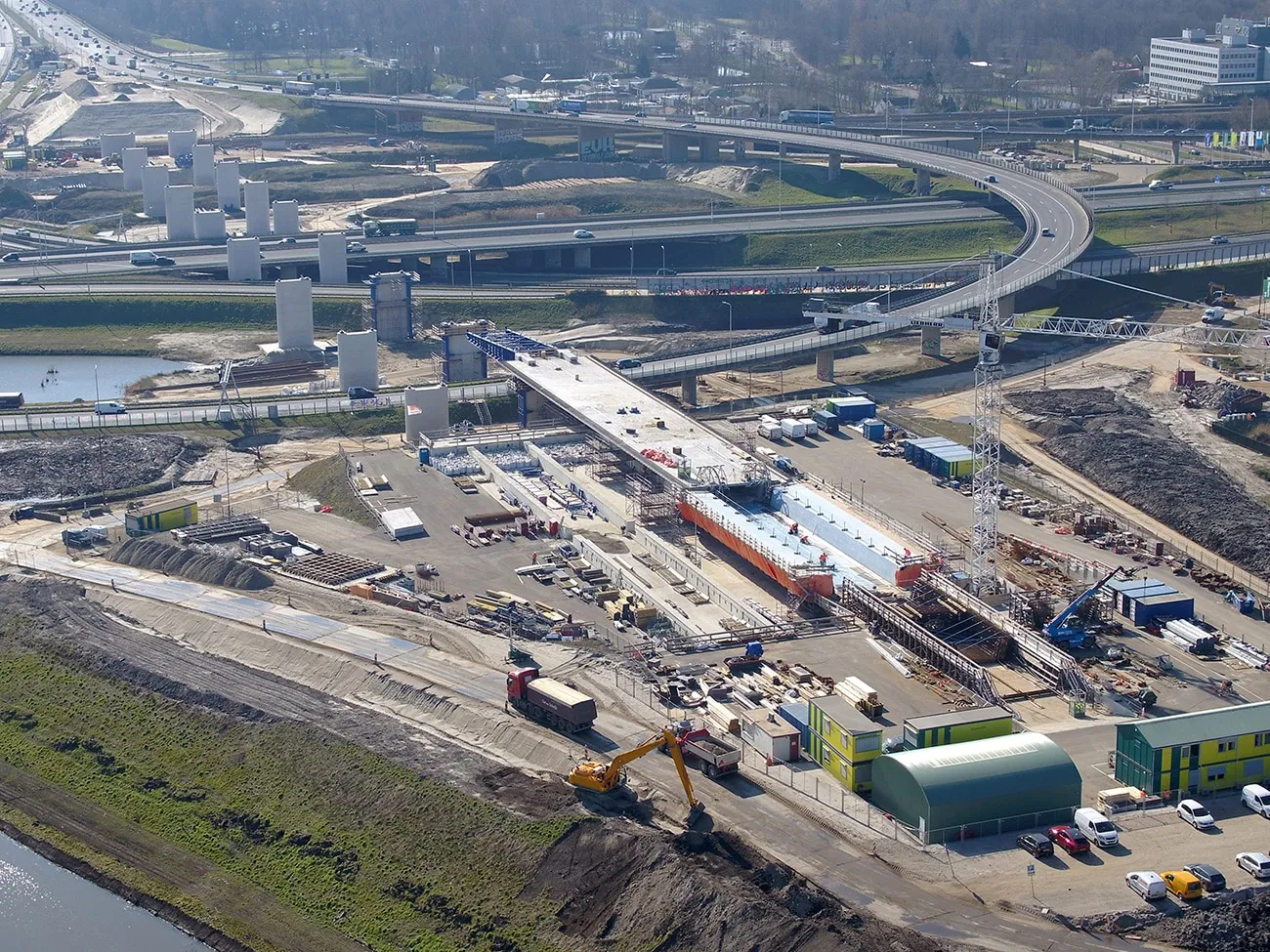
The new A16 Rotterdam will be an 11-kilometre national road between the A16/A20 at Terbregseplein and the A13 near Rotterdam The Hague Airport. The project is being carried out for Rijkswaterstaat by the De Groene Boog consortium, which includes BESIX, Dura Vermeer, Van Oord, TBI companies Mobilis and Croonwolter&dros, Rebel and John Laing. As part of the project, a viaduct over Terbregseplein will connect the new road to the existing A16.
The solution is the ILM method chosen by De Groene Boog
Construction of the viaduct is well under way, with traffic continuing to flow below. De Groene Boog opted for the ILM method, in which the segments are cast in situ and, once cured and finished, launched across the gap a little at a time. GWW-magazine visited the site and spoke to three De Groene Boog colleagues: works planner Erik Maarten Vermeulen (Mobilis), site supervisor Peter Augustyn (BESIX) and civil engineer Pierre Mengeot (BESIX).
The ILM method
It must be quite a sight for motorists at Terbregseplein. Above the slip road from the A20 towards the A16 hangs a ‘blue wedge’ made of steel sections. This is the ‘launching nose’, a piece of equipment that helps the viaduct reach the far side of Terbregseplein. Attached to the first segment to be cast, the nose keeps the structure stable and ensures it reaches the new viaduct’s piers without causing damage. De Groene Boog is using the Incremental Launching Method, or ILM. The concrete segments are cast in situ, joined together and, once a segment has cured and been post-tensioned, launched one stage further over the road while traffic continues to pass beneath.
Peter explains: “Terbregseplein, where the A20 and A16 meet, is one of the busiest traffic arteries in the Netherlands, so we are building the viaduct without closing the road. The ILM method is ideally suited to this. The launching nose is attached to the first segment cast to bridge the distance between the piers and distribute the weight properly.” Erik adds: “The ILM method has been used several times before, including on the A50, but there the deck was launched over water, not over a busy traffic artery. This is the first time we have used the method at an operational motorway interchange. The longest segment is 34.8 metres; the others range from 17 to 30 metres in length.”
The casting yard
At the ‘on-site factory’, Erik walks us through the viaduct production process: “Behind the launching nose are three zones where the segments are made. There is a prefabrication zone, a formwork zone and, finally, a curing zone. In the first zone, the reinforcement for the segment is assembled. Concrete is poured in the second zone, and in the last zone the segment is ‘finished off’ so it can then be launched. After we cast a segment, it has to cure for a few days before we can launch it. We cast the front section of the viaduct first.
Once the concrete has cured and a segment is ready, it is launched at a speed of around two and a half metres per hour. This frees up space to cast the next section onto it. The end result: two viaducts, each more than 400 metres long, one for each direction of traffic.”
No standard shape
Pierre explains how the launch works: “Temporary steel ‘pulling bars’ are installed in the segments, and the pull cables are attached to them. Subcontractor Freyssinet uses two large jacks to pull the entire structure forwards along these cables. The secret weapon? Large, lubricated Teflon sliding plates, which allow the segment to move despite its enormous weight. Once the plates have done their job beneath a segment, they are removed and ‘by hand’ placed back at the rear of the line.”
The cast segments are far from standard in shape: they follow a gentle curve and are also skewed. This makes the 3D geometry a major challenge. “However, the jacking system allows us to make good adjustments,” Erik explains. “A pulling force of 1,000 tonnes is needed to pull segment 17, the most recently cast segment, out of the formwork. Each jacking stroke moves it forward by about 28 cm. We can launch it 30 metres at a time.” Pierre adds: “The formwork is a challenge every time. We worked through every stage in advance using a specific calculation method, so we could work safely. During launching, we continuously monitor the forces and deformations in both the concrete and the piers. The tolerances are extremely tight: this is millimetre-precision work, unprecedented in concrete construction.”
A monolithic structure
The segments cast together use different concrete mixes depending on their function, Pierre says. “There is a constant balancing act between the programme, heat generation and launching. The only joints will be at the ends, by the two abutments. The deck itself will form a monolithic structure. We are using prestressing, hence the internal tendons, to compress the segments.” Peter adds: “The first segment alone contains 54 tendon ducts.”
Once a segment is in position, it is jacked up so that the bearings can be installed between the pier and the deck. Erik explains: “When all the segments are finally in place, we post-tension the whole structure, then install the edge elements and cast the kerbs. Once that is done, the road can be paved.”
Two decks
“We expect segment 17 to be in position by the end of February 2023. But we cannot rest on our laurels then, because that will only mark the halfway point. Deck A will be complete, but we have to build two decks. We will dismantle the launching nose and simply start again. One interesting detail: deck B is one and a half times as wide as deck A, which we are working on now. That is because the slip road will join deck B.” Detailed calculations have been carried out for every segment. Pierre says: “We started these calculations back in 2019. It is a challenge: the underside of each segment is straight, but the top is slightly tilted, and the alignment is skewed.” Erik adds: “That is why the casting yard is skewed too. We feed the reinforcement into the formwork along roller tracks, with the reinforcement itself already following a curve. Every stage of the construction requires exceptional precision. One particular area of focus is the reinforcement in the diaphragm walls inside the box girder. These are located at the piers and transfer forces from the box girder to the bearings on the piers.”
Side sections will also be cast at the ends of the deck. These will be added at a height of 9 metres once the launching process is complete. The end will then be as wide as the deck itself. The reason for adding these sections afterwards is to reduce the weight during launching.”
Peter concludes: “All in all, this is a remarkable feat. It is a highly complex job that we are carrying out with great care, with the safety of our people and of those driving beneath our work as our top priority. Will we ever see another project like this? Probably not.”
Have a business enquiry for BESIX Nederland BV? Get in touch
Who worked on A16 Rotterdam
- consortiumDe Groene BoogMentioned in Project A16 Rotterdam to become the first energy-neutral motorway, including a 2.2 km-long tunnel
- lifting and transport frame
 SarensMentioned in Reinforced underwater concrete floor for Rottemerentunnel
- supplier of reinforcing steelBCSMentioned in Reinforced underwater concrete floor for Rottemerentunnel
- construction consortium
 Van OordMentioned in De Groene Boog aims for maximum reduction in CO2 emissions
- construction consortiumDura VermeerMentioned in De Groene Boog aims for maximum reduction in CO2 emissions
- construction consortiumJohn LaingMentioned in De Groene Boog aims for maximum reduction in CO2 emissions
- construction consortiumDe Groene Boog construction consortiumMentioned in GPS-guided precision excavation in the wet cofferdam
- excavation workAannemingsbedrijf Verboon Maasland BVMentioned in GPS-guided precision excavation in the wet cofferdam
- foundation contractor consortium
 Voorbij FunderingstechniekMentioned in The foundation joint venture is De Groene Boog’s ‘invisible friend’
- foundation contractor consortiumFranki GrondtechniekenMentioned in The foundation joint venture is De Groene Boog’s ‘invisible friend’
- UO calculationsM.U.C.Mentioned in The foundation joint venture is De Groene Boog’s ‘invisible friend’
- UO calculationsHektecMentioned in The foundation joint venture is De Groene Boog’s ‘invisible friend’
- subcontractorFreyssinetIn this story
- reinforcementDiepstraten WapeningstaalMentioned in Specialist reinforcement solutions for 33 structures
- ready-mixed concreteDyckerhoff BasalMentioned in Specially formulated mixes significantly reduce carbon footprint
- waterproofingBrabotechMentioned in Watertight construction with flexible joint seals and a liquid-tight layer
- construction consortiumDe Groene Boog construction consortiumMentioned in Watertight construction with flexible joint seals and a liquid-tight layer
- prefabricatedCiviele technieken deBoerMentioned in A leading name in heavy lifting and specialist transport
- Bonneveld Gewapende Grondconstructies
 BonneveldMentioned in One of the largest EPS structures ever built



Keep following this
Get an email when a new story is published. No account needed.
- ProjectA16 Rotterdam
- ThemeExtending the life of roads and civil engineering structures
- SubjectNews
- CompanyFreyssinet
- CompanyBESIX Nederland BV
- CompanyMobilis
- CompanyVan Oord
- CompanyCroonwolter&dros







