









Julianakanaal: the challenge of managing logistics safely
Text Suzanne van Gaale Image Jac Rijk
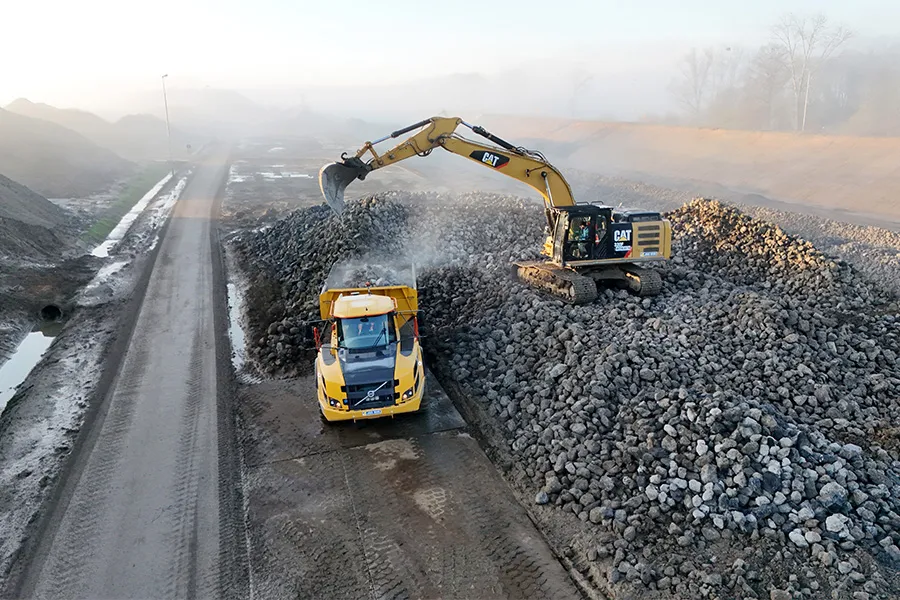
On behalf of Rijkswaterstaat, contractor Van den Herik-Sliedrecht is deepening and widening a 4-kilometre stretch of the Julianakanaal between Berg aan de Maas and Born. The project is so large that it has been divided into three work sections: North, Central and South. Jac Rijk was brought in to carry out the earthworks in the 1.5-kilometre Central section.
“Limburg is familiar territory for us. We know the local ground conditions and soil characteristics. The latter are a real issue at the Julianakanaal. It was built on the existing ground level, using methods different from those used today.” Anders Ooms, project manager at Jac Rijk, explains. With a small team of four, he oversees all the earthworks in the Central section. “We have worked on many large earthmoving projects with Van den Herik. For example, in 2018 we worked together on the widening of the Julianakanaal near Elsloo.”
Family business
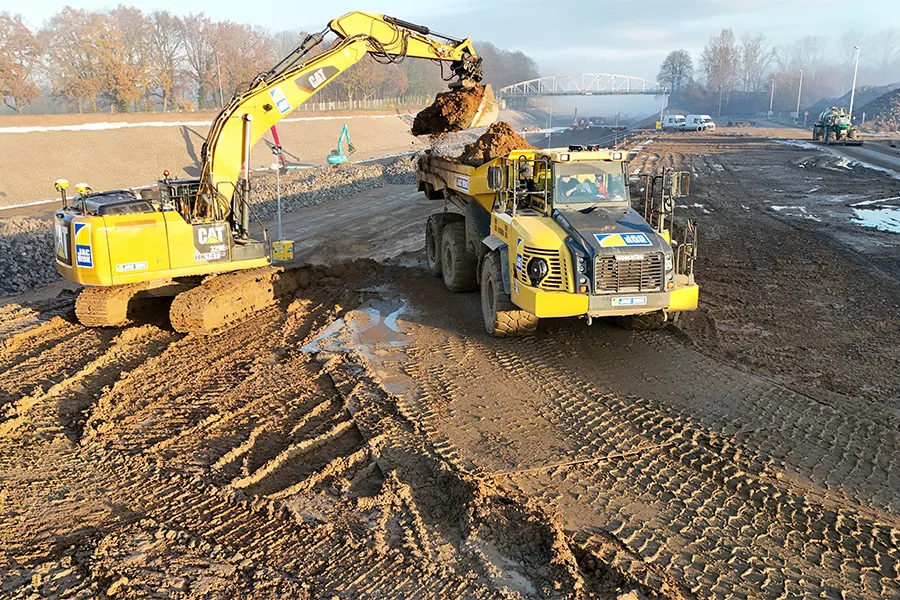
Family-owned Jac Rijk, as Anders puts it, has been around for quite some time. Founded in 1933, it is now run by the third generation. The company originally specialised in earthmoving, mineral extraction, hydraulic engineering, and road and dike construction. Its projects extend well beyond the Netherlands. They range from excavating bauxite in Suriname and road construction in Africa to beach nourishment in Taiwan. Closer to home, Jac Rijk has been involved in the construction of Maasvlakte II, a dike improvement project in Breskens and, further back, the former ENCI limestone quarry near Maastricht.
Getting started with the work plan
Anders and his team started work in April 2024, when Van den Herik asked them: ‘Would you draw up a work plan for the earthworks in the Central section?’ The plan set out, among other things, the construction of the access road, the ramp into the canal, the phased excavation and profiling of the slopes, the installation of bentonite mats and the placement of rock armour. “It covers every aspect of the earthworks. Large volumes to move in a short time, while also rebuilding the canal to a high standard from a hydraulic engineering perspective, so that it is watertight. That presents challenges. People had always talked about a water-retaining layer. We are building it to be almost completely watertight. That is the standard we are aiming for. We are all working towards a lifespan of well over a hundred years.”
Three objectives
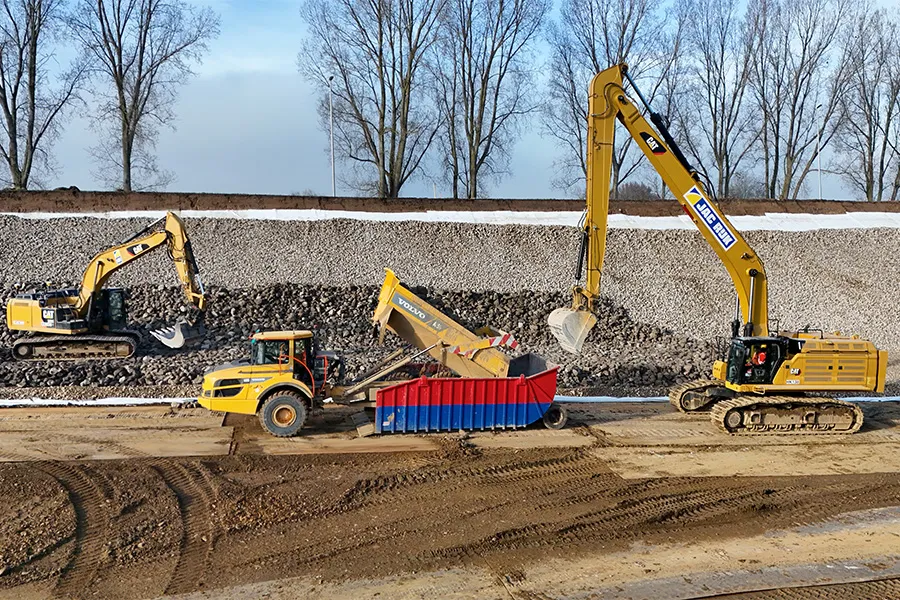
The project has three main objectives: safety, quality and speed. “The last of these, speed, is actually at odds with the other two. But it was still required. That makes it a challenge to manage all the logistics as safely as possible, while delivering high-quality work at the required pace and under the pressure of the deadline. The key is to get the planning right so that water can flow back into the Julianakanaal in April 2025.”
Narrow work section, heavy traffic
To improve safety, Jac Rijk opted to build a 12-metre-wide central haul road. It is wide enough for two lorries to pass each other safely. Traffic also follows fixed routes, with a one-way system in place. This keeps crossing traffic to a minimum. These measures are essential. “The Central section is relatively narrow, less than 40 metres wide, and a lot of soil has to be moved through it. That means huge volumes of earth and a great many vehicle movements. At the peak of the work, there were around 600 vehicle movements a day in a work section 1.5 kilometres long. On the busiest days at the end of 2024, we had 38 machines working in the canal in the Central section.” Anders therefore holds daily briefings with his team: Who is working today? Which activities will overlap?
Different soil streams
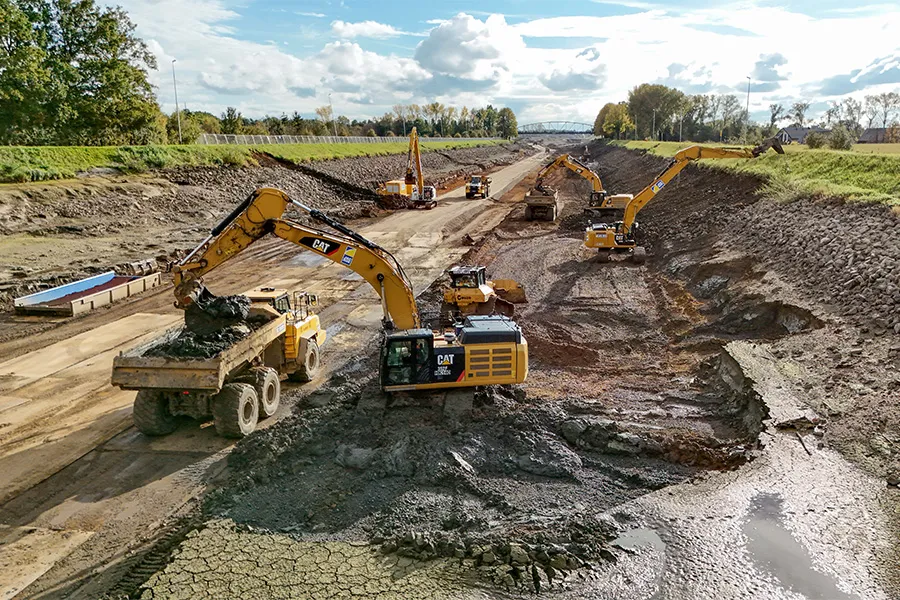
The different soil streams required particular attention in terms of quality. A thorough ground investigation was carried out in the Central section before work began. This distinguished, among other things, between industrially contaminated soil, category 1 clay, gravel and sandy material.
“These different soil streams have to be excavated separately and taken to the designated depots. We also have to ensure that each stream is delivered separately. In total, we moved 240,000 m3 of soil, but had only limited depot capacity. The challenge was finding space for it all.”
Striking differences between work sections The soil conditions varied considerably along the stretch of just over 4 kilometres. In the North section, a great deal of contaminated silt was found; in the South section, the ground consisted mainly of sand; and in the Central section, it was relatively hard and contained a lot of gravel. “Gravel is beneficial for drainage during the wet period, in autumn and winter, when we are working. Most of the rainwater drains into the ground thanks to the gravel, which works in our favour. There was also a fault line in the middle, where the groundwater level was much lower than in the South section.
Along the fault line, we found mainly more sandy clay.”
Working together
Jac Rijk is working as a subcontractor, and subcontractors are expected to be flexible. “That is one of Jac Rijk’s strengths. We are agile and adapt to what is happening at the time. On the Julianakanaal project, we are working with a small project team of four. That keeps communication direct and allows us to respond quickly.” As an example of this quick response, Anders points to the good cooperation between the North, Central and South work sections. “The earthworks in our section progressed fairly quickly and without problems. That meant we could lend a hand in the North section, where a great deal of silt had to be excavated and removed. As a team, you support each other wherever and whenever needed.”
Building a team
Anders sees the Julianakanaal as a special project, bringing together dry earthworks, hydraulic engineering earthworks and stone placement. “This is where our people’s expertise really comes to the fore, and where we can show what we are capable of. We have quite a few machine operators of our own, but we could not do it alone. The challenge was to bring together a strong team of skilled people from other contractors we work with in a very short time. As soon as Van den Herik invited us, we got in touch with our contacts and assembled the team we thought we would need. When that works out, everyone understands each other and gets on with the job, it makes all the difference to delivering a great project.”
Question about this story? Ask your question
Who worked on Julianakanaal
- Trimble dealer
 SITECHMentioned in Efficient excavation on the Julianakanaal thanks to Trimble machine control
- setting outPS SurveyMentioned in Efficient excavation on the Julianakanaal thanks to Trimble machine control
- main contractorVan den Herik-SliedrechtMentioned in PS Survey deploys a range of surveying techniques on the Julianakanaal
- groundworksJac RijkMentioned in Julianakanaal: A mega-project involving 180 machines, 200 workers and nearly 1.5 million tonnes of earth
- earthworks partnerFL BVMentioned in Complexity of Julianakanaal calls for flexibility and quick decision-making
- earthmoving companiesErmersMentioned in Complexity of Julianakanaal calls for flexibility and quick decision-making
- earthmoving companiesBC van der VisMentioned in Complexity of Julianakanaal calls for flexibility and quick decision-making
- project control
 Count & CooperMentioned in Project controls demonstrate their value on the Julianakanaal project
- clientRijkswaterstaatMentioned in Project controls demonstrate their value on the Julianakanaal project
- natural stoneRoxx InternationalMentioned in 500,000 tonnes of natural stone used in the Julianakanaal
- water management
 VanderkampMentioned in The challenge for Van der Kamp: how do you keep the Julianakanaal dry?
- earthworksErmers GrondverzetMentioned in Working as one team in the northern section of the Julianakanaal
- earthworks
 Van Schaik GrondverzetMentioned in Van Schaik deploys heavy equipment for earthworks on the Julianakanaal
Keep following this
Get an email when a new story is published. No account needed.
- ProjectJulianakanaal
- SubjectWater infrastructure







