Precision work underwater
Text Roel van Gils Beeld DISA International
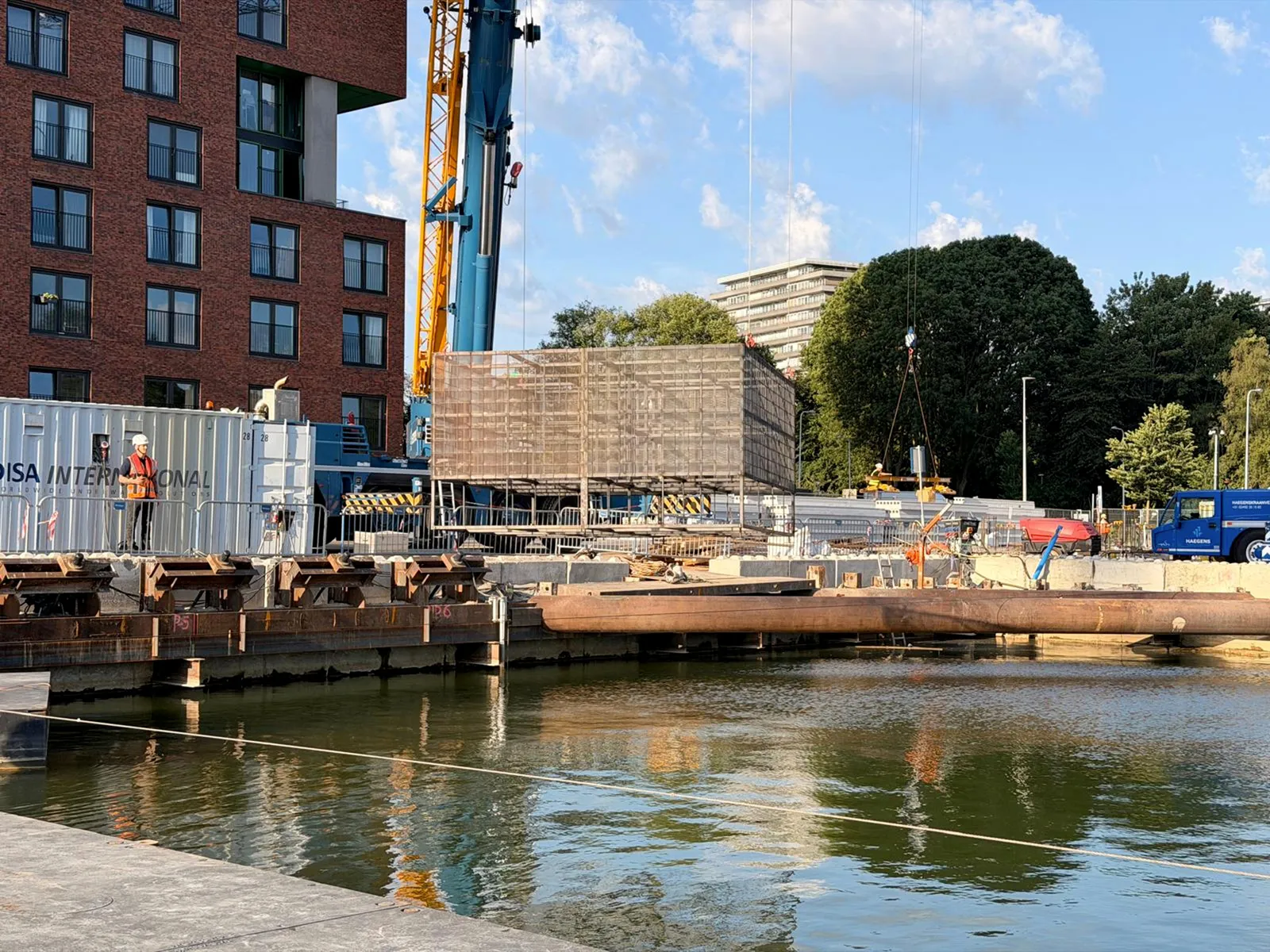
Before the first storey of the new residential tower at the Our Domain project on Europalaan in Utrecht takes shape, a major feat of engineering is completed more than five metres below ground level. In a 120 by 45 metre cofferdam, divers and specialists from DISA International are laying the foundations for the structure. With 4,700 m³ of underwater concrete poured just after the summer holidays, the cofferdam has now become ‘the cork’ on which the tower can be built.
“As a long-standing partner of Roel van der Stoel, we were brought in to carry out the specialist underwater work,” says Cecil de Groot of DISA International. “Our scope of work was extensive. First, we cleaned and inspected the CSM walls in their entirety to ensure the underwater concrete would bond optimally. Using water at 400 bar, we removed loose cement residue and roughened the surface.”
Extending the anchors
Another key part of the work was extending no fewer than 731 Gewi anchors. “These anchors protruded upwards from the base and hold the concrete floor in place. By fitting the anchors to length afterwards using couplers, you avoid damaging them while excavating the cofferdam,” explains dive team leader Juul Bakker. DISA also prepared the bases for the lift pits underwater. “The reinforcement cages were lowered into place under controlled conditions and now form an integral part of the foundation.”
Controlled crack formation
To keep cracking under control, DISA installed two 45-metre crack inducers in the 120-metre-long underwater concrete floor. “A steel frame and plates were used to create a localised weakness in the concrete, so any shrinkage cracks would form exactly where intended,” says Cecil. “Injection hoses were installed at these locations and covered with an inflatable seal. If sand or water later starts to leak through, gel or injection grout can be pumped in through the hoses to seal the crack permanently.” Injection hoses were also installed as a precaution in the corners of the cofferdam, where shrinkage makes leaks most likely.
Complex logistics
The work took place in a cofferdam with a water depth of around five metres, while underwater visibility ranged from just one metre to a few metres. During the busiest phase, three DISA dive teams worked on the project simultaneously. The work took around eight weeks in total. “The project also called for carefully planned logistics above water,” Juul notes. “Several cranes were positioned around the cofferdam, while three temporary access bridges served both as working platforms and as a bracing frame. This allowed equipment and personnel to work safely in the cofferdam.”
With the specialist underwater phase complete, the foundation is ready for the next step: construction of a new residential tower that will form part of the large-scale housing development along Europalaan in Utrecht.
Een zakelijke vraag aan DISA International? Get in touch
Who worked on it
Our Domain in Utrecht
- divers and specialists
 DISA International
Keep following this
Get an email when a new story is published. No account needed.
- ProjectOur Domain
- ThemeUnderground construction
- SubjectWater infrastructure
- CompanyDISA International