









De Klerk Waterbouw dismantles fendering on the Julianakanaal
Text Suzanne van Gaale Images De Klerk Waterbouw
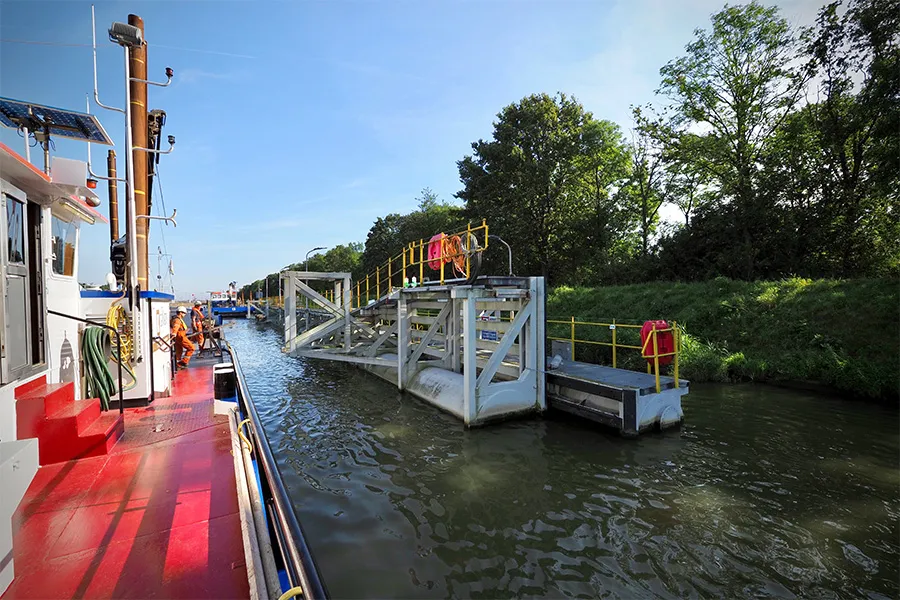
De Klerk Waterbouw has removed the fendering on the Julianakanaal in just three weeks. It was quite a job, given the different lengths and types involved. But the biggest challenge was the location itself. No holes could be made in the canal bed during removal. How did De Klerk’s team tackle this? Rolph Bolwerk, site manager at De Klerk Werkendam, explains.
“The Julianakanaal is familiar territory for us,” says Rolph. “Back in the early stages, in 2013, we carried out various works to widen the canal where there was no room for a natural slope, including pressing and vibrating sheet piles and installing combi-walls.” Last year, De Klerk was called into action again. On behalf of Van den Herik-Sliedrecht, the fendering upstream of Born lock was dismantled and removed. Just seven weeks passed between the request and the work being carried out, including the construction holiday. “Thanks to our experience with fendering, having the right people on the job and our familiarity with the location, we completed the work within the timeframe.”
165 years
The company from Werkendam has been in business for 165 years and specialises in structural hydraulic engineering. Skilled and dedicated employees at its branches in Werkendam, Woudrichem, Amsterdam and Moerdijk work every day on excellent projects in the sea and inland ports of Amsterdam, Vlissingen, Terneuzen and Rotterdam, among others. Subsidiary Labrujère in Middelburg is responsible for the mechanical engineering division, enabling De Klerk to offer a very extensive and comprehensive range of services.
No heavy lifting required
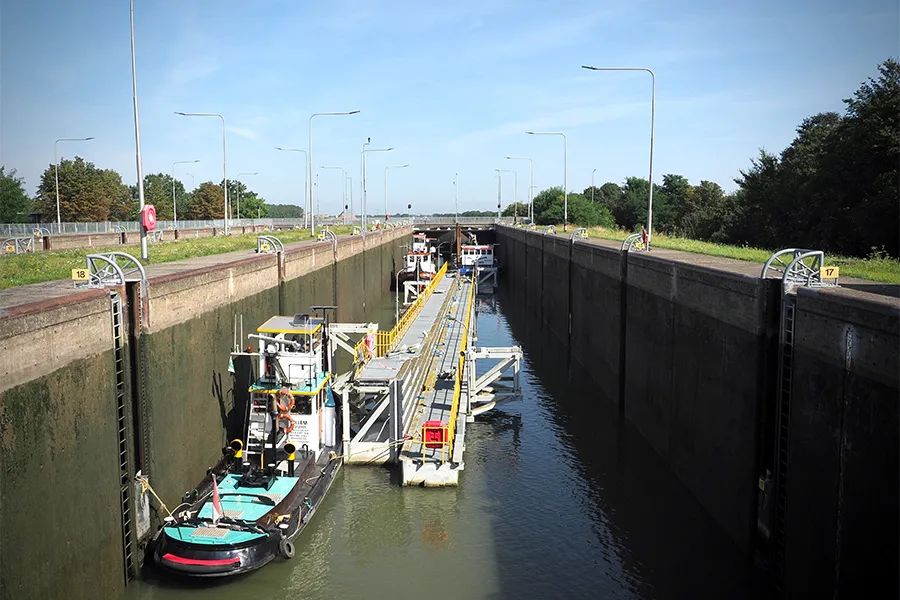
The floating fendering in the Julianakanaal consists of eleven different sections, the longest of which is around 100 metres. “Only three sections are identical, and all the others differ in size. We removed the sections individually while they were afloat, using pontoons and workboats, because nothing is as light as material floating on water. This meant there was no need for heavy lifting. We then connected the sections to the pontoon and took them through the lock. They are now temporarily moored at floating berths. Once Van den Herik has completed its work on the Julianakanaal, we will put the fendering back in the right place.”
No holes in the bed
Positioning the workboat required special attention. De Klerk normally anchors spud poles in the bed to keep the workboat firmly in position. Downstream, however, no holes could be made in the Julianakanaal bed. “We used spud poles with blunt tips here to give the workboat some stability. Positioning will also require special attention when we put the fendering back, both downstream and upstream. Another challenge is putting each section back in the right place so that they can then be connected, especially as they are all different. To prepare for this, we drew up a plan before dismantling the fendering and numbered each section.”
Taking the weight off
Rolph has high praise for the collaboration with Van den Herik. “It’s a special project, and it’s fantastic to be involved. Van den Herik is a no-nonsense company that’s a pleasure to work with. From day one, they trusted us to carry out the work and take care of everything for them. That’s exactly what we’re good at. Contractor since 1859, for good reason!”
Have a business enquiry for De Klerk Werkendam? Get in touch
Who worked on Julianakanaal
- Trimble dealer
 SITECHMentioned in Efficient excavation on the Julianakanaal thanks to Trimble machine control
- setting outPS SurveyMentioned in Efficient excavation on the Julianakanaal thanks to Trimble machine control
- main contractorVan den Herik-SliedrechtMentioned in PS Survey deploys a range of surveying techniques on the Julianakanaal
- groundworksJac RijkMentioned in Julianakanaal: A mega-project involving 180 machines, 200 workers and nearly 1.5 million tonnes of earth
- earthworks partnerFL BVMentioned in Complexity of Julianakanaal calls for flexibility and quick decision-making
- earthmoving companiesErmersMentioned in Complexity of Julianakanaal calls for flexibility and quick decision-making
- earthmoving companiesBC van der VisMentioned in Complexity of Julianakanaal calls for flexibility and quick decision-making
- project control
 Count & CooperMentioned in Project controls demonstrate their value on the Julianakanaal project
- clientRijkswaterstaatMentioned in Project controls demonstrate their value on the Julianakanaal project
- natural stoneRoxx InternationalMentioned in 500,000 tonnes of natural stone used in the Julianakanaal
- water management
 VanderkampMentioned in The challenge for Van der Kamp: how do you keep the Julianakanaal dry?
- earthworksErmers GrondverzetMentioned in Working as one team in the northern section of the Julianakanaal
- earthworks
 Van Schaik GrondverzetMentioned in Van Schaik deploys heavy equipment for earthworks on the Julianakanaal
Keep following this
Get an email when a new story is published. No account needed.
- ProjectJulianakanaal
- SubjectWater infrastructure
- CompanyDe Klerk Werkendam







