









Widening the Schipholbrug: precision drilling between parabolic prestressing tendons
Text Roel van GilsImage Interboor Midsland
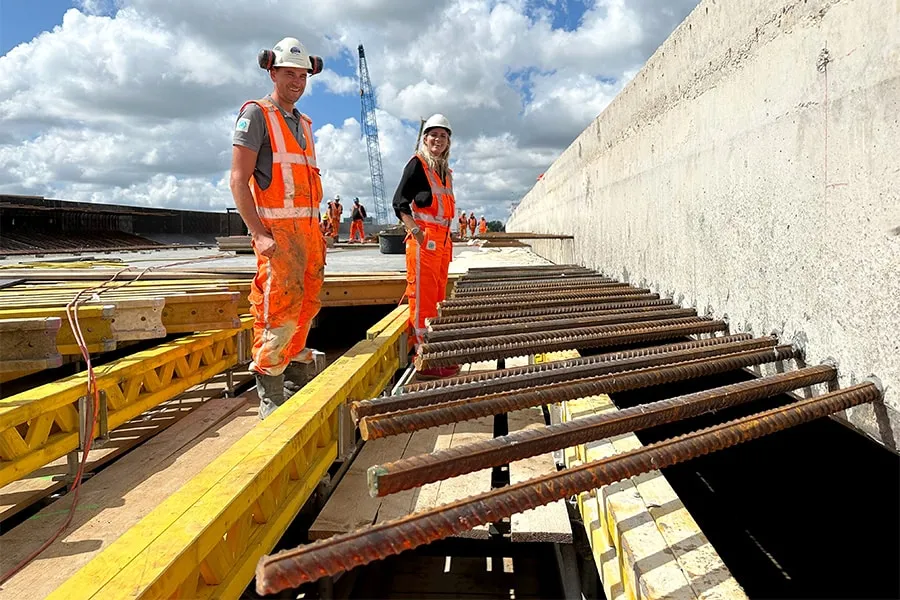
On behalf of Rijkswaterstaat, construction consortium VeenIX is widening the A9 between Badhoevedorp and Holendrecht. The route includes several structures, including the Schipholbrug, which is being widened on both sides. To anchor the new sections to the existing structure, anchors up to 180 centimetres deep are drilled into the existing structure, passing extremely close to the parabolic prestressing tendons. VeenIX is relying on a globally unique concept from Interboor Midsland and TerraCarta.
Interboor Midsland and TerraCarta have been working together for five years to address problems with hollow-core slab floors. “You’ll probably remember the collapse of the car park at Eindhoven Airport,” says Onno Dikkerboom, director and owner of Interboor Midsland. “Together with TerraCarta, we developed a technique for locating the existing reinforcement in floors, so that new anchors can then be drilled with great precision. It’s a tailor-made solution that enables us to strengthen floors with minimal disruption. Together, we’ve already completed many projects, including strengthening the floors of the JuBi towers on Turfmarkt in The Hague (the vast building housing the Ministry of Economic Affairs, ed.) with 50,000 anchors.”
Advanced scanning techniques
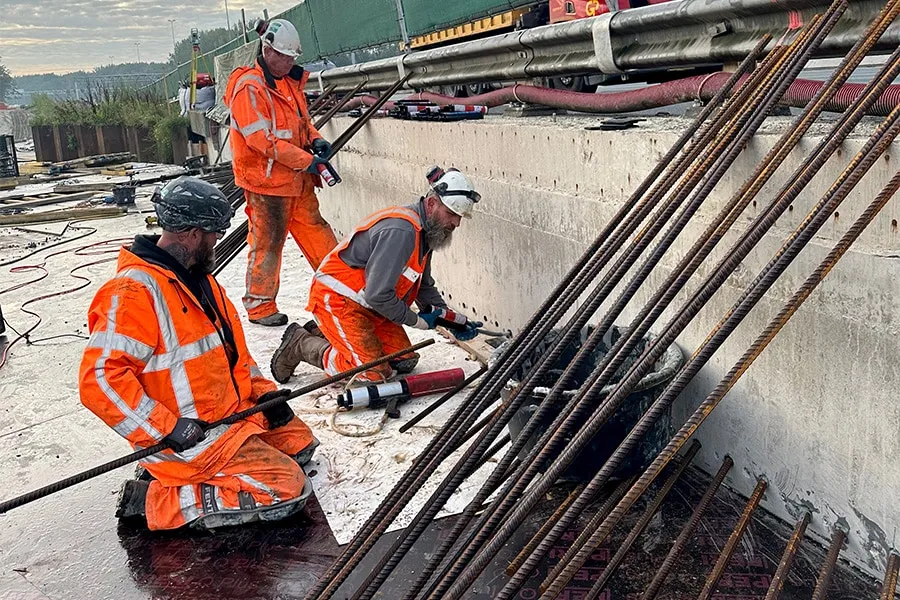
When widening the Schipholbrug, VeenIX faces essentially the same challenge as with the hollow-core slab floors. “Here too, there is existing reinforcement that is naturally invisible from the outside, and its precise location is not shown in detail on the drawings,” says Karel Meinen, CEO of TerraCarta. “Our task is to map the prestressing steel with a high degree of accuracy, so that our colleagues at Interboor Midsland can drill the anchors safely and responsibly. Using measuring antennas, we look right through the concrete, almost like an X-ray. Our method allows us to detect the closely spaced reinforcement and clearly visualise the main reinforcement. We then use a 3D wireframe model to show what is happening inside the bridge.”
Sinusoidal reinforcement
Locating the prestressing tendons and drilling the anchors may sound like a piece of cake, but it is anything but, Onno assures us. “It’s an advanced concept that we’ve continued to develop over the past five years, and it’s unique in the world. No one else is doing this. As a result, we’ve built up a lead of more than five years over our competitors. No other drilling company was willing to risk drilling the anchors in the Schipholbrug. Here, we’re dealing with parabolic prestressing tendons that run through the viaduct in a sinusoidal pattern. The great advantage is that less concrete is needed to build a very large, strong bridge. If you want to renovate or widen a structure like this, as we’re doing here on the A9, it’s crucial to map the exact position of the reinforcement. If you hit it while drilling, you could end up beheading six cows 200 metres away. It’s therefore extremely dangerous, and if anything goes wrong, repairs can be very costly.”
Combining measurement techniques
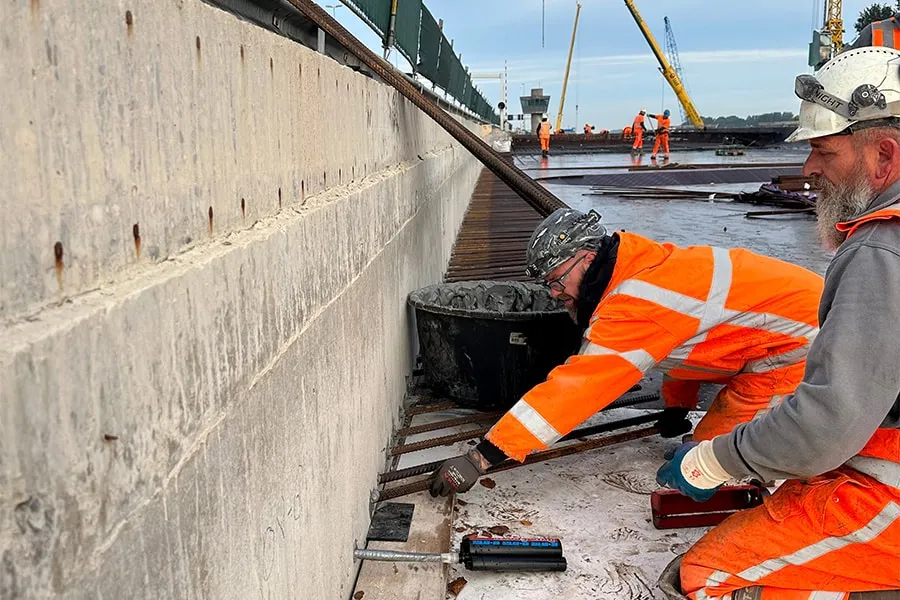
It is therefore essential to map the reinforcement in the Schipholbrug as accurately as possible. “Combining measurement techniques determines how confident you can be in what you map,” Karel continues. “After all, you need to be able to verify your findings. We also took measurements from both the top and the underside to account for any potential margins of error. We weigh up many factors to determine how accurately we can map the reinforcement, and how much effort that will take. The greater the certainty, the more work it requires. That’s what we do: aim for the highest possible level of certainty. The drilling itself also has a certain tolerance.”
Precision drilling technique
The 3D wireframe model supplied by TerraCarta and Interboor Midsland is overlaid on the planned drill holes to detect any clashes. “This allows us to indicate, for example, that a hole needs to be moved 5 or 10 centimetres so that the existing reinforcement is not hit,” says Karel. Onno adds: “Out in the field, a team of scanning and drilling specialists works together to drill and bond the anchors into the structure with great accuracy, passing extremely close to the existing reinforcement. It requires real precision: if you’re already 1 degree off at the front, you’ll have a serious problem at a depth of 180 centimetres. Thanks to our 360-degree approach and precision drilling technique, along with some additional developments (trade secrets, ed.), we’re confident enough to guarantee, with almost 100% certainty, that we won’t hit the existing reinforcement.”
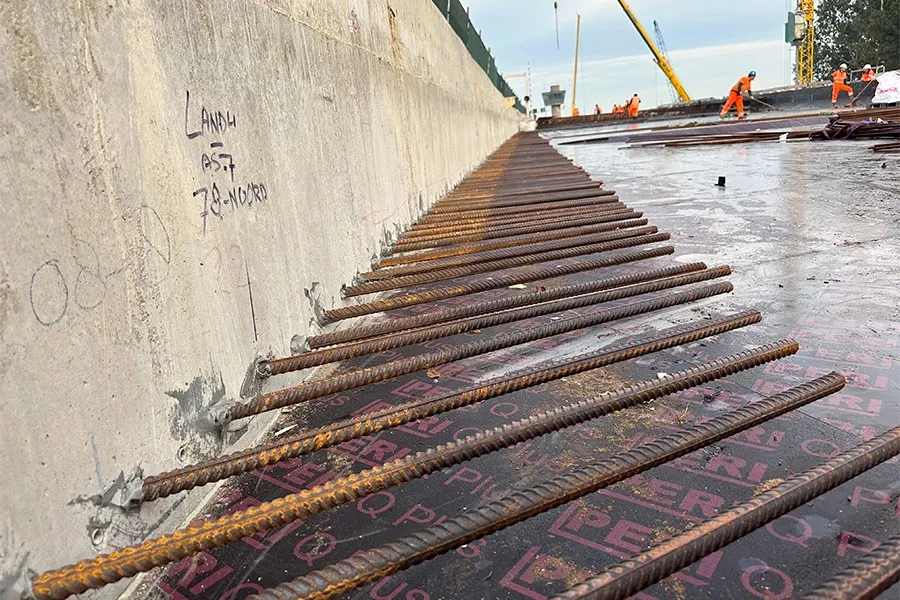
Interboor Midsland has now successfully drilled several thousand starter bars into the Schipholbrug without weakening the existing structure. Onno sees huge potential for this technique in infrastructure. “The potential for strengthening the structural safety of structures and other assets is enormous. That applies overseas too, where the collapse of a bridge or viaduct regularly makes the news.” There will no doubt be more to come!
A business enquiry for TerraCarta B.V.? Get in touch
Who worked on A9 Badhoevedorp – Holendrecht
- temporary bridges
 Janson BridgingMentioned in Temporary bridges on and over the A9 safeguard mobility
- precision drilling technologyInterboor MidslandIn this story
- foundation specialist
 KandtMentioned in Kandt, foundation specialist, delivers quality work on the A9
- welding sheet piles
 Marsé MontageMentioned in Specialist welding on the A9: welding 21 kilometres of sheet piling
- foundation contractor consortiumDe Vries TitanMentioned in The Netherlands’ largest anchor pile project
- foundation contractor consortiumBAUER FunderingstechniekMentioned in The Netherlands’ largest anchor pile project
- construction cost consultancy
 BKS SchagenMentioned in A9: BKS Schagen demonstrates the value of its expertise and approach
- UP scaffolding system
 PeriMentioned in Van der Panne installs special viewing tower alongside A9 Amstelveen
- scaffolding structuresVan der PanneMentioned in Van der Panne installs special viewing tower alongside A9 Amstelveen
- Type C self-drilling anchor pilesHigh 5 SolutionsMentioned in A9: Smart solution for testing anchor piles next to a sheet-pile wall


Keep following this
Get an email when a new story is published. No account needed.
- ProjectA9 Badhoevedorp – Holendrecht
- SubjectRoad construction
- CompanyInterboor Midsland
- CompanyTerraCarta B.V.







