









A9: Smart solution for testing anchor piles next to a sheet-pile wall
Text Suzanne van Gaale Image High5 Solutions
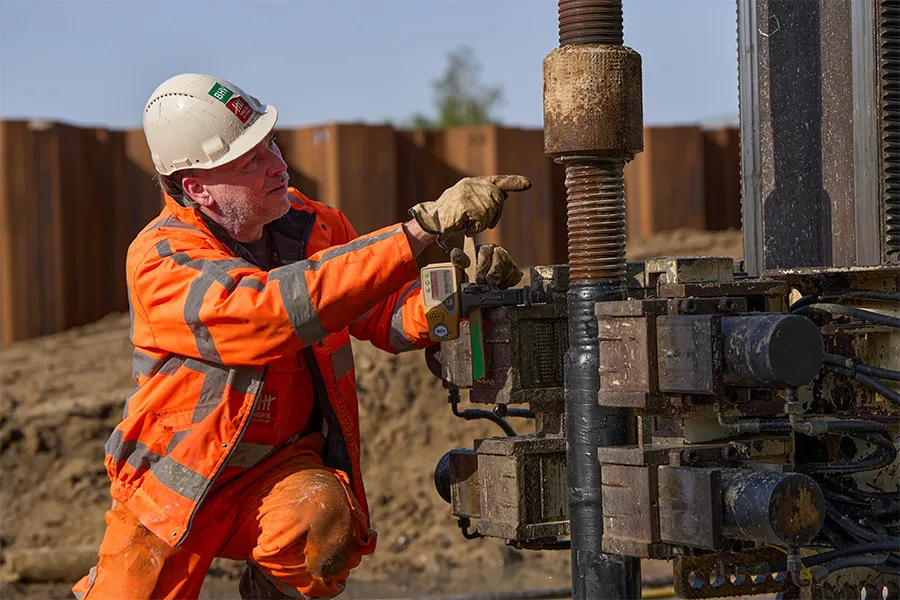
On behalf of Rijkswaterstaat, VeenIX is widening and deepening the A9 between Badhoevedorp and Holendrecht. Near Amstelveen, a 1.6-kilometre section of the A9 is being built in a cutting. The site of the future sunken section has been divided into 18 cofferdams using sheet-pile walls. The VeenIX construction consortium has brought in High 5 Solutions to install approximately 2,000 Type C self-drilling anchor piles. These hold the underwater concrete in place and will later serve as foundation piles for the sunken road section. High5 Solutions devised a special lever system on a pontoon for testing the piles.
“We work faster and cleaner thanks to sonic technology. That means less energy and less grout,” says Timo Gijbels, head of the office team at H5S and also involved in the A9 Badhoevedorp-Holendrecht project as a site engineer. “Our drilling motor does not just rotate, it also vibrates at a special sonic frequency. The vibrations are very fast, between 150 and 180 times per second. These sonic vibrations make it easier for us to drill through very hard sand layers, and we use less grout. The high frequency of the vibrations also has little impact on the surrounding area.” High 5 Solutions, also known as H5S, is a young company specialising in foundation engineering. It uses a unique drilling and vibration technique that it developed and patented itself. This is used to install grout anchors and anchor piles, among other things. The company also uses other grouting techniques, for example to prevent buildings or utility pipes from subsiding. “Sonic technology can also be used for other drilling and vibration work in construction, infrastructure, offshore and environmental projects. This includes pre-drilling through obstacles such as existing quay walls or pile foundations. We work in the Netherlands and abroad. Projects we are proud of include the Maasdeltatunnel, the dike reinforcement project between Tiel and Waardenburg, and the Ocean Reef Island project in Panama.”
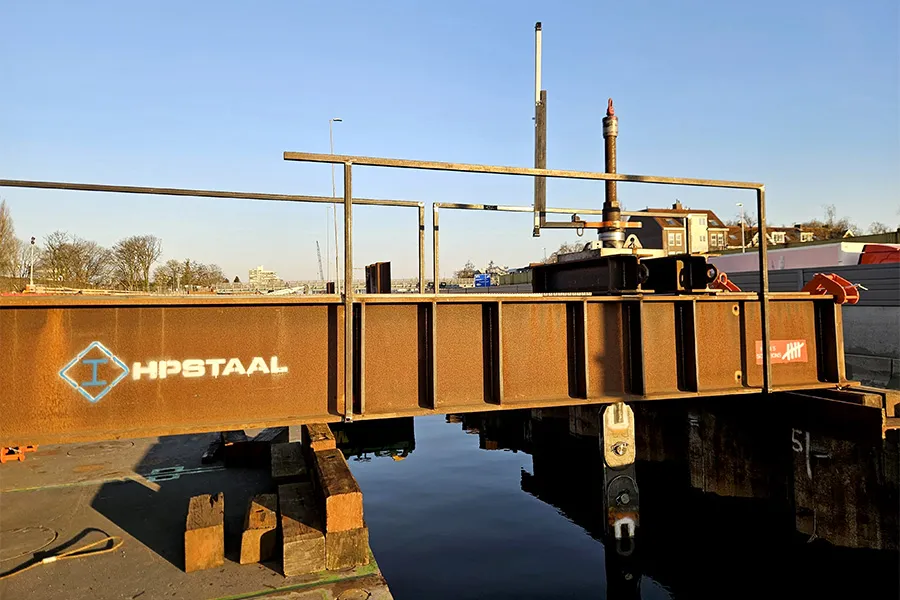
Special lever system
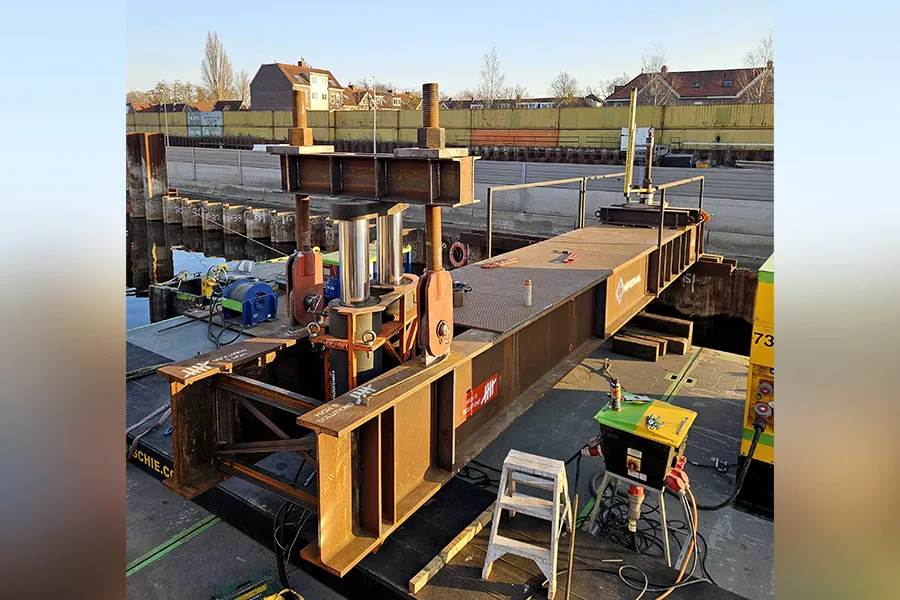
At the A9, H5S is installing approximately 2,000 Type C self-drilling anchor piles along the edges of the cofferdams. In addition to installing the piles, H5S tests whether they are securely fixed, working alongside an independent company. What makes this project unusual is that the tests have to be carried out from the water. “When the piles are in the middle of the cofferdam, we can easily test them from a pontoon. But we installed these piles along the edge, close to the sheet-pile wall. The standard method does not work there.” H5S came up with a smart solution: a special lever system. The test beam rests partly on the pontoon and partly on the sheet-pile wall. This system has not been used for this type of test in the Netherlands before. “We use a jack system to push the pontoon down into the water. Since the pile is offset, this creates a lever effect. This meant we could pull the pile with a force of 150 tonnes using a small pontoon and relatively little force.” Before installation, H5S also carried out failure tests on its Type C anchor piles. “This demonstrates that the production piles meet the optimised design factors.”
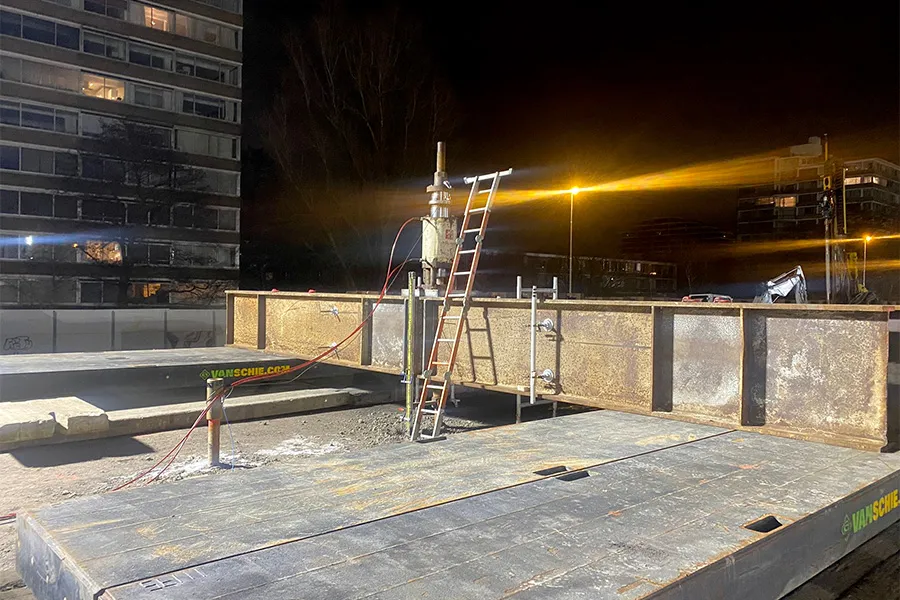
Working with limited headroom
At VeenIX’s request, H5S also installed anchor piles beneath the two temporary access bridges. “There was limited headroom beneath these bridges. To work there, we modified our drilling rig by shortening the leader. This made us the only company able to install anchor piles beneath these bridges.”
Pride
The A9 is a multi-year project that places significant demands on a relatively small company like H5S. “There are also quite a few complex aspects, such as the weight of the piles and installing them at depths of up to 10 metres below ground level. Together with the failure and suitability tests, this means you have to work to a high standard of quality. We are especially proud to be able to contribute to this part of the Netherlands’ infrastructure.”
Question about this story? Ask your question
Who worked on A9 Badhoevedorp – Holendrecht
- temporary bridges
 Janson BridgingMentioned in Temporary bridges on and over the A9 safeguard mobility
- precision drilling technologyInterboor MidslandMentioned in Widening the Schipholbrug: precision drilling between parabolic prestressing tendons
- foundation specialist
 KandtMentioned in Kandt, foundation specialist, delivers quality work on the A9
- welding sheet piles
 Marsé MontageMentioned in Specialist welding on the A9: welding 21 kilometres of sheet piling
- foundation contractor consortiumDe Vries TitanMentioned in The Netherlands’ largest anchor pile project
- foundation contractor consortiumBAUER FunderingstechniekMentioned in The Netherlands’ largest anchor pile project
- construction cost consultancy
 BKS SchagenMentioned in A9: BKS Schagen demonstrates the value of its expertise and approach
- UP scaffolding system
 PeriMentioned in Van der Panne installs special viewing tower alongside A9 Amstelveen
- scaffolding structuresVan der PanneMentioned in Van der Panne installs special viewing tower alongside A9 Amstelveen
- Type C self-drilling anchor pilesHigh 5 SolutionsIn this story



Keep following this
Get an email when a new story is published. No account needed.
- ProjectA9 Badhoevedorp – Holendrecht
- ThemeUnderground construction
- SubjectRoad construction
- CompanyHigh 5 Solutions







