









‘You can’t see from the outside how much work is being done on the Afsluitdijk’
Text Suzanne van Gaale Beeld Topview/Levvel/Rijkwaterstaat
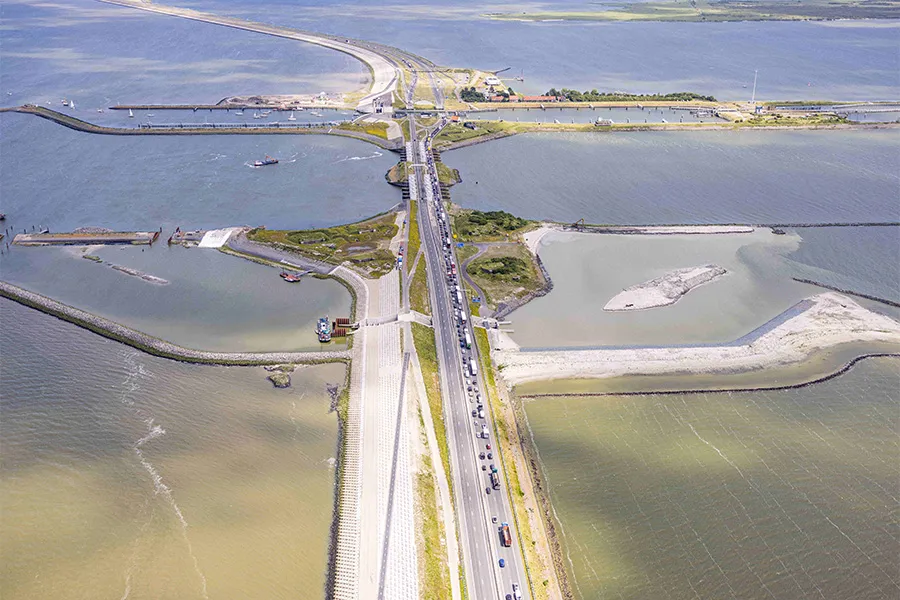
A succession of technical challenges and milestones
Strengthening and upgrading the Afsluitdijk is a project on an extraordinary scale. It is a prime example of how to future-proof a major structure sustainably. Together with Wop Schat, project director at Rijkswaterstaat, and Jan Jalving, project director at Levvel EPC, we look back at the key milestones and ahead to the work still on the schedule, both visible and out of sight, such as the construction of the pumping station at Den Oever, one of Europe’s largest.
“A large proportion of the projects have now been completed,” says Wop. “A great deal of work has been done, and we have achieved important milestones and completed projects. Things have not always gone smoothly, but we are now on a steady course towards completion at the end of 2026. Levvel will continue working on the pumping station at Den Oever and the new discharge sluices until the end of 2026. We will need at least another five years in total for the other projects. One major milestone is the completion of the reinforcement of the 32-kilometre-long Afsluitdijk, including the upgrade of the A7. This was a high point because a range of innovations were used to strengthen and upgrade the 32-kilometre-long dike. On the Wadden Sea side, the dike has been raised by almost 2 metres and reinforced with innovative concrete blocks. Quattroblocks have been used to reinforce the top of the dike, and Levvel-blocs the bottom. The blocks break the waves during severe storms. This means the dike now meets the requirement to withstand an extreme storm that could occur once every 100,000 years.”
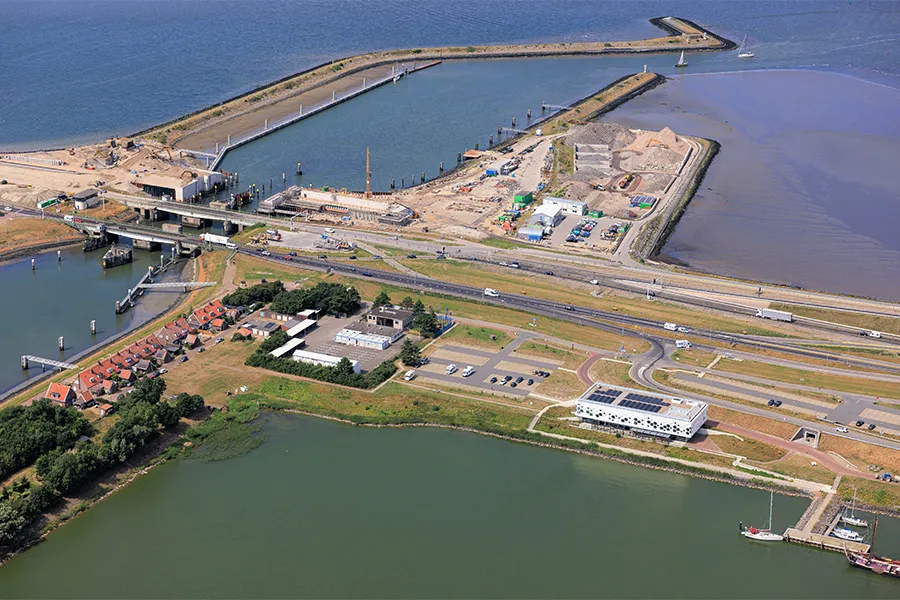
Den Oever as an eye-catcher
The other requirement was to ensure that the dike could discharge more water. “When the water level in the Wadden Sea is lower than in the IJsselmeer, we use the discharge sluices in the Afsluitdijk to release surplus water from the IJsselmeer. However, rising sea levels mean we can discharge less water this way. At the same time, more water is flowing into the IJsselmeer from rivers and surrounding areas. That is why we need to be able to discharge more water.” To make this possible, construction of the pumping station at Den Oever is now in full swing. It will include two additional discharge sluices and a pumping station with two pump units. Strengthening and upgrading the Afsluitdijk is already a technical and logistical puzzle, and that will remain the case for the next five years. “We are not just working on the pumping station and the discharge sluices. The swing bridges also need replacing, and the existing discharge sluices need renovating, all on the same ‘postage stamp’ of land at Den Oever. So, from a logistical point of view, it will remain a huge challenge for some time.” In May this year, six enormous pumps were installed in the new pumping station. The operation went well thanks to months of preparation. The pumps are expected to be ready by the end of 2025, after which construction of the new discharge structures will continue for just over a year. “The whole complex at Den Oever has been the eye-catcher, because it will give us extra discharge capacity for the IJsselmeer. In terms of energy use, the principle is: discharge water when possible, pump it when necessary. The energy used by the discharge sluices and pumps will be generated sustainably using solar power on and around the Afsluitdijk. This will make the Afsluitdijk an energy-neutral dike.” The new discharge structures look spectacular. The existing structures are listed monuments and must retain their appearance. But apart from that, they will be stripped back and rebuilt internally. According to Wop, that is at least as complex. “They are almost a hundred years old and need to last at least another fifty. So the technical challenges are certainly not behind us. Work on the Afsluitdijk never stops either. There are always new things to do, such as replacing the swing bridges, and at some point the locks will need major maintenance, and so on.”
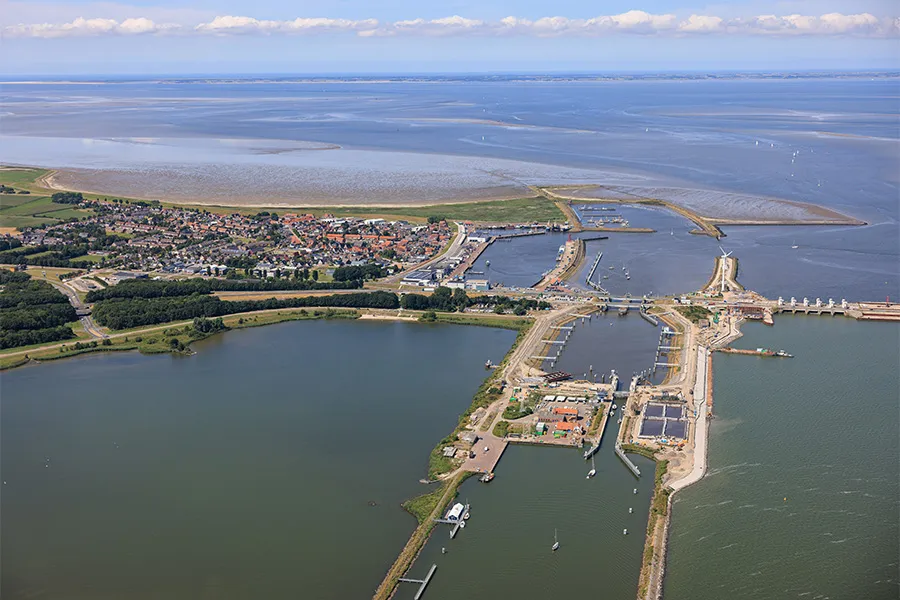
A remarkable feat
In addition to reinforcing the dike and upgrading the A7, other projects have also been completed. These include the construction of two flood barriers, one at Kornwerderzand and one at Den Oever, the passage beneath the dike for the Fish Migration River, and the service area, including the viewing balcony on the Wadden Sea side at the Vlietermonument. Projects still on the schedule and currently in full swing include, besides the pumping station and new discharge sluices at Den Oever, construction of the Fish Migration River and the restoration and extension of the Vlietermonument. Wop believes both deserve special mention. “The Fish Migration River (see separate box) is unique of its kind.
It is the first of its scale and complexity anywhere in the world. It is the first time a man-made tidal river has been built on the boundary between fresh and salt water. The restoration and modernisation of the Vlietermonument is also a remarkable feat, because you are building into a flood defence. We are extending it with a larger catering facility overlooking the IJsselmeer, and a new footbridge is also being built. The statue of Cornelis Lely, the man who designed the Afsluitdijk, will retain its prominent position.”
An integrated project in two respects
It is not only the milestones achieved that Wop is proud of. He also wants to highlight the collaboration with the contractors. “It is an extremely difficult job, and no one could have predicted how things would unfold. Even so, we managed to keep the end goal in sight together.” Jan also stresses the good working relationship. “There is a real sense of pride. It is a major, special and iconic project. What makes it special is that it is an integrated project. First, it serves several functions: it has to hold back water and discharge it, while also allowing shipping and road traffic to pass. These different functions have to be maintained during construction, which makes the work complex. It is also integrated in terms of disciplines. It brings together civil engineering structures, hydraulic engineering, mechanical engineering, industrial automation, and the relocation of cables and pipelines. That makes it enjoyable too, especially now that the work is concentrated at Den Oever. All these disciplines come together there. So we have moved from several project teams to one integrated team, which has been characteristic of the past year and a half. A huge amount of work has been done, both visible and out of sight. Looking at the Afsluitdijk as a whole, we have certainly achieved the striking simplicity people often talk about. From the outside, you can’t see how much work has been done. At peak times, around 600 people are working, both indoors and out. On an average day, 300 people are at work. These are the people whose work on projects such as the Afsluitdijk keeps you and me safe from flooding. They have the knowledge and experience.”
Fish Migration River: unique of its kind
A special feature of the Afsluitdijk is the Fish Migration River: a 4-kilometre-long winding river for fish, running right through the Afsluitdijk. This innovative project will reconnect the Wadden Sea and the IJsselmeer. Thanks to the Fish Migration River, fish such as sea trout, salmon, eel and flounder will once again be able to migrate between the Wadden Sea and the IJsselmeer. This will improve the health of the IJsselmeer’s waters and allow fish populations to recover. “Years of research and study went into determining the best design for the river,” says Wiepkje Elsinga, project manager at Provincie Fryslân. “It is the first time anywhere in the world that a man-made tidal river of this scale and complexity has been built on the boundary between fresh and salt water. It offers opportunities at around 200 locations worldwide that could benefit from this innovative approach. The Fish Migration River is of historic significance for the Afsluitdijk and our province, and for our nature and tourism. The Netherlands is showing here that coastal safety, freshwater conservation and nature restoration can go hand in hand. We are very proud of that.”
Circular approach
Another special feature is the circular approach. Much of the material released during the dike reinforcement has been reused in the construction of the Fish Migration River. “For example, we are using sand excavated during the work at Den Oever. We have also been able to reuse materials from the temporary working island, which was needed to create the passage through the Afsluitdijk, as well as the rock armour released during the dike reinforcement. And from the Makkumer Noordwaard nature reserve, we transplanted reeds that would otherwise have been destroyed. All in all, we have so far built almost all the different sections of the Fish Migration River using materials sourced from the immediate area.”
Every step feels like a victory
Wiepkje values the collaboration between all the parties involved. And there are quite a few: the client is provincie Fryslân. The Fish Migration River was initiated by the Waddenvereniging, It Fryske Gea, Sportvisserij Nederland, NetVISwerk and coalition het Blauwe Hart Natuurlijk. For Rijkswaterstaat, construction consortium Levvel (BAM, Van Oord, Rebel and Invesis) created the passage through the Afsluitdijk. Contractor consortium IJsselmeerwerken VOF (BAM, Van Oord) is creating the outlines on either side of the Afsluitdijk, while contractor Boskalis is building the unique zigzagging river. “This is the first time we have developed and built a project like this. Every step we take together feels like a victory. We are looking forward to the end of 2025, when the first fish swim through the Fish Migration River!”
About the Afsluitdijk
The Afsluitdijk has protected large parts of the Netherlands from flooding from the sea since 1932. But the dike needed upgrading. It does not meet current statutory standards for flood safety. The climate is also changing. As a result, sea levels are rising and extreme weather events will become more frequent. The dike must continue to protect us from flooding as conditions change. Upgrading the dike is an exceptionally special and complex project that is expected to take a total of eight years. There are ten sub-projects in all, starting at different times. Construction consortium Levvel (BAM, Van Oord, Rebel and Invesis) and Rijkswaterstaat are working on these sub-projects. The project is scheduled for completion in 2026. The upgraded Afsluitdijk will then once again meet statutory flood safety standards until at least 2050. Read more and find the latest news at www.deafsluitdijk.nl.
Have a business enquiry for Van Oord? Get in touch
Who worked on Afsluitdijk
- clientRijkswaterstaatMentioned in Greater discharge capacity through specialist, bespoke pump design
- central control
 Croonwolter&drosMentioned in Afsluitdijk system integration: invisible and indispensable
- supplierSaferoadMentioned in “Alternative systems are permitted, provided they comply with the rules”
- underwater construction
 DISA InternationalMentioned in ‘Placing underwater concrete is all about good planning’
- underwater excavation
 BonneveldMentioned in A sheet pile structure with anchoring has been installed at the Lely monument, halfway along the dyke.
- technical integrator
 Batenburg Industrial AutomationMentioned in A complex IT puzzle on the Afsluitdijk
- Levvel construction consortiumInvesisIn this story
- contractors' joint ventureIJsselmeerwerken VOFIn this story
- clientProvince of FrieslandIn this story
- fire alarm and evacuation systems
 Unica Fire SafetyMentioned in Optimal fire safety for the Afsluitdijk
- Levvel construction consortiumAberdeenMentioned in Afsluitdijk reinforcement complete: pumping station and new sluices officially opened

Keep following this
Get an email when a new story is published. No account needed.
- ProjectAfsluitdijk
- SubjectWater infrastructure
- CompanyBoskalis Nederland
- CompanyInvesis
- CompanyIJsselmeerwerken VOF
- CompanyProvince of Friesland
- CompanyVan Oord







