









Safe driving on the Afsluitdijk thanks to unique safety barrier between the carriageways
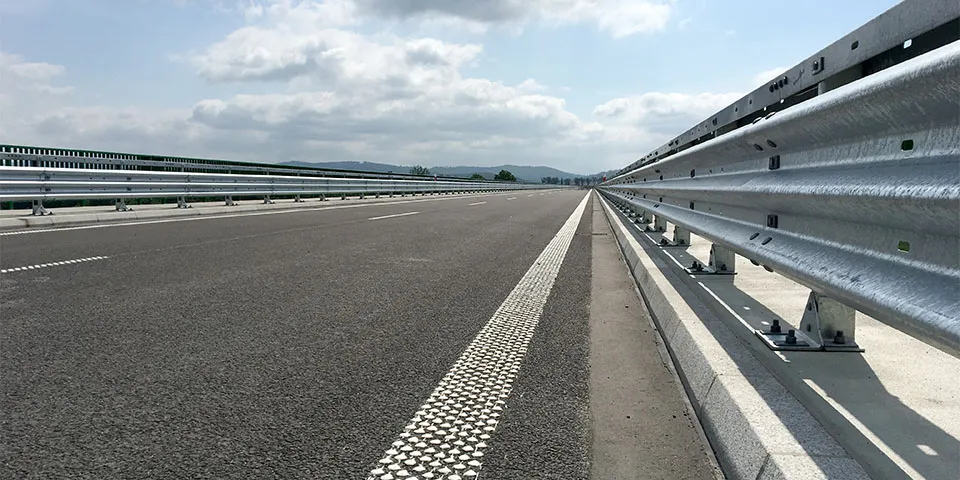
When the renovation work on the Afsluitdijk is complete and we are all driving comfortably between the IJsselmeer and the Wadden Sea, take a moment to look at the safety barrier between the carriageways. It will be significantly different from the barriers you are used to. The barrier was developed by Saferoad, while the idea for this special application came from Levvel. As you may have read, the Afsluitdijk renovation is being carried out by construction consortium Levvel, comprising BAM, Van Oord and Rebel, on behalf of Rijkswaterstaat.
Herman Odijk, Managing Director, and Henk Zwartenkot, Director Business Development at Saferoad, tell us about the unique solution that will soon safely separate the traffic.
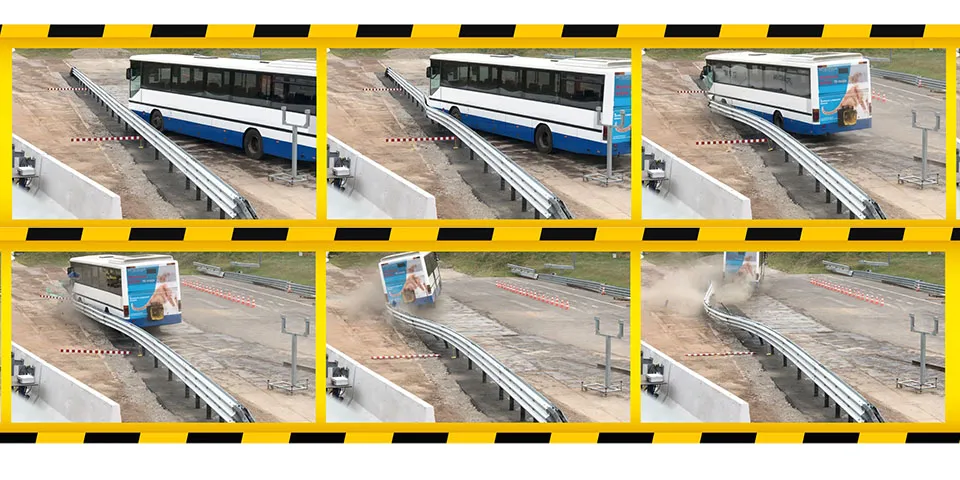
The SafeStar 241d performed well in the crash test.
Gaining space and improving road safety
“One of Rijkswaterstaat’s requirements in the tender was to widen the A7 Afsluitdijk while meeting the requirements for resistance to wave overtopping. For that reason, a conventional barrier installed in the central reservation was ruled out. The other conventional option, a concrete barrier, was also ruled out. Concrete would not help with water drainage and would also take up too much space from both carriageways,” Odijk begins. “In addition, while barriers mounted on concrete blocks are effective at keeping traffic off the opposite carriageway, the impact of a collision with concrete is actually unacceptably severe. The barrier’s safe energy-absorbing performance is negated by the hard concrete. Another drawback is that barriers mounted on concrete cost about twice as much as other barriers. Levvel therefore wanted a narrow barrier mounted in the asphalt, with outstanding safety performance. That brought us to the table with Levvel, where we concluded that our SafeStar safety barrier would be an ideal fit. The only outstanding question was how to install it in the asphalt.”
The central reservation will be replaced with a layer of asphalt, ensuring that its water-retaining function is maintained. Zwartenkot explains: “The SafeStar safety barrier is just 29 cm wide. Installing it in the asphalt therefore frees up a great deal of space for the lanes. Another advantage is that the central reservation will no longer need maintenance. Rijkswaterstaat required a tested and certified system for the Afsluitdijk. We were happy to take on that challenge, and we took a risk together with Levvel. With Levvel setting the requirements, we kept testing until we had developed a system that met them all. The result is a safety barrier made of triple-wave beams, embedded 80 cm into the asphalt, with a structural height of 100 cm, H2/W4 specifications and a high containment level.” Odijk adds: “The system not only performs better than conventional safety barriers, it is also more sustainable thanks to lower material use and faster installation. It has a service life of 50 years and is a modern, cost-effective solution, including for future new road construction and the replacement market. Countries currently carrying out development work have also discovered the triple-wave beam system.”
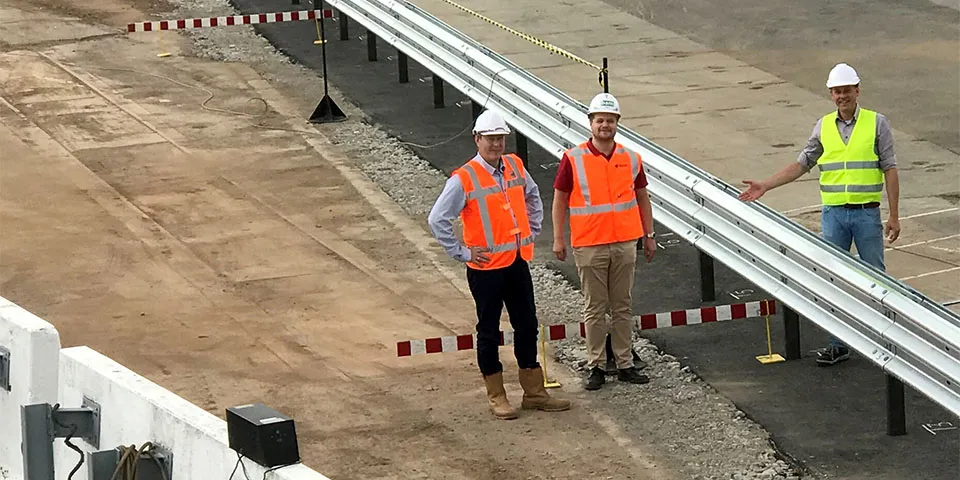
Ruurt Veldman and Danny Kraak (Levvel) with Herman Odijk at the test barrier on the crash-test site.
One complete family of safety barriers for every application
“Saferoad has developed the entire SafeStar product family over the past few years. It is a complete range, including transitions, expansion joints and different containment levels, with a solution designed for every situation. There is really no reason not to use SafeStar everywhere. The fact that the SafeStar 241d is now available for installation in asphalt is thanks to all the knowledge and experience we already had. It came down to carrying out the right tests to obtain the certifications that matter to Rijkswaterstaat. We have fully succeeded,” says Odijk.
Draw on the expertise of the manufacturer that developed the product
Product development and innovation are the driving forces behind Saferoad. The annual budget for crash testing is around 1.5 million euros. “You should expect something from us in return,” says Zwartenkot. “That is why we are always pleased when people draw on our expertise. We are a real centre of expertise and are happy to share our knowledge. Often, only the contractors are invited to discuss challenges, while the developers are overlooked. That is a missed opportunity, as people often end up sticking with ‘the old way of thinking’. The solution and the expertise lie with the manufacturer that developed the product. So draw on our knowledge, not only to save time and money, but above all to future-proof your projects! We have a specialist on our team specifically for this purpose, Henriëtte Soesbeek, who is our Road Safety Consultant.
She is our first point of contact for all queries. For example, she built the specification service on our website from the ground up. It is a great online tool. Saferoad has the expertise to meet the needs of specific situations with specialist designs.”
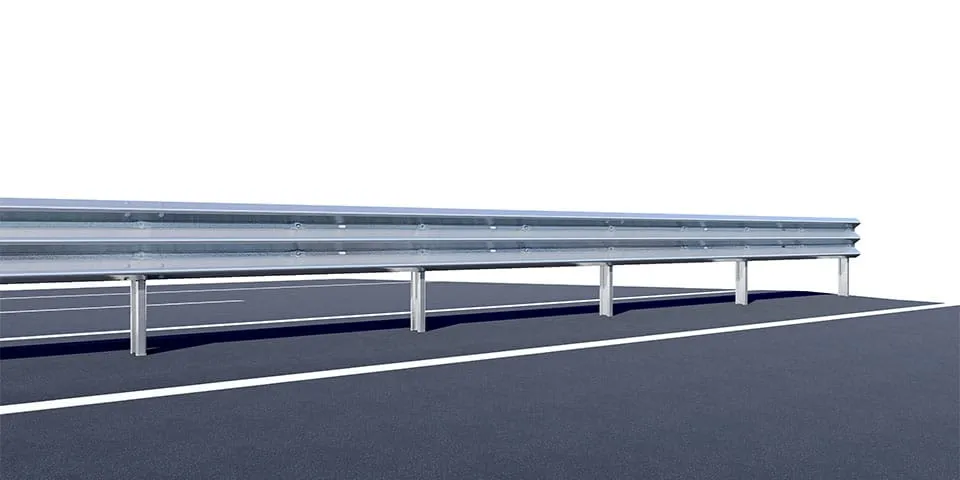
The SafeStar 241d for the Afsluitdijk is a tested and certified product.
Taking a forward-looking approach
There are often understandable reasons for continuing to use safety barrier systems dating back to the 1970s: conventional barriers look familiar on the road, people know what to expect, and their installation and maintenance are familiar too. Even so, it would be a shame not to make use of the latest developments, which are an excellent addition to the old NEN 5190 standard. “Levvel and Rijkswaterstaat understand the value of working to current standards. That is why you will probably also see our triple-wave beam system on the locks. The same quality and safety, and a great, uniform appearance,” says Zwartenkot.
In closing, Odijk says: “So we are not only supplying safe products that meet tomorrow’s needs, we are also providing Levvel with ‘safe administration’. Everything is properly tested, certified and documented. We guarantee that the product complies with the requirements.”
Have a business enquiry for Van Oord? Get in touch
Who worked on Afsluitdijk
- clientRijkswaterstaatMentioned in Greater discharge capacity through specialist, bespoke pump design
- central control
 Croonwolter&drosMentioned in Afsluitdijk system integration: invisible and indispensable
- supplierSaferoadMentioned in “Alternative systems are permitted, provided they comply with the rules”
- underwater construction
 DISA InternationalMentioned in ‘Placing underwater concrete is all about good planning’
- underwater excavation
 BonneveldMentioned in A sheet pile structure with anchoring has been installed at the Lely monument, halfway along the dyke.
- technical integrator
 Batenburg Industrial AutomationMentioned in A complex IT puzzle on the Afsluitdijk
- contractorBoskalisMentioned in ‘You can’t see from the outside how much work is being done on the Afsluitdijk’
- Levvel construction consortiumInvesisMentioned in ‘You can’t see from the outside how much work is being done on the Afsluitdijk’
- contractors' joint ventureIJsselmeerwerken VOFMentioned in ‘You can’t see from the outside how much work is being done on the Afsluitdijk’
- clientProvince of FrieslandMentioned in ‘You can’t see from the outside how much work is being done on the Afsluitdijk’
- fire alarm and evacuation systems
 Unica Fire SafetyMentioned in Optimal fire safety for the Afsluitdijk
- Levvel construction consortiumAberdeenMentioned in Afsluitdijk reinforcement complete: pumping station and new sluices officially opened

Keep following this
Get an email when a new story is published. No account needed.
- ProjectAfsluitdijk
- ThemeFlood protection and climate-resilient water management
- SubjectWater infrastructure
- CompanyVan Oord







