









“Alternative systems are permitted, provided they comply with the rules”
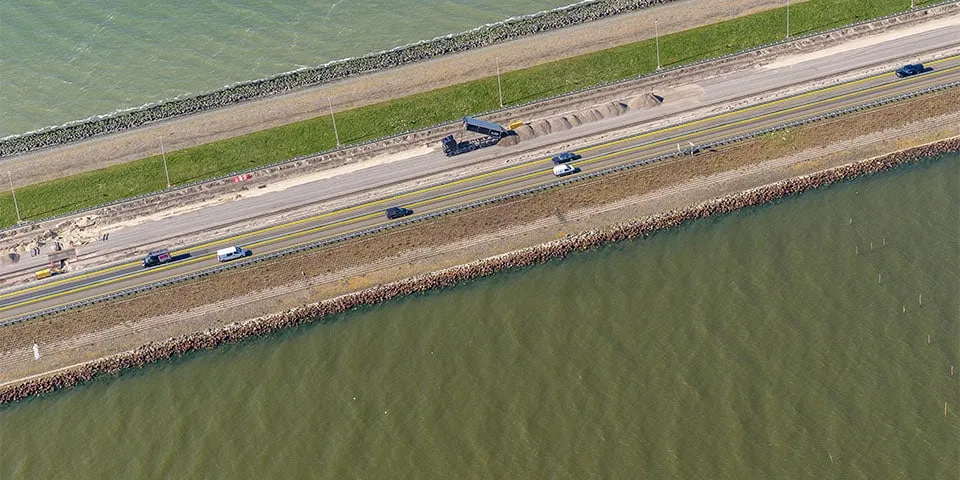
The Afsluitdijk renovation has already produced some excellent, innovative solutions. The result of clever thinking and fruitful collaboration. One example is the solution developed to install the narrow guardrail, tested at full scale in asphalt. Danny Kraak is Project Manager at BAM Infra Verkeerstechniek and tells us: “In 2017, I was involved in the tender, working on traffic management measures and the guardrail. It was an exciting challenge, as the requirements called for some unusual solutions. The Rijkswaterstaat tender documents stated that ‘alternative systems are permitted, provided they comply with the rules’. That gave us the opportunity to think outside the box, and it paid off.”
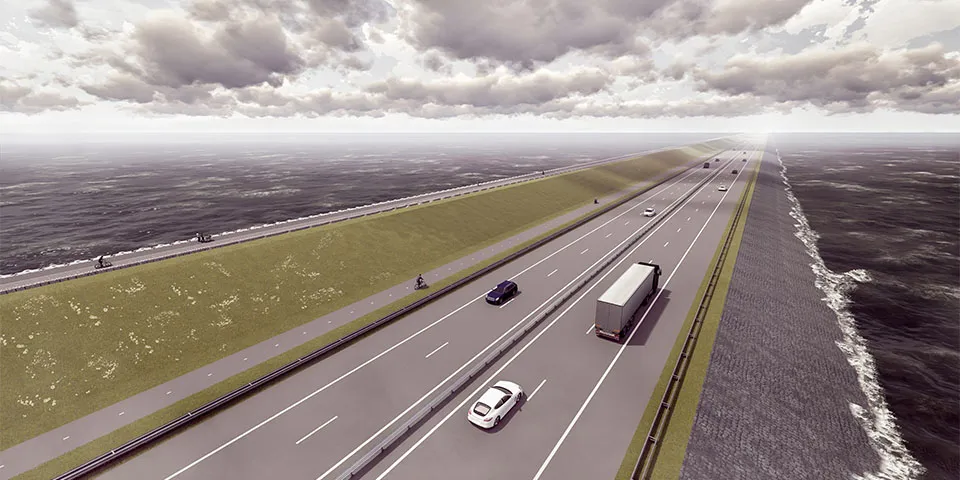
Artist’s impression of the reinforced Afsluitdijk, showing the new A7 road layout.
Road design played a key role in the tender
The narrow central reservation meant a fully tested guardrail installed in asphalt was needed. “The freedom we were given, within certain limits, sparked the idea,” says Danny. “From there, I took on the coordinating role. Together with Ruurt Veldman, Project Manager of the Roads and Bridges Team at Levvel (BAM/Van Oord/Rebel), I developed the idea further. We found the right supplier and were then able to present an integrated road design. We won the tender just before Christmas in 2017. The road design played a key role in the tender.”
Provisional award followed in March. “That means you have to deliver on everything you proposed. Together with our supplier, Saferoad, we looked more closely at the possibilities and discussed the tests required. We attended the simulations and physical tests, which were particularly impressive. In the end, we developed a CE-marked guardrail system installed in asphalt. We were also appointed to install it, and expect to start in June.”
Adding value in the tender
Ruurt Veldman takes over: “I work for BAM Infra Multidisciplinaire Contracten. At Levvel, we work in six teams, and I am Project Manager of the Roads and Bridges Team. The tender focused mainly on flood protection, which is why the dyke is being raised and widened. The dyke’s resistance to overtopping must be maintained, so we are using asphalt on the central reservation. This in turn led to the need for a central guardrail mounted in asphalt. The road was already narrow, with narrow hard shoulders. This gave us an opportunity to add value by creating more space. Since the dyke’s infrastructure cannot be expanded, we have found a solution by widening the road at the central reservation and installing a central guardrail that is considerably narrower, but fully meets all the requirements. The chosen system is Saferoad’s new SafeStar 241d.”
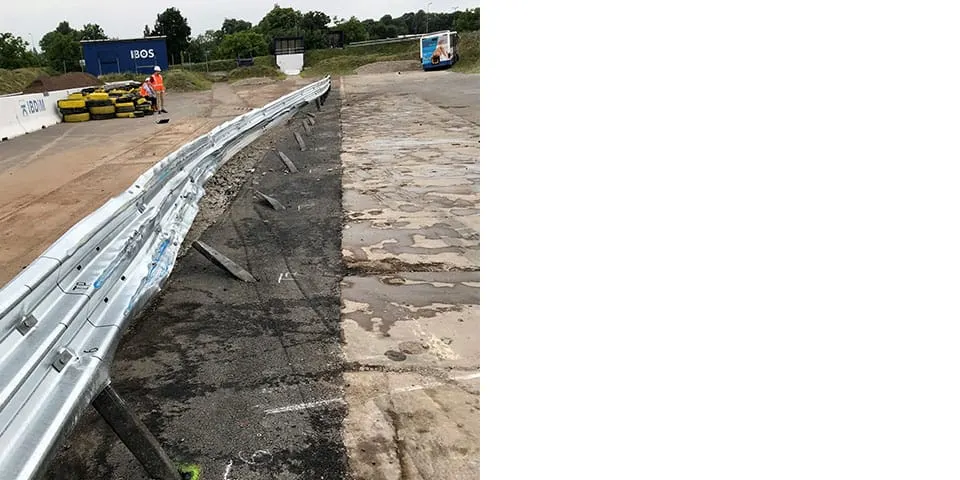
The guardrail after the crash test: passed with flying colours!
The solution was found in the central reservation
Originally, the Afsluitdijk had a grass strip with surface water drainage in the central reservation. “To improve its ability to retain water, we came up with the idea of also paving the central strip with asphalt. Together with the narrow central guardrail, this gives us traffic lanes and hard shoulders that are 350 cm wide. A concrete barrier is not desirable, either for drainage when water overtops the dyke or for aesthetic reasons. This fully justifies the new central guardrail system we developed. We found a good supplier in Saferoad: its SafeStar was exactly the guardrail we were looking for. Together, we looked for a way to install it in asphalt. After we put forward the idea during the tender phase, Saferoad carried out all the calculations and we were able to submit the design. If it was approved, we could then develop it further. Our proposal was judged the best, and we could begin designing the system. We then had to put our money where our mouth was, with extensive calculations, simulations and tests.”
A year of development, simulation and testing
The new guardrail was not developed overnight. Live crash tests were carried out in Poland at the guardrail factory, with independent testing bodies in attendance. Ruurt says: “That ultimately gave us a fully CE-marked product.” Herman Odijk of Saferoad explains how the system works: “The guardrail posts are driven through the asphalt. The rails are attached to the posts with breakaway bolts, resulting in a strong guardrail with a low ASI A injury index for passenger cars. On impact, the guardrail keeps the vehicle travelling in its original direction. At just 28 cm wide, it is the narrowest guardrail on the market, and fully meets Rijkswaterstaat’s current stringent requirements in the event of an impact.”
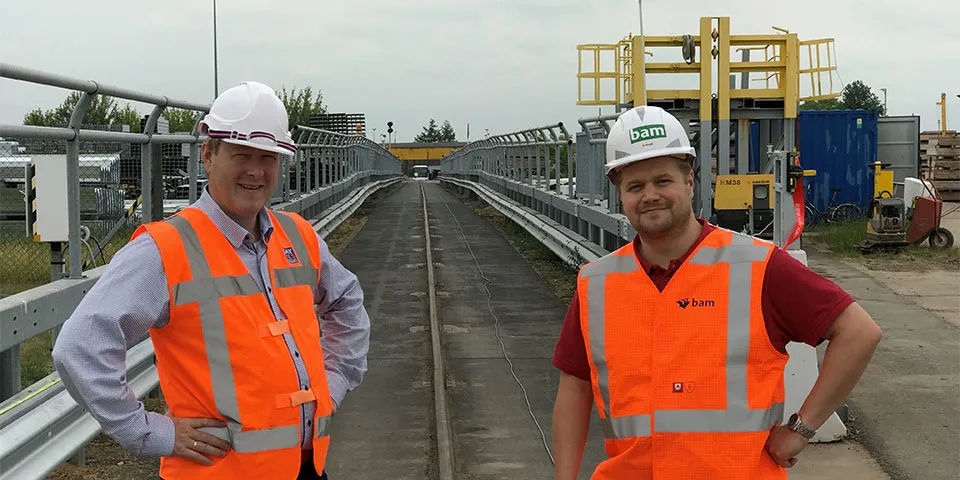
Ruurt Veldman (left) and Danny Kraak, with a bus used for the crash test in the background.
Not only safe, but sustainable too
As this is a DBFM project, Levvel is responsible for maintaining the Afsluitdijk for 25 years. “We are paid according to the availability of the facilities,” Ruurt explains. “The guardrail we developed together fits that model perfectly. It also scores well on sustainability. The zinc coating provides effective protection against rust, the guardrail causes less disruption for road users, and we were able to do away with the conventional grass central reservation, meaning no mowing work is required there. We can also install the posts using a fully automated, GPS-guided piling machine. Neat, straight, precise and fast.” Danny adds: “The installation method is just as unique as the product and the solution itself. The rails are quite heavy, so they are better installed mechanically. That means less manual labour and therefore a lower risk of injury. Sustainability is further improved by eliminating concrete, since the new system is fully recyclable.”
The longest construction site
The Afsluitdijk is the longest construction site the Netherlands has ever seen. To ensure safe working conditions, construction traffic is separated from other road traffic. “During the works, we route traffic past the work zone using a 2-0 system. We go from two carriageways with two lanes each to two lanes on a single carriageway. This allows us to tackle work zones 5 kilometres at a time. In two years’ time, when the dyke is complete, traffic is expected to have experienced little disruption throughout the works,” Ruurt concludes.
Question about this story? Ask your question
Who worked on Afsluitdijk
- clientRijkswaterstaatMentioned in Greater discharge capacity through specialist, bespoke pump design
- central control
 Croonwolter&drosMentioned in Afsluitdijk system integration: invisible and indispensable
- supplierSaferoadIn this story
- underwater construction
 DISA InternationalMentioned in ‘Placing underwater concrete is all about good planning’
- underwater excavation
 BonneveldMentioned in A sheet pile structure with anchoring has been installed at the Lely monument, halfway along the dyke.
- technical integrator
 Batenburg Industrial AutomationMentioned in A complex IT puzzle on the Afsluitdijk
- contractorBoskalisMentioned in ‘You can’t see from the outside how much work is being done on the Afsluitdijk’
- Levvel construction consortiumInvesisMentioned in ‘You can’t see from the outside how much work is being done on the Afsluitdijk’
- contractors' joint ventureIJsselmeerwerken VOFMentioned in ‘You can’t see from the outside how much work is being done on the Afsluitdijk’
- clientProvince of FrieslandMentioned in ‘You can’t see from the outside how much work is being done on the Afsluitdijk’
- fire alarm and evacuation systems
 Unica Fire SafetyMentioned in Optimal fire safety for the Afsluitdijk
- Levvel construction consortiumAberdeenMentioned in Afsluitdijk reinforcement complete: pumping station and new sluices officially opened

Keep following this
Get an email when a new story is published. No account needed.
- ProjectAfsluitdijk
- ThemeFlood protection and climate-resilient water management
- SubjectWater infrastructure
- CompanySaferoad
- CompanyVan Oord







