









A complex technical challenge calls for a unique partnership
After the decision was definitively taken in 2003 not to reclaim the Markermeer, the Markermeerdijken became a primary flood defence. This flood defence protects 1.2 million people in North Holland and around €25 billion in economic value against high water.
During a periodic safety inspection in 2006, most of the dike between Hoorn and Amsterdam was found not to meet the required standards. From then on, extensive studies were carried out into how the dike reinforcement could be delivered technically and what it should look like. The Markermeerdijken not only serve as a flood defence, they also have historic monument status. In short, this is a special project that calls for a unique way of working together.
The dike reinforcement project covers a stretch of around 33 kilometres and is being delivered by Alliantie Markermeerdijken, a public-private partnership between Hoogheemraadschap Hollands Noorderkwartier, Boskalis and VolkerWessels ondernemingen. “It is a fairly unique partnership, in which the water authority is not only the client but also a partner in the Alliance,” says Reijer Baas, Alliance Manager at Markermeerdijken. “The choice was driven entirely by the complexity of the technical challenge. The water authority also chose to involve the private sector early in the project, so that its knowledge, expertise and experience could be used in the planning process. This dike reinforcement project is quite innovative for the water engineering sector and calls for innovative techniques and smart organisation of the construction work.”
Peatland
Reinforcing the Markermeerdijken requires a tailored approach. “We have to take account of the historic qualities of the existing dike. Conditions also vary from one location to another, whether there is a village against or even on the dike, a nature reserve, or a foreland that has to be crossed, and so on. In addition, much of the Markermeerdijken lies in peatland with a very soft subsoil. The 33-kilometre stretch has therefore been divided into sixteen modules, with a separate reinforcement method developed for each one,” Baas explains. “Extensive research has also been carried out into reinforcing dikes on peat. This research led to the development of a calculation method, which has been applied for the first time on the Markermeerdijken. To verify the method, we built trial embankments and took extensive measurements to determine how strength developed and how much settlement occurred over time. We are now monitoring the raised sections and can demonstrate that they meet the required strength development. For quality assurance, a limited number of additional probing tests may be needed afterwards.”
98% transported by water
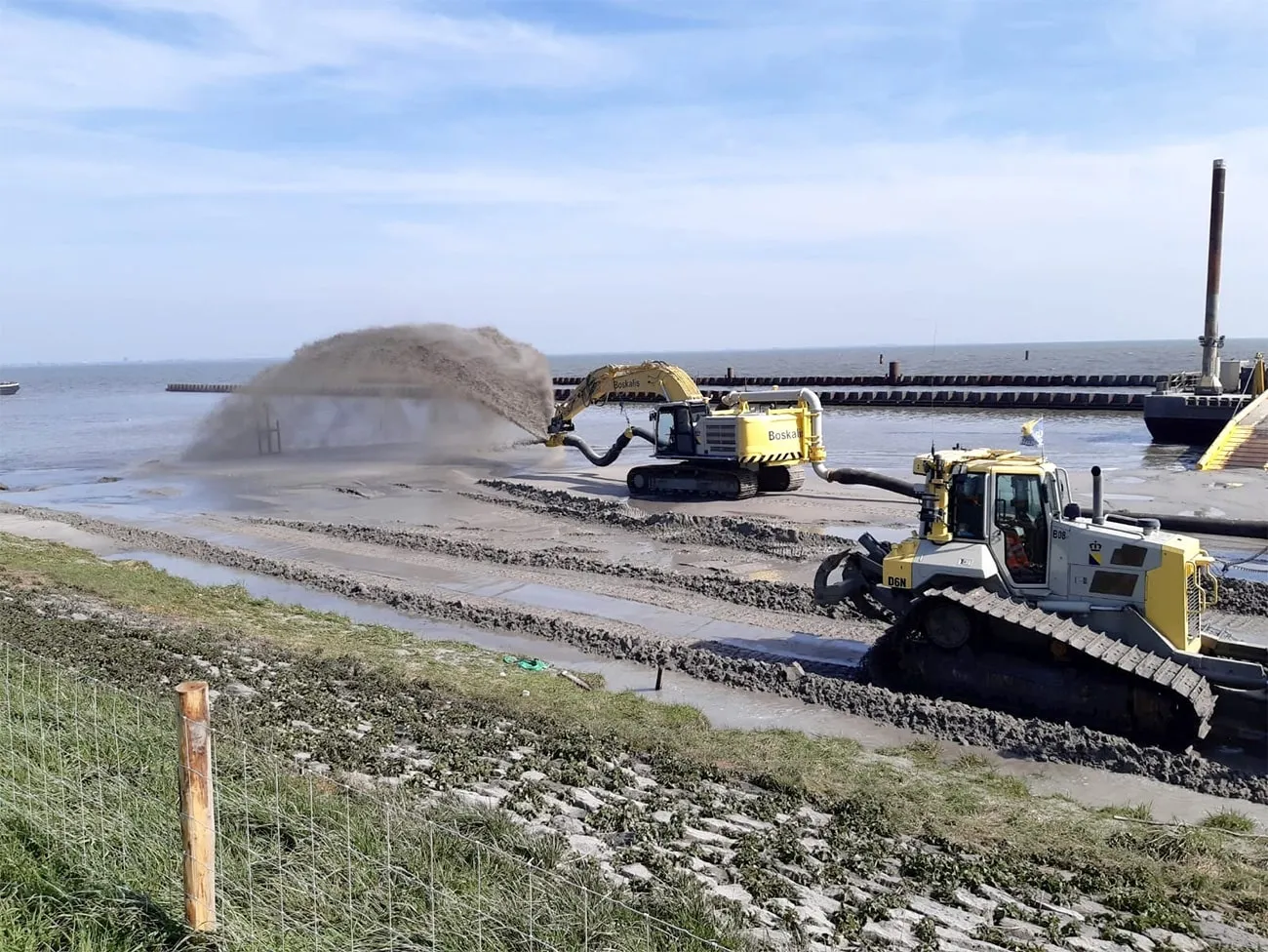
Because of the poor ground conditions, the dikes are being built up in layers. “This allows us to achieve considerable strength even on peat,” Baas explains. “We realised just how sensitive the subsoil is when we were building the unloading jetties. At the start of the project, one of them failed, even though everything had been calculated beforehand. It taught us that we need to be even more cautious when placing fill in successive layers. The sand is therefore sprayed in relatively thin layers from the water. Most of the work is carried out from the temporary access track built along the waterside of the dike. Around 98% of all materials and equipment are transported to and from the site by water, mainly to avoid disturbing the vulnerable hinterland. To make this possible, landing points, known as unloading jetties, have been built, along with several shipping channels in the Markermeer to allow large equipment to reach the dike.”
Opportunities to combine works
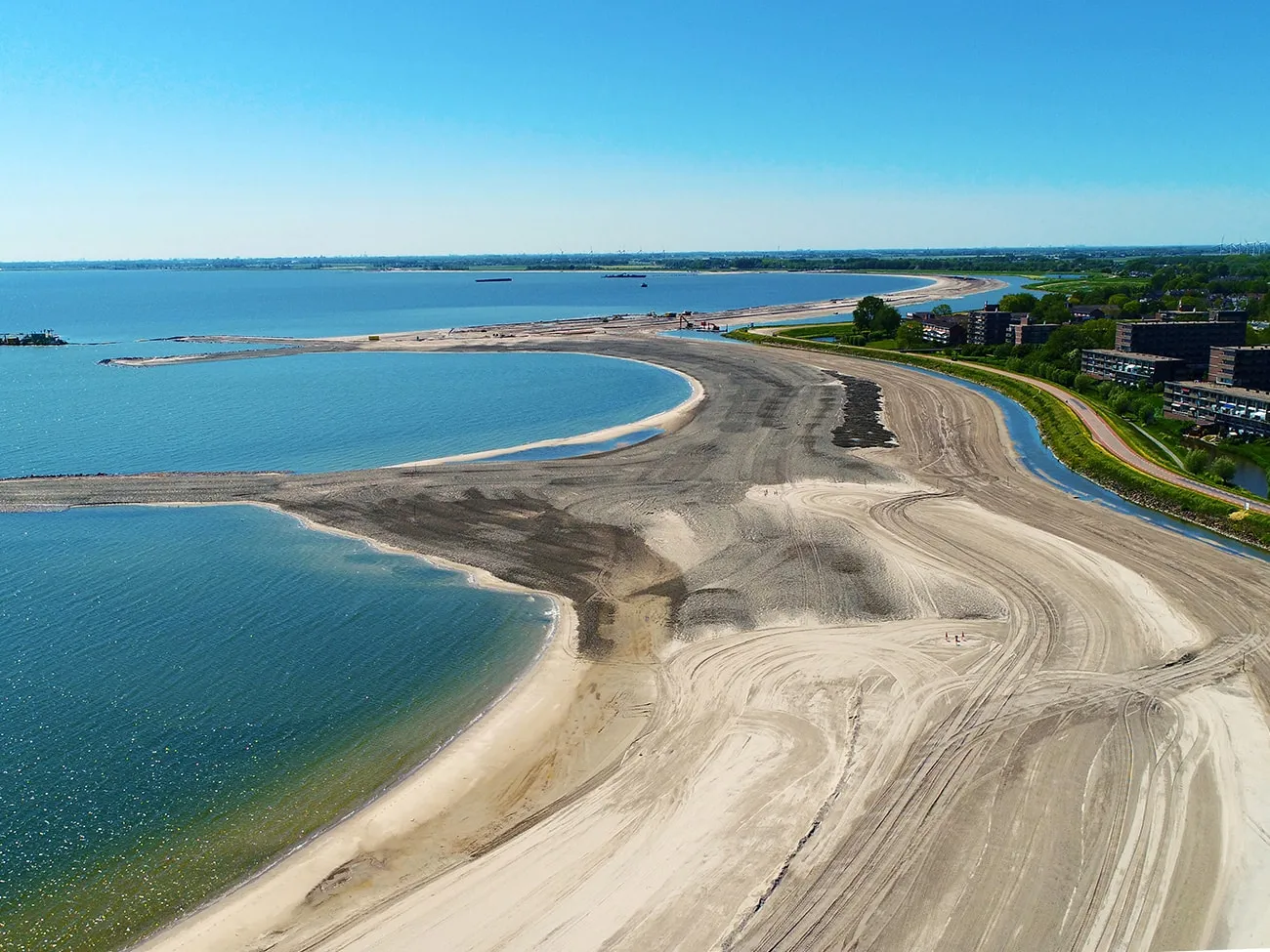
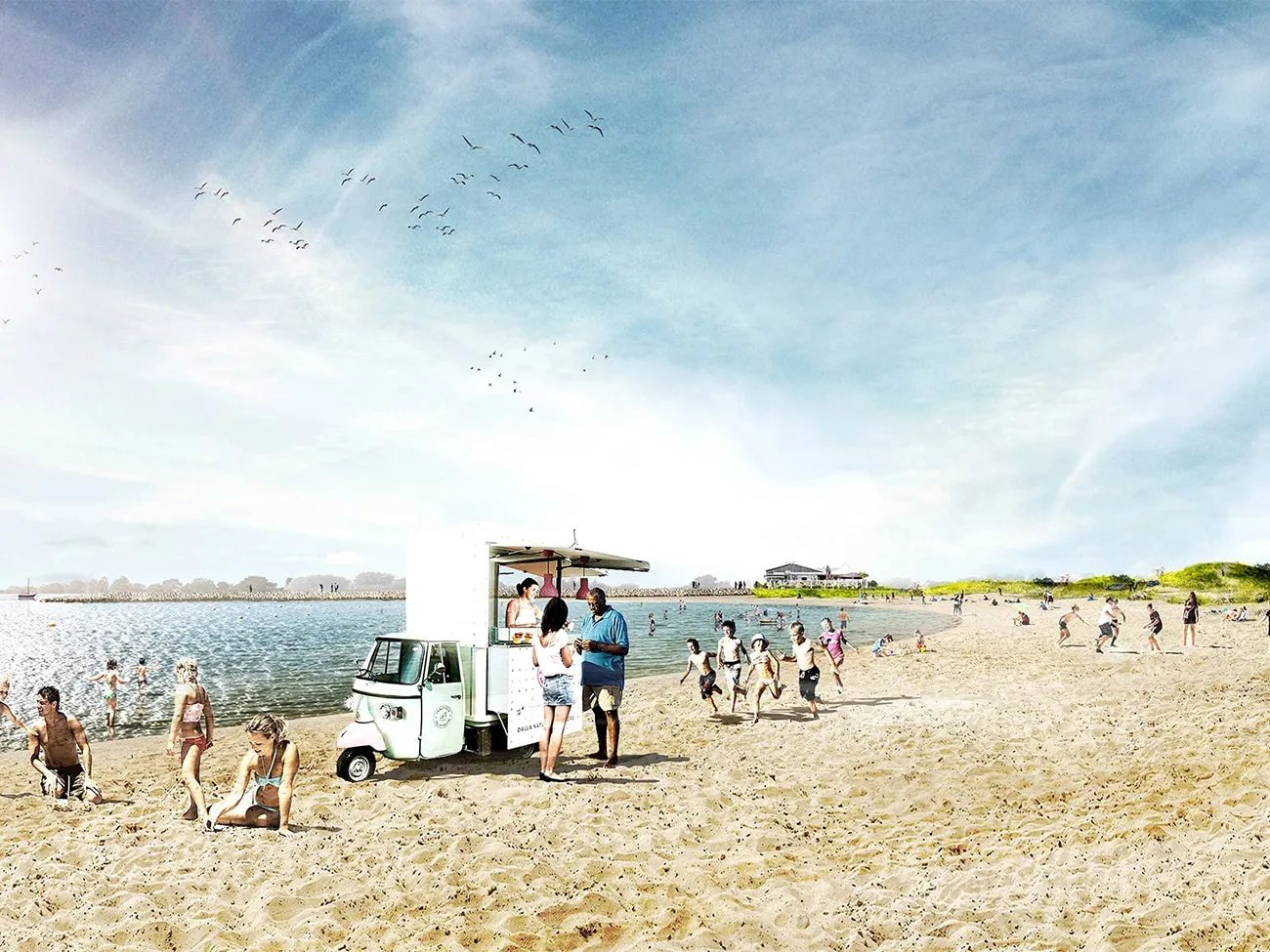
Each of the sixteen sections has its own approach. “Sometimes we also use a combination of methods,” Baas continues. “In some places, the existing historic dike is being left entirely untouched. In Hoorn, for example, the decision was taken to build a foreshore dike in front of the existing dike to absorb the impact of heavy waves. This also gives us an opportunity to combine works for the municipality of Hoorn. The municipality is investing in a city beach and catering and recreational facilities on part of the new dike. Bridges will link the existing dike to the new one, and there will even be parking spaces on the foreshore dike. Residents were invited to put forward their own ideas for how it should be used. Throughout the preparatory phase, considerable effort was made to keep residents informed along the entire 33-kilometre route. This included everything from public participation meetings to conversations around residents’ kitchen tables. Now that construction is under way, local construction liaison groups give residents the chance to contribute their views on phasing, closures and so on. These meetings are useful. Residents are the eyes and ears of the area.”
Enthusiastic about the partnership
The Alliance is working to a tight schedule to deliver the Markermeerdijken as ‘Dijk Veilig’ in 2027. “The reinforcement programme is funded by the Flood Protection Programme, a partnership between the Association of Water Boards and Rijkswaterstaat. This also means that progress on the project is reported to the House of Representatives,” says Baas. “Despite setbacks, we are still on schedule on site. We continue to see the strength of this unique way of working together. Combining industry knowledge and expertise with knowledge of management and maintenance, decision-making, and legislation and regulations means we can deliver this complex project. As well as creating an effective working process, this enables us to anticipate and respond effectively to changes and setbacks, while limiting additional social
costs as much as possible. All the Alliance partners are very enthusiastic about this partnership. Other parts of the country are already following its example.”
Have a business enquiry for Boskalis Nederland? Get in touch
Who worked on Markermeerdijken
- led consortiumBoskalis NederlandMentioned in Broad foundation expertise for the Markermeerdijken project
- All-round foundation specialistGebr. van ’t HekMentioned in Broad foundation expertise for the Markermeerdijken project
- welding and fabricationLinden StaalbouwMentioned in Broad foundation expertise for the Markermeerdijken project
- engineering consultancyHektecMentioned in Broad foundation expertise for the Markermeerdijken project
- clientHoogheemraadschap Hollands NoorderkwartierIn this story
- Integrated monitoring team (IMT)AMMDMentioned in Managing the risk of damage at the Markermeerdijken
- earthmoving machinery with operatorHuiberts BVMentioned in Cumela contractor at the heart of the dike reinforcement project
- contractorDe Vries & van de WielMentioned in Hopper suction dredger TEXEL unloads more than 3.5 million m3 of sand
- settlement markers and other temporary worksWelding and assembly work (LMW)Mentioned in Special settlement gauges and fencing
- reinforcement supplierSpanberg WapeningMentioned in Integrated design and installation of reinforcing steel
- integrated designStaalis EngineeringMentioned in Integrated design and installation of reinforcing steel
Keep following this
Get an email when a new story is published. No account needed.
- ProjectMarkermeerdijken
- ThemeFlood protection and climate-resilient water management
- SubjectWater infrastructure
- CompanyHoogheemraadschap Hollands Noorderkwartier
- CompanyBoskalis Nederland







