









Markermeer dikes: from sea dike to lake dike
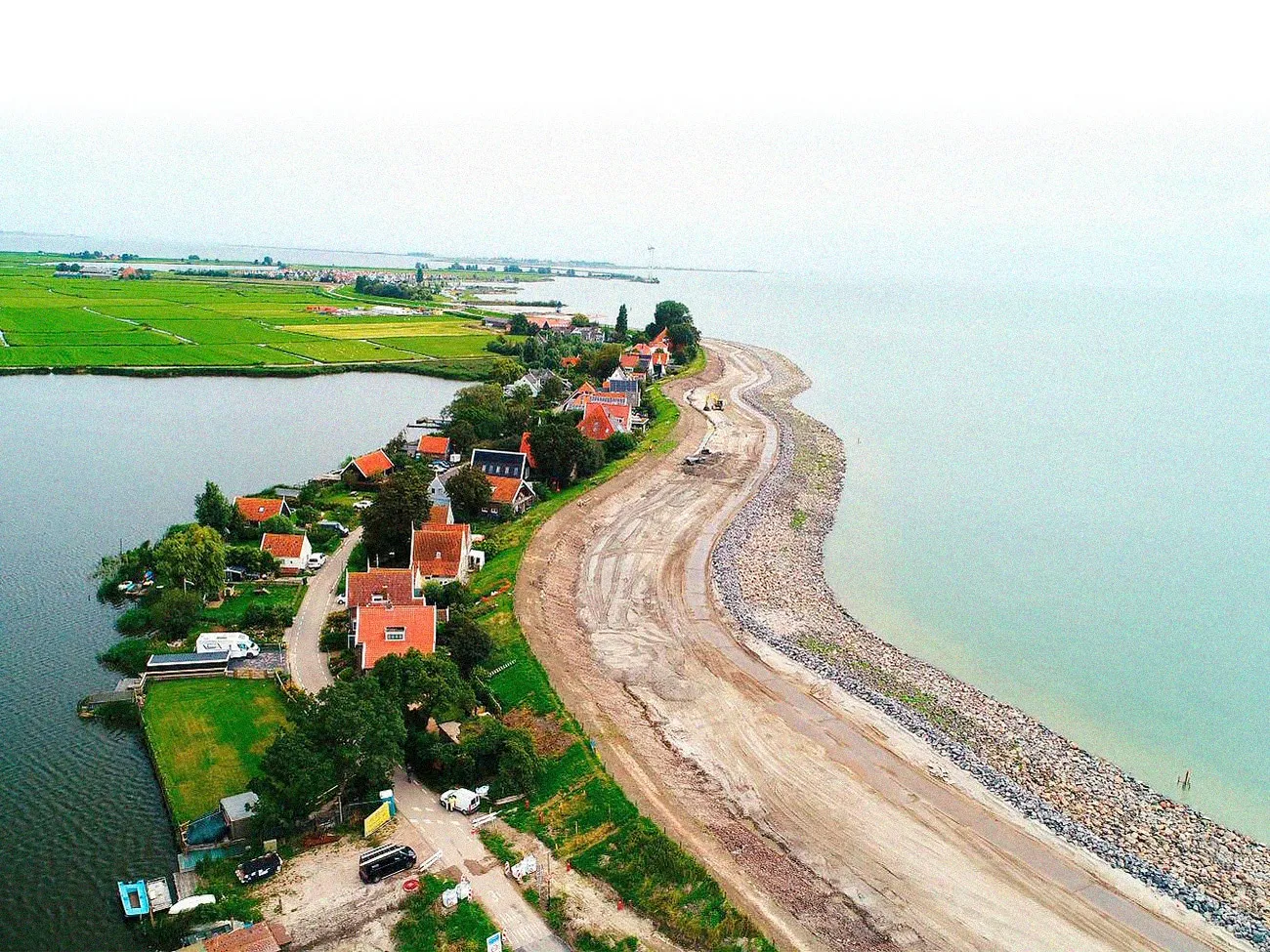
The Markermeer dikes have traditionally been sea dikes. Since the Afsluitdijk was built in 1932, they have effectively become lake dikes. That does not detract from the incredibly important role they play, particularly in the face of the threat posed by the major rivers. According to Rob Veenman, member of the executive board of Hoogheemraadschap Hollands Noorderkwartier, this calls for a profile quite different from that of a typical sea dike. All in all, this is a considerable challenge given the protected heritage status of the Markermeer dikes.
As a member of the executive board of Hoogheemraadschap Hollands Noorderkwartier, Rob Veenman is responsible for water safety and therefore for ensuring that 1.2 million people in North Holland can live, work and enjoy their leisure time below sea level in safety. “Of the 45 kilometres of dike between Hoorn and Amsterdam, 33 kilometres need to be upgraded. That is a long stretch, and its route through both rural and urban areas makes the process complex in terms of spatial planning. Not to mention the incredibly challenging subsoil. This makes the reinforcement task, which is part of the national Flood Protection Programme (HWBP) for dike upgrades, an enormously complex operation.”
Non-traditional procurement approach
The section between Enkhuizen and Hoorn was tackled ten years ago. “Based on that experience, we argued for a different approach for the current section,” says Veenman. “Work is now being carried out from the water wherever possible, to keep disruption to the community to a minimum. Despite the scale of the operation, the impact on local residents has been relatively limited so far. Implementation has also been proceeding with virtually no problems. This is due in part to the unique alliance-based approach to collaboration. In recent years, our water board has gained considerable experience with this non-traditional form of procurement. We have already completed several major projects under the HWBP, including the Hondsbossche en Pettemer Zeewering and the Prins Hendrikzanddijk on Texel. When you recognise that a project is extensive and complex for various reasons, embracing alternative forms of procurement is almost essential. The alliance model, in which public and private parties work together, is working extremely well here on the Markermeer dikes. From the very outset, the knowledge and experience of private-sector parties have provided an important foundation for project planning and delivery.”
Protected heritage status
Although most of the work is being carried out from the water, getting local residents on board was still quite a task, according to Veenman. “Everyone can understand why a sea dike needs to be reinforced. The urgency of reinforcing a lake dike is generally felt much less. It gives rise to a different kind of public debate. We are reinforcing the Markermeer dikes not because of the threat from the sea, but because of the threat posed by the major rivers. Sea dikes are exposed to short periods of ebb and flow and generally have a somewhat steeper profile than most lake dikes. With a lake dike such as the Markermeer dikes, water levels can remain high for a prolonged period. Imagine heavy, prolonged rain in our eastern neighbours and a north-westerly storm at sea. The Maeslant Barrier is closed and water cannot be discharged through the Afsluitdijk. As the rivers carry large volumes of water into our delta, the IJsselmeer and Markermeer fill up. This high-water scenario calls for a very stable dike rather than a steep one. That is why, in most places, we are not raising the dikes but stabilising them on both the landward and water sides. In effect, this means building a different type of dike: a lake dike with the appearance of a sea dike, because of its protected heritage status. That only makes the work more complex.”
As well as transforming the Markermeer dikes into lake dikes, we are also making this a very attractive and socially responsible dike project. “Projects covered by the HWBP must be delivered in a sober and efficient manner,” Veenman acknowledges. “However, at Hoogheemraadschap Hollands Noorderkwartier, we pay close attention to aspects beyond water management that have wider social value. This has led to some excellent opportunities to combine works, including extensive scope for nature development and the preservation of cultural heritage, as well as the construction of cycle paths, recreational facilities and a proper urban beach at Hoorn. And we are very proud of that,” Veenman concludes.
Question about this story? Ask your question
Who worked on Markermeerdijken
- led consortiumBoskalis NederlandMentioned in Broad foundation expertise for the Markermeerdijken project
- All-round foundation specialistGebr. van ’t HekMentioned in Broad foundation expertise for the Markermeerdijken project
- welding and fabricationLinden StaalbouwMentioned in Broad foundation expertise for the Markermeerdijken project
- engineering consultancyHektecMentioned in Broad foundation expertise for the Markermeerdijken project
- clientHoogheemraadschap Hollands NoorderkwartierMentioned in A complex technical challenge calls for a unique partnership
- Integrated monitoring team (IMT)AMMDMentioned in Managing the risk of damage at the Markermeerdijken
- earthmoving machinery with operatorHuiberts BVMentioned in Cumela contractor at the heart of the dike reinforcement project
- contractorDe Vries & van de WielMentioned in Hopper suction dredger TEXEL unloads more than 3.5 million m3 of sand
- settlement markers and other temporary worksWelding and assembly work (LMW)Mentioned in Special settlement gauges and fencing
- reinforcement supplierSpanberg WapeningMentioned in Integrated design and installation of reinforcing steel
- integrated designStaalis EngineeringMentioned in Integrated design and installation of reinforcing steel
Keep following this
Get an email when a new story is published. No account needed.
- ProjectMarkermeerdijken
- SubjectRoad construction







