









Flame barriers protect underside of service walkway in the event of a fire
Text Roel van GilsImage Van der Aa Brandwerende applicaties
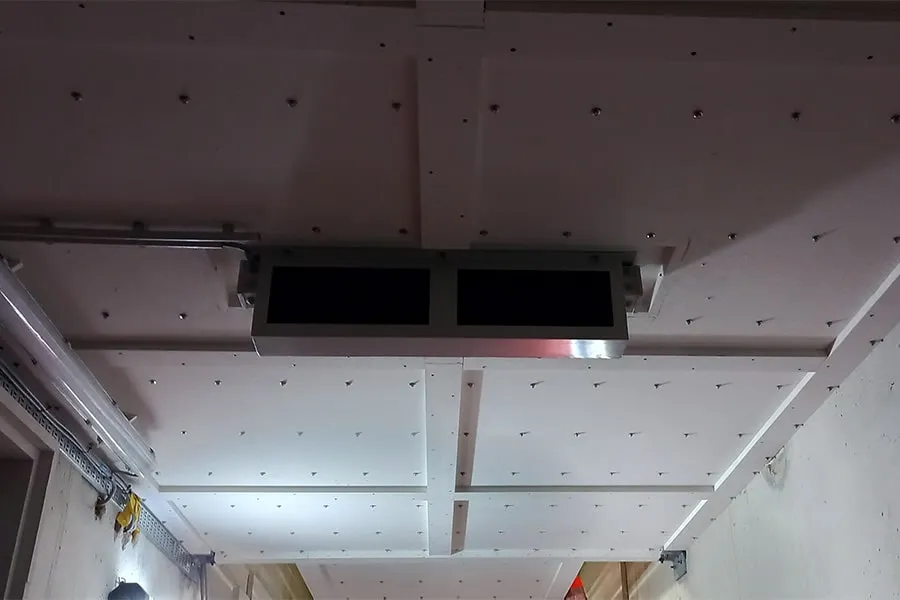
To ensure that the service walkway in the central tunnel duct of the Rottemerentunnel on the A16 Rotterdam remains intact in the event of a fire, Van der Aa Brandwerende applicaties has installed flame barriers at the 21 emergency exits. Given the repetitive nature of the work, the fire protection specialist supplied as many of the barriers as possible prefabricated from its workshop in Waalwijk.
Van der Aa has years of experience in engineering, supplying and installing fire protection systems. “We were asked by the De Groene Boog construction consortium to fit a flame barrier beneath the service walkway, which is made of steel grating, behind the 21 emergency exits in the central tunnel duct. The barrier must remain intact for 120 minutes in the event of a fire,” says Bart van der Rijt, project manager at Van der Aa brandwerende applicaties. “This means 10 metres to the left and 10 metres to the right of each emergency door in the central tunnel duct between the two tunnel tubes. The service walkway carries all the tunnel’s cables and control systems. The flame barriers are intended to keep the walkway intact so that the tunnel can quickly return to operation after any incident.”
Made-to-measure, easy-to-handle packages
Van der Aa was responsible for both the engineering and installation of the 21 flame barriers. “We first built a mock-up of our proposed design, consisting of Promatect-T boards fitted to a self-supporting frame beneath the grating. The main advantage of the mock-up was that the client could inspect the design in advance, and we could make adjustments where necessary. So everything was ready before work began,” says Bart. “Given the repetitive nature of the work, the dimensions of the central tunnel duct are practically identical at all 21 locations, so we prepared as much as possible off site. This cut down considerably on sawing and drilling, and therefore on dust in the tunnel. Supplying made-to-measure, easy-to-handle packages for each location significantly reduced installation time on site. It also made logistics much easier. Thanks to this thorough preparation, installation went smoothly. We were able to follow De Groene Boog’s schedule and ‘conveyor-belt’ sequence of work very closely.”
Question about this story? Ask your question
Who worked on Rottemerentunnel
- construction consortiumDe Groene BoogMentioned in Reinforcement steel for the Rottemeren Tunnel’s underwater concrete floor
- reinforcing steelBCS (Buig Centrale Steenbergen)Mentioned in Reinforcement steel for the Rottemeren Tunnel’s underwater concrete floor
- fire-resistant boardsPromatMentioned in Fire-resistant boards offer the new Rottemerentunnel optimal protection
- De Groene Boog construction consortium
 MobilisMentioned in Focus on fit-out works in the Rottemeren Tunnel
- lining walls and slatted claddingAldowaMentioned in Concrete structure ‘wrapped’ in aluminium acoustic screens and louvre cladding
- architectQWA-architectenMentioned in Concrete structure ‘wrapped’ in aluminium acoustic screens and louvre cladding
- installationKaeferMentioned in Rottemerentunnel concrete structure protected with fire-resistant cladding
- fire protection applicationsVan der Aa Brandwerende applicatiesIn this story


Keep following this
Get an email when a new story is published. No account needed.
- ProjectRottemerentunnel
- ThemeMaterials and techniques for infrastructure
- SubjectUnderground infrastructure
- CompanyVan der Aa Brandwerende applicaties







