









‘Berend Botje’ can keep sailing as usual
The De Groene Boog construction consortium, comprising BESIX, Dura Vermeer, Van Oord, TBI companies Mobilis and Croonwolter&dros, Rebel and John Laing, is delivering the A16 Rotterdam project on behalf of Rijkswaterstaat. The new A16 Rotterdam will be an 11-kilometre, energy-neutral trunk road between the A16/A20 at Terbregseplein and the A13 at Rotterdam The Hague Airport.
Smart construction of the Rottemeren Tunnel keeps the Rotte open
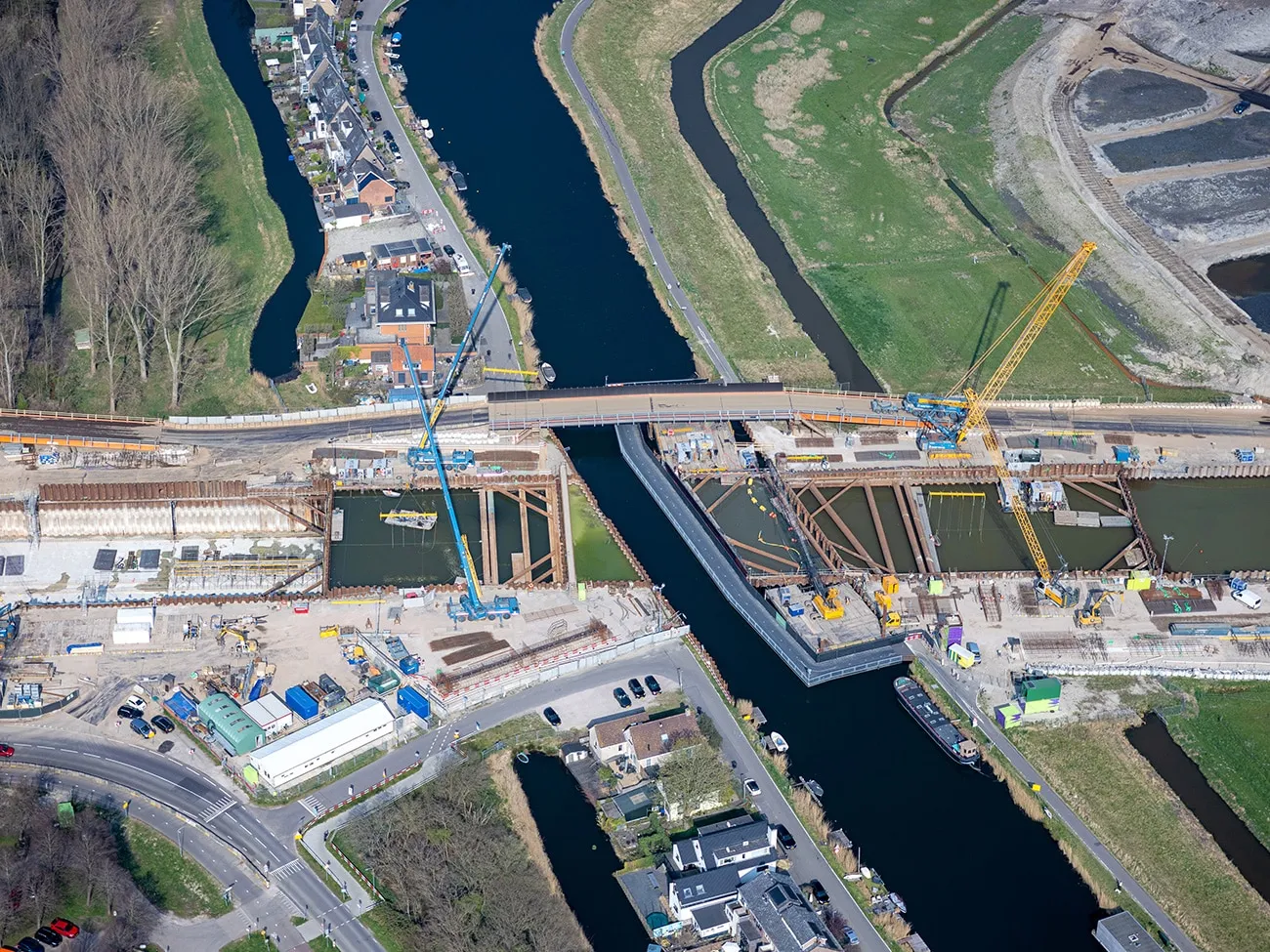
The project includes construction of the Rottemeren Tunnel, an impressive structure covered in issue 6 of this magazine late last year. The tunnel passes beneath the Rotte river near Rottekade. De Groene Boog is working there in a confined space, right under the watchful eyes of local residents. A sound design, a watertight plan and plenty of craftsmanship are ensuring the job gets done. Project coordinator Remco Berkelaar (BESIX) and structural engineer Didier Droogné (BESIX) give us a behind-the-scenes look.
Working in phases
“A major challenge in designing the Rottemeren Tunnel as a whole is phasing the different stages of construction,” Didier explains. “At Rottekade, the tunnel has to cross beneath the Rotte, while a section of the river must remain open to boat traffic at all times, during every stage of construction.” The Rotte also carries away the water pumped out of the site. Remco says: “Two years ago, we began with the first mitigation measure: installing sheet piles to reinforce the dykes. This addressed one of the main risks identified by Rijkswaterstaat and the Schieland and Krimpenerwaard Water Authority: preventing potential dyke failure.”
The work is split into two half-width closures of the Rotte to keep the navigation channel open. Remco says: “First, we installed the piles in the Rotte (for both halves), then the sheet piling for one
half (the cofferdam).
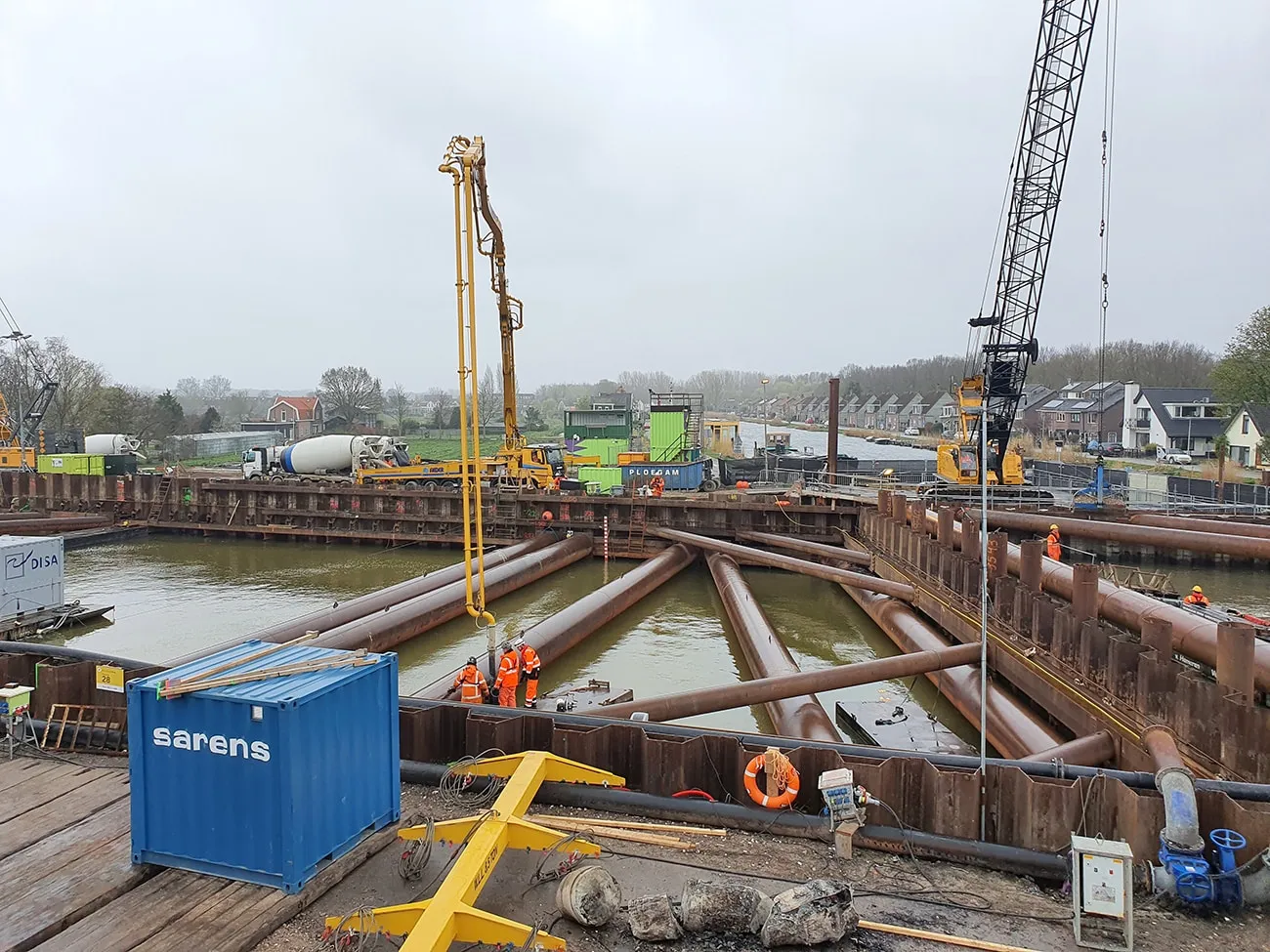
Because the tunnel lies deeper beneath the Rotte and the Water Authority has stringent requirements for the protection zone, the cofferdams around the Rotte are fitted with anchors and strut frames. Our excavation work goes deeper than elsewhere along the tunnel, to around 14 metres below NAP. The tunnel descends further into the ground here than it does elsewhere.” Didier adds: “We are building the southern section first, followed by the northern section. Once the tunnel sections are connected, the Rotte will be restored to its full width.”
- One option was selected from all the possible phasing arrangements
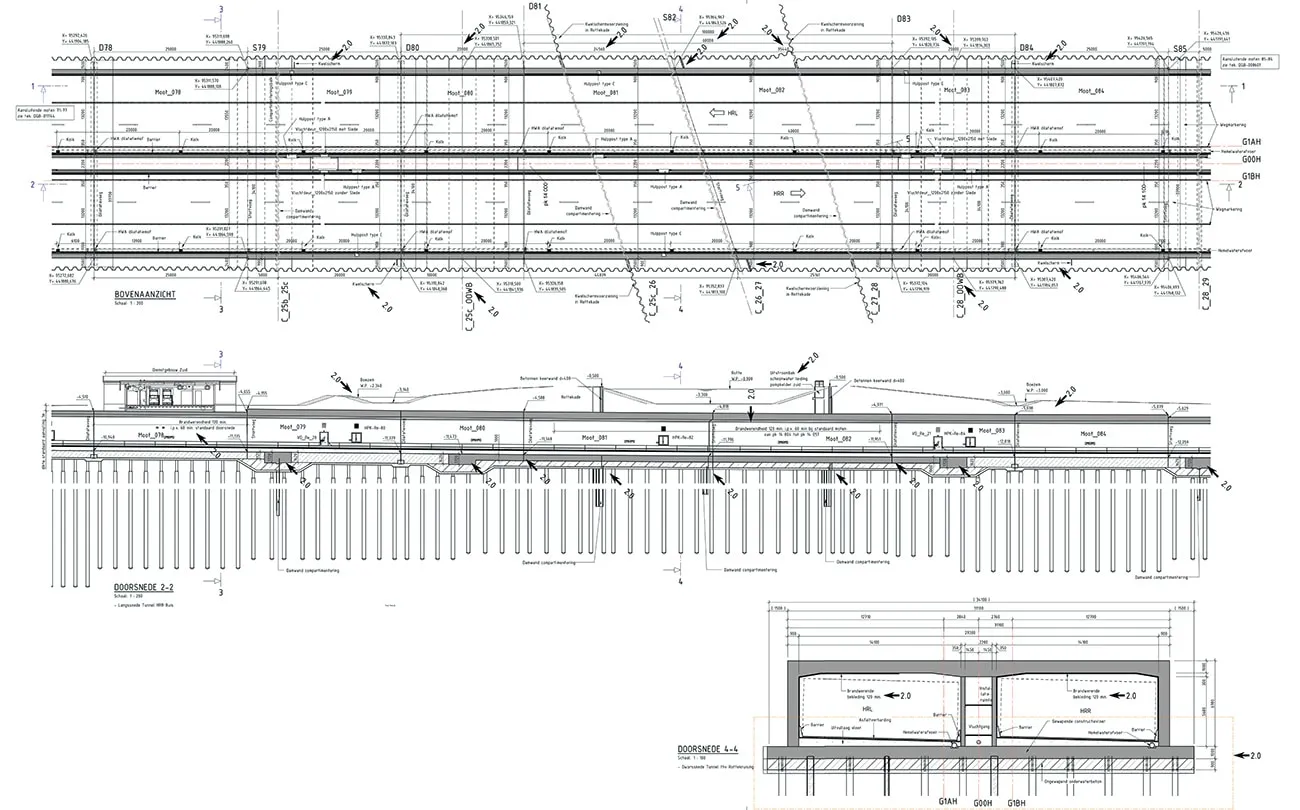
Didier continues: “It was a difficult design. The requirements for the sheet-pile design were stringent, to prevent settlement. The houses are close to the cofferdam. We selected the best option from all the possible phasing arrangements. Rottebandreef also had to be realigned during the phasing, so a temporary bridge was built. Coordinating the work is quite a feat. Each phase has a different load configuration. We mapped all the effects in detail in advance and accounted for them in the design.”
Unreinforced underwater concrete
Unlike the rest of the tunnel, which uses reinforced underwater concrete, the tunnel section beneath the Rotte will have an unreinforced underwater concrete floor. “That is due in part to the angle at which the tunnel crosses the Rotte and the various construction phases within a small work area,” Remco explains. “Using reinforced underwater concrete there would have been too risky. So we are relying more on traditional unreinforced underwater concrete.” Didier adds: “Leka piles and traditional underwater concrete work well. The challenge lies in considering the effects of using two different types of piles and floors, as well as the position of the expansion joints. But everything has been coordinated through several design iterations.”
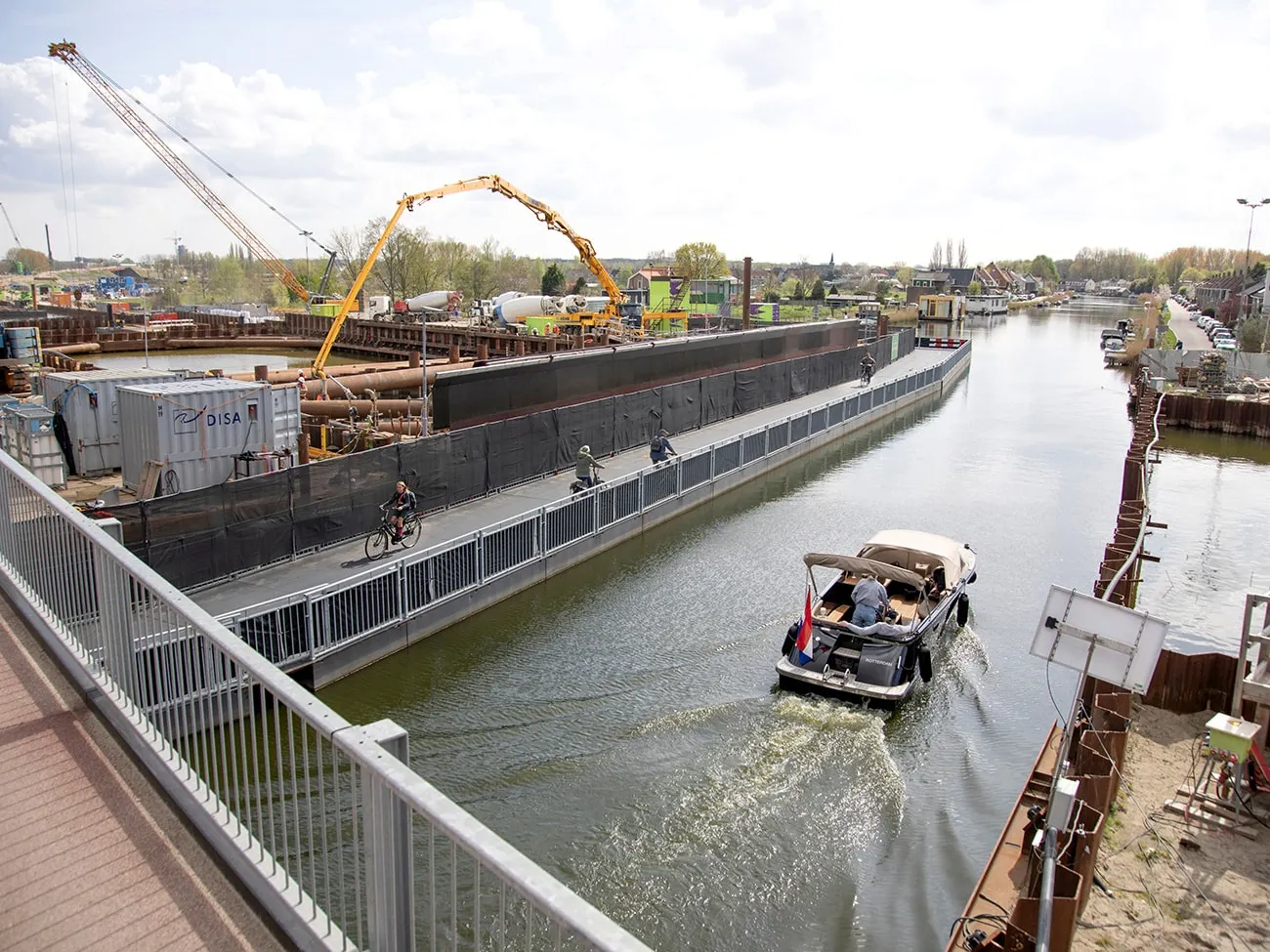
In the tender phasing plan, Bergse Linker Rottekade followed a winding route over cofferdam 29. “To speed up the work and give cyclists plenty of room, we created a cycle path along the cofferdam using a pontoon bridge,” Remco explains. “The first underwater concrete pours for the tunnel floors took place in this section. One or two weeks after pouring, we pump the cofferdam dry. Then we can continue building the tunnel. First, we lay a structural floor with reinforcement on top of the underwater concrete. We then build the tunnel sections using traditional formwork for the walls. We pour the walls first, one tunnel section at a time. The roof is built using traditional support from Safe, following the walls in sequence.”
Changing over
Once the tunnel has been built halfway across the Rotte, a temporary strut structure is installed between the end of the tunnel and the compartment screen in the Rotte. “We then build a permanent retaining wall along the bank to protect it. A temporary retaining wall is also installed at the end of the tunnel, after which we remove the longitudinal sheet piles. This creates a mini-cofferdam in the Rotte, where the tunnel connection will come out,” says Remco. “We then install sheet piles in the second section of the Rotte and build the second cofferdam in the same way. The compartment screen is then cut off, and we can connect the tunnel sections on either side.”
For both men, the project presents an interesting design challenge, but all the work required near the Rotte makes it even more demanding. “We enjoy challenges like these. You see in practice that what we came up with really works. But some circumstances make it especially unusual: space is limited, and the houses are close to the cofferdam. Once everything is complete, we can look back on a job that should really have been ‘business as usual’, but which the circumstances made quite special,” Didier concludes.
Have a business enquiry for BESIX Nederland BV? Get in touch
Who worked on Rottemerentunnel
- construction consortiumDe Groene BoogMentioned in Reinforcement steel for the Rottemeren Tunnel’s underwater concrete floor
- reinforcing steelBCS (Buig Centrale Steenbergen)Mentioned in Reinforcement steel for the Rottemeren Tunnel’s underwater concrete floor
- supportSafeIn this story
- fire-resistant boardsPromatMentioned in Fire-resistant boards offer the new Rottemerentunnel optimal protection
- De Groene Boog construction consortium
 MobilisMentioned in Focus on fit-out works in the Rottemeren Tunnel
- lining walls and slatted claddingAldowaMentioned in Concrete structure ‘wrapped’ in aluminium acoustic screens and louvre cladding
- architectQWA-architectenMentioned in Concrete structure ‘wrapped’ in aluminium acoustic screens and louvre cladding
- installationKaeferMentioned in Rottemerentunnel concrete structure protected with fire-resistant cladding
- fire protection applicationsVan der Aa Brandwerende applicatiesMentioned in Flame barriers protect underside of service walkway in the event of a fire


Keep following this
Get an email when a new story is published. No account needed.
- ProjectRottemerentunnel
- SubjectNews
- CompanyBESIX Nederland BV
- CompanySafe
- CompanyVan Oord
- CompanyMobilis
- CompanyCroonwolter&dros







