









Sustainable steel
Text Roel van GilsImage ArcelorMittal
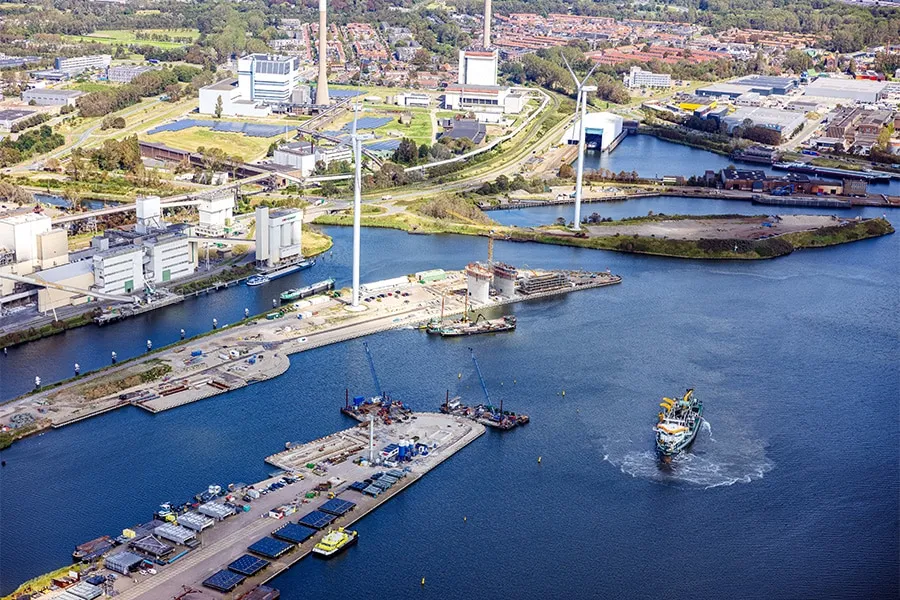
Around 9,500 tonnes of steel sheet piles, combi-walls and tubular piles are required to build the Selectieve Onttrekking at the IJmuiden sea lock. Van Hattum en Blankevoort and ArcelorMittal entered into a partnership at an early stage to supply the steel, some of which will also be used temporarily. Using combi-walls in temporary works is fairly unusual and, above all, exceptionally sustainable.
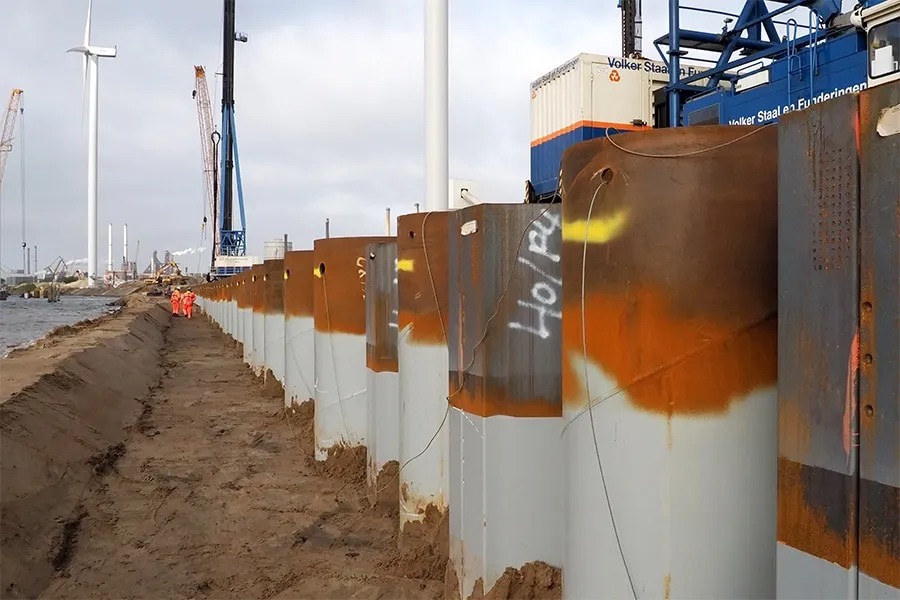
The IJmuiden lock complex is familiar territory for ArcelorMittal, too. The steelmaker previously supplied steel for the construction of the world’s largest sea lock. “The Selectieve Onttrekking is at least as remarkable for us, not only because of the volumes involved, but also because of the collaboration and contract negotiations during a period of sharply fluctuating prices,” says Patrick Mulders, Technical Sales Manager at ArcelorMittal. “We have already delivered a number of combi-walls in various sizes, with sections ranging from 1020 to 1620, around 6,600 tonnes of tubular piles and a further 2,800 tonnes of sheet piles. All in different phases.”
Sheet piles made from scrap
According to Patrick, the main challenge was the tight schedule between final design, production and delivery. “During the preparatory phase, considerable attention was devoted to finalising the design. As a result, we had to move quickly on production. That is not a problem given the size of our organisation, but it still has to be managed properly.” All the sheet piles (AZ sections) were made from scrap in the electric arc furnace at ArcelorMittal’s plant in Luxembourg. “So it is all recycled steel, including the heaviest AZ 52-700 section,” Patrick stresses. “The sections have also been weight-optimised, resulting in further CO2 savings. Sustainability is often measured per tonne, after all. The lower the weight, the lower the CO2 emissions.”
Lock indicator
The 6,600 tonnes of tubular piles for the Selectieve Onttrekking were supplied from the production site in Dintelmond. “Most of these were newly produced, with a small proportion added to stock to enable faster delivery,” Patrick explains. To verify that the combi-wall had been installed correctly, ArcelorMittal fitted a number of tubes with its in-house-developed Dixeran lock indicator system. “Locks are welded to the tubular piles and, together with the sheet pile sections fitted later, form the combi-wall. At the bottom of some of the locks is the indicator, which is simply a pin through the tube and lock, attached to a sensor. The sensor’s wiring runs up through the tube. The sensor is connected to a control box. When the sheet pile reaches the required depth and is correctly installed, the pin breaks and the sensor sends a signal upwards. Dixeran is therefore a reliable, discontinuous monitoring system for checking whether the sheet pile has slipped out of the lock. However, it does not indicate the height at which any gap in the lock occurs. To make this easier to check, ArcelorMittal has also developed a continuous system using proximity switches, called AM-SIS. This latter system has been extensively tested for reliability and is now also being used on projects.”
In-house coating facility
ArcelorMittal has had its own coating facility in Dintelmond for around three years. “By coating in-house, we can optimise our logistics and make our production process more sustainable,” Patrick rightly points out. “For the Selectieve Onttrekking, we coated the top 3 metres of all the sheet piles and tubular piles.” What makes the project unique, finally, is that not only will the sheet piles be extracted at the end of the project, but so will the section of combi-wall used for the construction pit. “Only the bottom 10 metres will remain in place; the rest will be cut off and can be reused. Combi-walls are not often used temporarily.” Patrick expects this to become more common in future for sustainability reasons.
Een zakelijke vraag aan ArcelorMittal Projects Europe B.V.? Get in touch
Who worked on Selectieve Onttrekking
- construction companyVan Hattum en BlankevoortMentioned in An innovative project for water quality and safety
- main contractorVan Hattum BlankevoortMentioned in Offshore diving experience proves invaluable on Selective Extraction project
- temporary steel structures
 Marsé MontageMentioned in Versatile specialist in steel temporary works presses ahead on the Selective Withdrawal
- lifting cushion and bearing
 TrelleborgMentioned in Trelleborg devises ingenious solution for Selective Extraction IJmuiden Sea Lock walls


Keep following this
Get an email when a new story is published. No account needed.
- ProjectSelectieve Onttrekking
- ThemeUnderground construction
- SubjectWater infrastructure
- CompanyArcelorMittal Projects Europe B.V.







