









A modern take on a proven concept
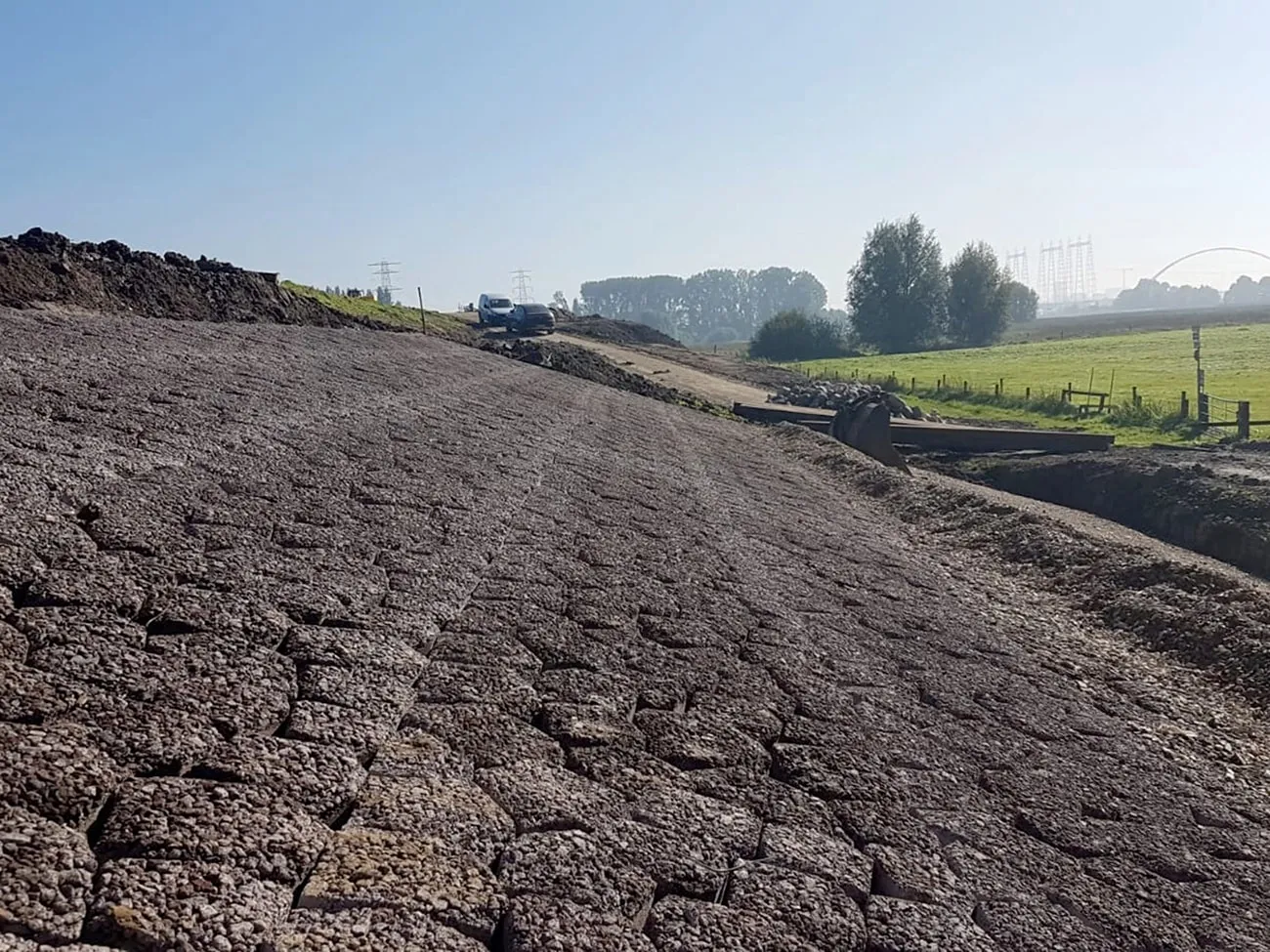
Until the late 1970s, basalt was the go-to material for protecting dykes and coastlines against erosion. At the request of Rijkswaterstaat, Holcim Coastal developed a concrete version of this proven concept in 1976: Basalton®. Unlike the traditional natural-stone version, Basalton can be installed mechanically. It has a similarly authentic appearance and offers good interlocking, resulting in excellent stability. Over the years, Holcim has continued to develop the product. For example, a version with an eco-friendly surface layer is being used for the Wolferen-Sprok dyke reinforcement project. A few years ago, the Basalton Quattroblock was also launched, the most stable block revetment currently available.
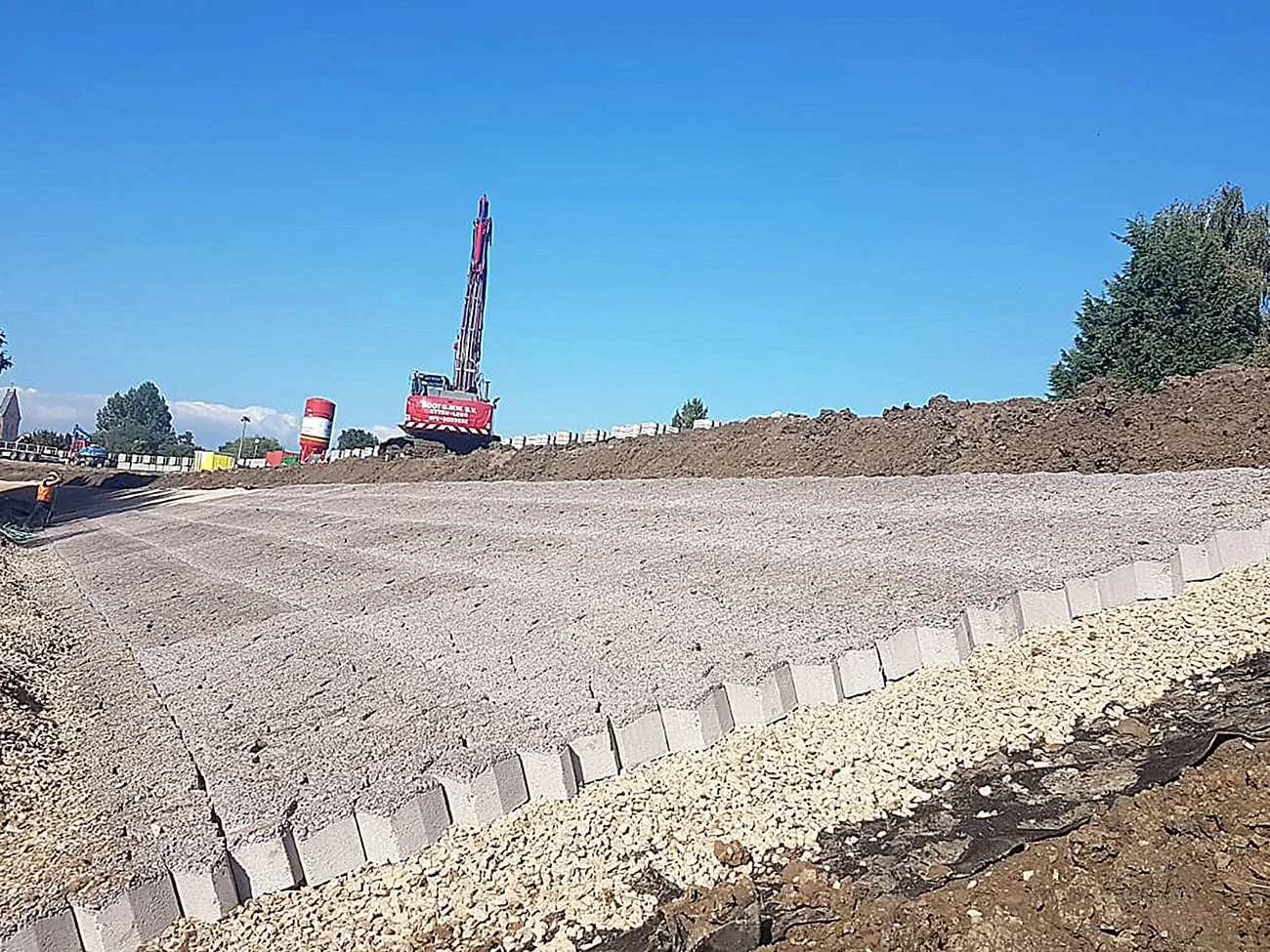
“When a dyke specification calls for block revetment, Basalton is often included as standard in the tender,” says Jean-Pierre Quataert of Holcim Coastal. “Waterschap Rivierenland is also keen to use Basalton on its dykes. For the Wolferen-Sprok project, we are supplying around 25,500 m² in total to the De Betuwse Waard joint venture, in several phases. We supplied 3,500 m² last year, 14,000 m² is scheduled for this year, and a further 8,000 m² for next year. These days, 98% of Basalton is transported directly from our production site in Alphen aan den Rijn to the site by ship. The products are then delivered straight to the crane, ready to be installed on the dyke slope. All this helps to keep the environmental cost indicator (MKI) as low as possible and maximise CO2 reductions.”
Polygonal pattern
Holcim Coastal’s modern Basalton revetment is available in several versions. At Wolferen-Sprok, the STS version was selected. It consists of a set of 18 concrete columns of various sizes, laid in a polygonal pattern and installed mechanically in a single operation. “This creates an extremely stable revetment on the dykes,” says Quataert. “The rough surface layer of lava stone, with 50 per cent void space, encourages the development of micro-organisms and allows plants and weeds to take hold more quickly, creating a natural, green surface. Despite Basalton’s low profile, we can guarantee stability for 50 to 100 years, whereas much taller natural-stone columns were previously needed.” With a view to further improving sustainability, the Basalton Quattroblock was developed. This much more stable block requires significantly less concrete. “It is also much easier to install, using a standard sorting grab.”
The Basalton Quattroblock was launched in late 2018, and its story reads like a boy’s own adventure. “Immediately after the launch, we won the biggest dyke block-revetment project ever awarded in the Netherlands. Over the coming years, we will supply no less than 700,000 m² for the reconstruction of the Afsluitdijk. It is a fantastic reward for this unique product, which is also the most stable block revetment currently available.” Holcim Group has taken notice of its success in the Netherlands. The head office in Switzerland is currently investing heavily in smarter design, such as the Basalton Quattroblock, and smarter materials, such as bioreceptive and CO2-free concrete, to make coastal and river areas safer and more sustainable.
Question about this story? Ask your question
Who worked on Dijkversterking Wolferen Sprok
- construction consortiumDe Betuwse Waard construction consortiumIn this story
- anchoring of the steel sheet pile wallDe Vries TitanMentioned in Expertise required to install grout injection anchors
Keep following this
Get an email when a new story is published. No account needed.
- ProjectDijkversterking Wolferen Sprok
- ThemeMaterials and techniques for infrastructure
- SubjectSpecials
- CompanyDe Betuwse Waard construction consortium







