









Van Aalsburg supplies and ties fascine mattresses for scour protection along the Afsluitdijk
Text Susan Peek Beeld Waterbeeld/Levvel/Rijkswaterstaat
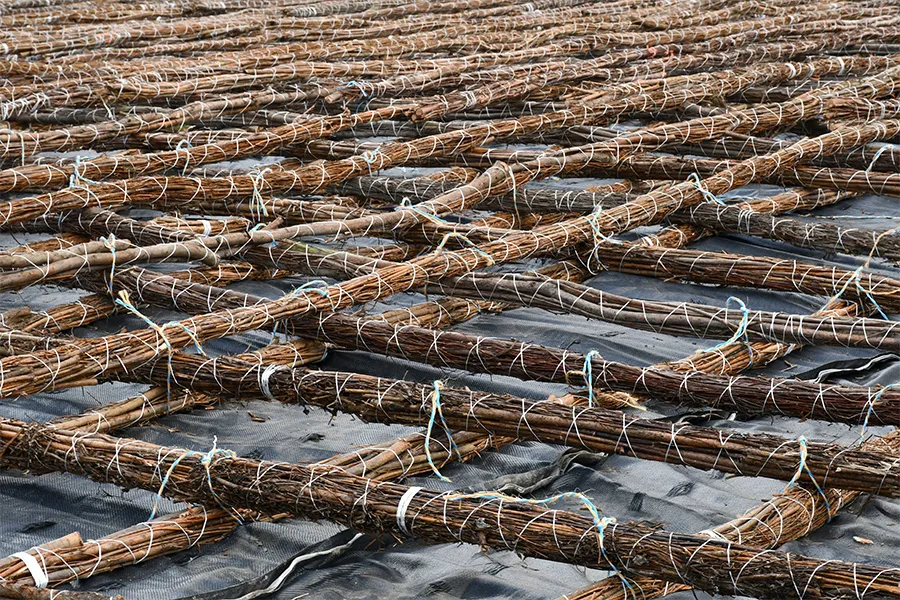
Commissioned by construction consortium Levvel, which is carrying out the reinforcement and renovation works on behalf of Rijkswaterstaat, Van Aalsburg supplied and tied fascine mattresses to protect the seabed around the Afsluitdijk. A fascine mattress consists of bundles of intertwined willow rods, tied together in a grid to form mats.
Fascine mattresses with geotextile
“Around 45,000 m2 of fascine mattresses have been used here to provide robust seabed protection,” says Dick van Aalsburg. “The fascine mattresses used here consist of a fascine grid made up of two or three layers of fascines, spaced 1 metre apart centre to centre. A PP60L geotextile was laid underneath, with a nonwoven layer of 600 and 900 grams per m2 below that. This is the first time such a heavy geotextile has been used beneath fascine mattresses.”
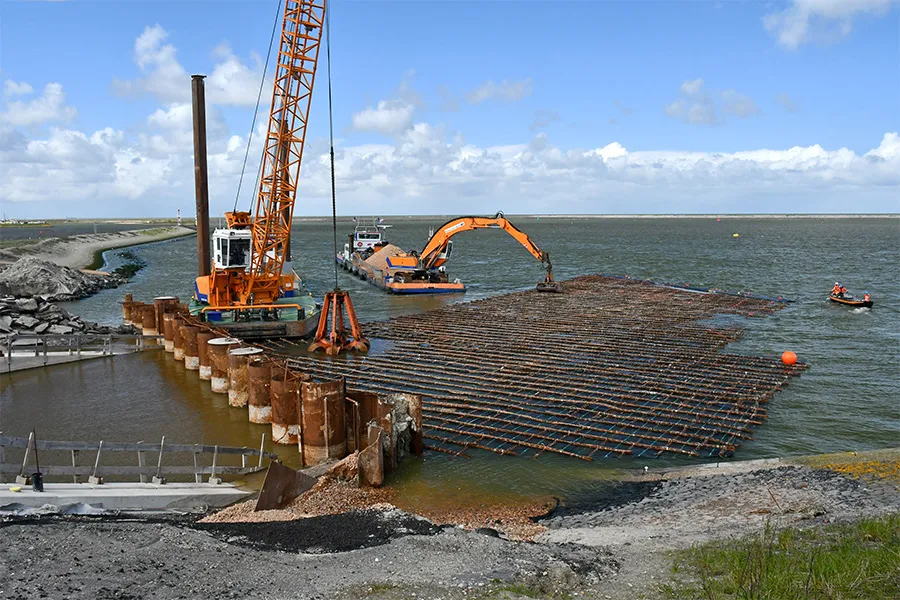
Input during planning and construction
Van Aalsburg’s many years of experience proved valuable during the planning stage and construction. “We provided input in advance on how many layers of fascines the fascine mattress structure should comprise and which geotextile should be used. The structure was manufactured on the basis of drop tests carried out late last year by knowledge platform CROW and Rijkswaterstaat, and the resulting report Erratum. This means we can be sure the fabric is strong enough to prevent damage from the rock armour used. We then worked with Van Oord, part of construction consortium Levvel, to determine the best way to install the fascine mattresses for this specific project.” Van Aalsburg drew up the installation plan, while Van Oord was responsible for installation and sinking. The fascine mattresses are connected to a sinking beam and towed into position by a crane vessel. They are then lowered to the seabed using winches and sinking stones, after which a layer of rock armour is placed on top to stabilise them.
Long-lasting protection
Fascine mattresses have been made using traditional methods for more than a century and last for many years, sometimes as long as a hundred years. “This has been demonstrated by excavations carried out at the Afsluitdijk by Van Oord and Rijkswaterstaat,” says Dick, explaining that the excavations uncovered traditional fascine mattresses, without geotextile, whose structure was still intact. SHR, a testing and knowledge partner for the construction industry and construction-related products, examined the condition of the fascines after they had been in service for a long time. “It is good to use nature to protect nature, and to know that our fascine structures will last for a long time,” Dick concludes.
A business enquiry for Van Aalsburg BV? Get in touch
Companies in this story


Keep following this
Get an email when a new story is published. No account needed.
- ThemeFlood protection and climate-resilient water management
- SubjectWater infrastructure
- CompanyVan Aalsburg BV
- CompanyVan Oord







