









Six domes with a distinctive structure for the pumping station on the Afsluitdijk
Text Suzanne van Gaale Beeld Waterbeeld/Levvel/Rijkswaterstaat
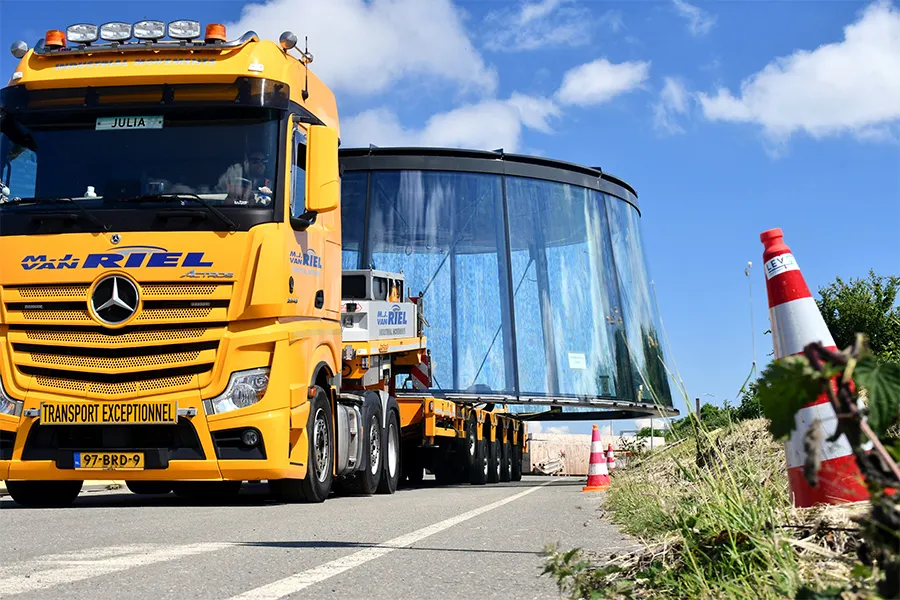
The task of designing six domes for the pumping station at Den Oever that must both meet Rijkswaterstaat’s guidelines for the design of civil engineering structures and withstand the superstorm that could occur once in 10,000 years is quite something. The stringent requirements, combined with the use of glass, aluminium and steel, presented a number of challenges.
To give an idea of the scale of the six domes, here are a few figures. Each dome is 8.7 metres in diameter, 4 metres high and weighs 30 tonnes. The structure is made from three different materials: aluminium, glass and steel. “Levvel (the construction consortium comprising BAM, Van Oord, Rebel and Invesis) gave us the overall contract to design, manufacture and install the domes,” explains Jorrit de Bie, project manager at Bersselaar Constructie. “As a company with a background in steel construction, we brought in our partners Glasdesign and Aldowa to manufacture the glass and aluminium panels. We spent more than a year calculating everything in detail. The roof is domed, and the upper ring is smaller than the lower ring. Creating a 7-centimetre-thick glass structure and aluminium panels to fit that shape is highly unusual. There are also always tolerances when designing anything circular, whether it is made of glass, steel or aluminium. The structure therefore has to be designed to accommodate the expected tolerances. The structural engineers and designers carried out all the necessary calculations.”
Working separately
Once the design had been worked out in sufficient detail to meet the structural requirements and withstand the forces of a superstorm, the three parties began manufacturing their respective components separately. “That is another thing that makes this project special. Even when you know it works on paper, it is still nerve-racking when all the components have to be assembled into one structure.” Manufacturing the individual components required a great deal of precision. “Just consider the 7-centimetre-thick glass. Rolling and pressing it has to be accurate to the nearest millimetre. You can shape the glass while it is hot, but once it has cooled, you cannot change it. A structure like these domes has to be right first time, otherwise the financial and logistical consequences are considerable. The fact that everything went smoothly and all the parts fitted together as planned shows just how well we can predict the outcome at the design stage.”
By water to Den Oever
As for the installation, the domes were manufactured in two halves. The simple reason was that, at almost 9 metres in diameter, they could not be transported by road. “We transported the half-domes to Moerdijk. There they were welded together to form complete domes, protected against corrosion and fully assembled on site, before being shipped by boat across the water to Den Oever.” The domes were installed in June. It was a special moment for the project team and the crowning achievement of their work.
Een zakelijke vraag aan Bersselaar Constructie? Get in touch
Companies in this story
Keep following this
Get an email when a new story is published. No account needed.
- ThemeFlood protection and climate-resilient water management
- SubjectWater infrastructure
- CompanyBersselaar Constructie
- CompanyVan Oord







