









Geo-data specialist plays prominent role in sustainable dike reinforcement
Text Roel van GilsImage Fugro
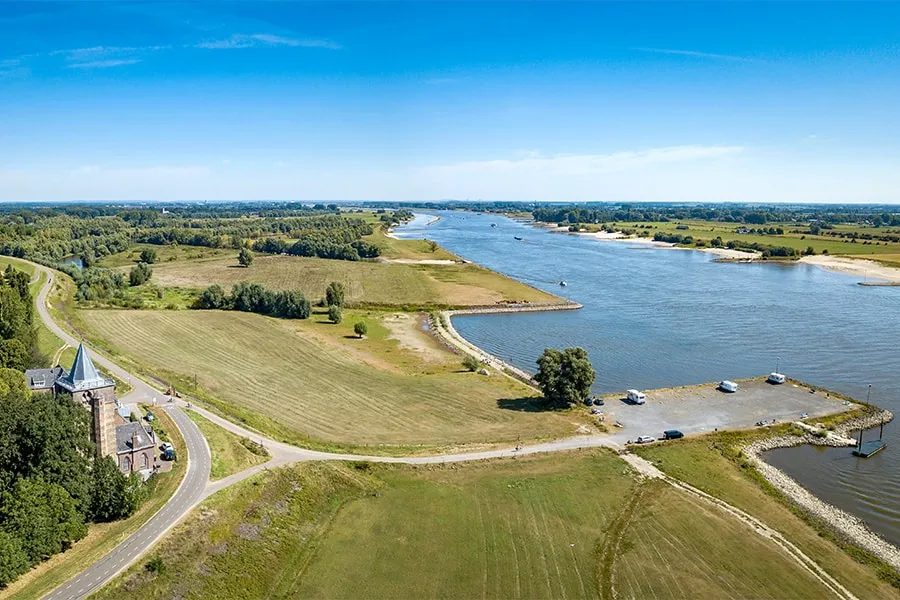
The dike along the Waal, the Netherlands’ busiest river, is being reinforced by construction consortium Mekante Diek along a 19-kilometre stretch between Tiel and Waardenburg. Fugro has a prominent role in this multi-year project. The geo-data specialist was involved in the design and ground investigations from the outset, and is now also responsible for monitoring and quality inspections of the dike materials during construction. Fugro is also making an important contribution to the project team’s work on digitising geo-data, a role that is becoming increasingly important in major dike reinforcement projects of this kind.
Fugro has been actively involved in reinforcing the Waaldijk between Tiel and Waardenburg since the tender stage. “We supported Mekante Diek in preparing its tender design,” explains Ben Rijneveld, Water Sector Manager at Fugro. “Two key Most Economically Advantageous Tender (MEAT) criteria were optimising the sheet-pile design and sustainability. A critical review of the sheet-pile design saved a considerable amount of steel. The more closely you examine it, for example by looking at more cross-sections in detail, the more accurately you can work and the more intelligently you can select your design assumptions. The design, of course, still meets the specified flood safety requirements. Less steel means lower emissions and therefore a more favourable Environmental Cost Indicator (MKI) score. Mekante Diek scored 10 out of 10 on all the MEAT criteria, and the optimised sheet-pile design contributed to that result.”
An Olympic challenge
After the contract was awarded, the consortium had to get to work quickly. “Completing the Final Design (DO) within six months was almost an Olympic challenge,” says Ben, describing how the project unfolded. “We also had to carry out the necessary ground investigations at locations along the 8-kilometre sheet-pile alignment where little information was available. At Fugro, we like to be prepared for every eventuality, so during the tender stage we had already considered which ground investigations would be needed and where. That meant we could start the investigations immediately after the contract was awarded. We also kept the design team that had worked on the tender on standby, then expanded it quickly once the contract was awarded. Our team worked closely with Mekante Diek’s team. Together, we were able to complete the DO in six months. That is exceptionally fast for a 19-kilometre dike reinforcement project.”
3D ground model
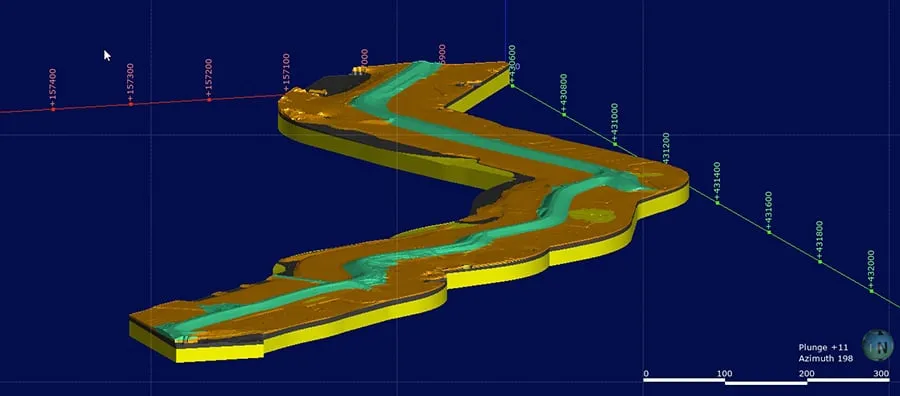
Using data from all the ground investigations, Fugro modelled the subsurface in 3D and combined it with the dike’s geometric model. “In some places the dike moves inwards, in others it moves outwards; the ground conditions are irregular and the fill varies considerably,” Ben continues. “By combining all the variables in the 3D ground model, we can calculate settlement in great detail. Usually, you take a dike section a few hundred metres long and work from the worst-case geometry and the poorest cone penetration test results. Here, because we have gathered much more data and are modelling in much greater detail, we can refine the design and identify ‘problem locations’ more effectively. This is particularly important for efficient construction. It allows the volume of earthworks to be estimated and determined much more accurately.” Fugro also uses data from the 3D ground model for sheet-pile calculations, making them more efficient. Ben adds: “This far-reaching digitalisation makes this project special.”
Trial embankment
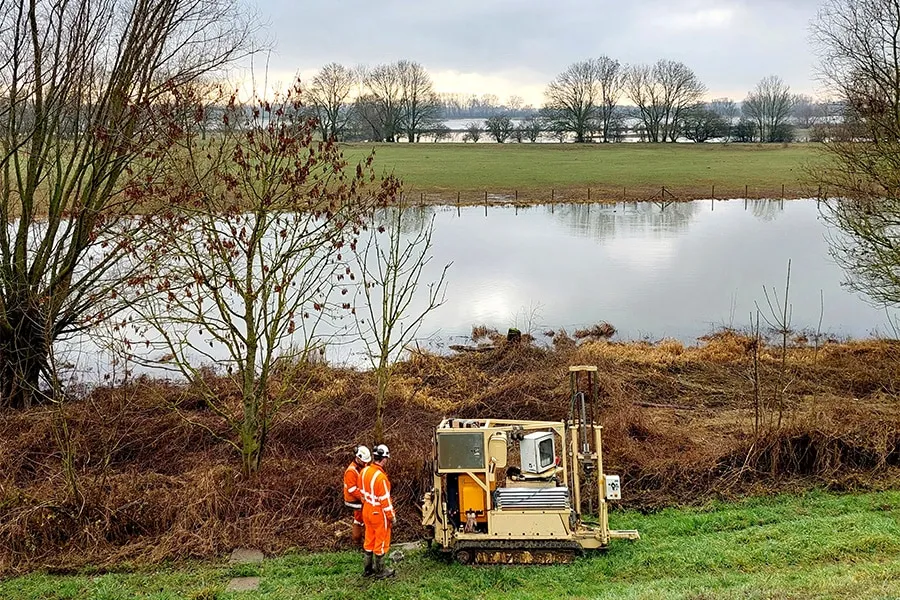
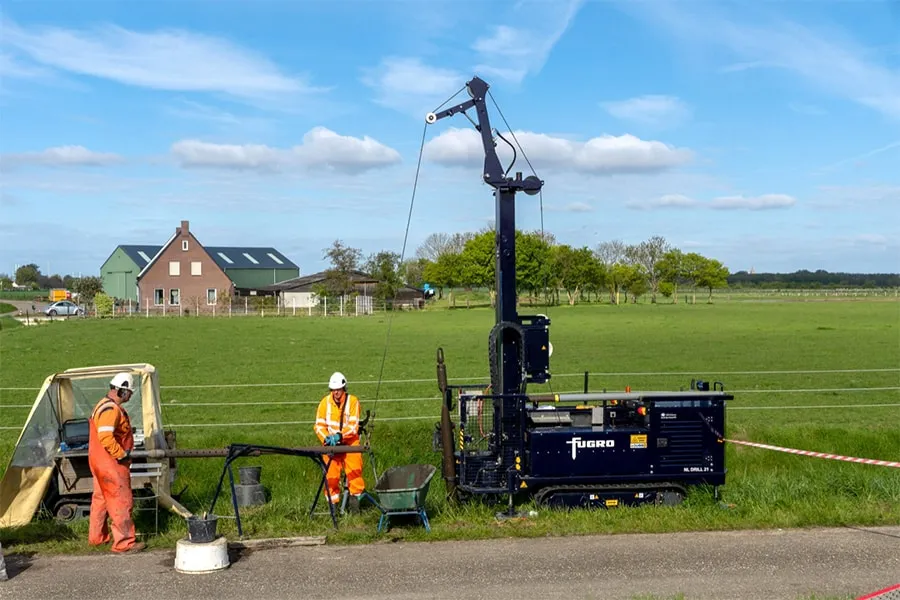
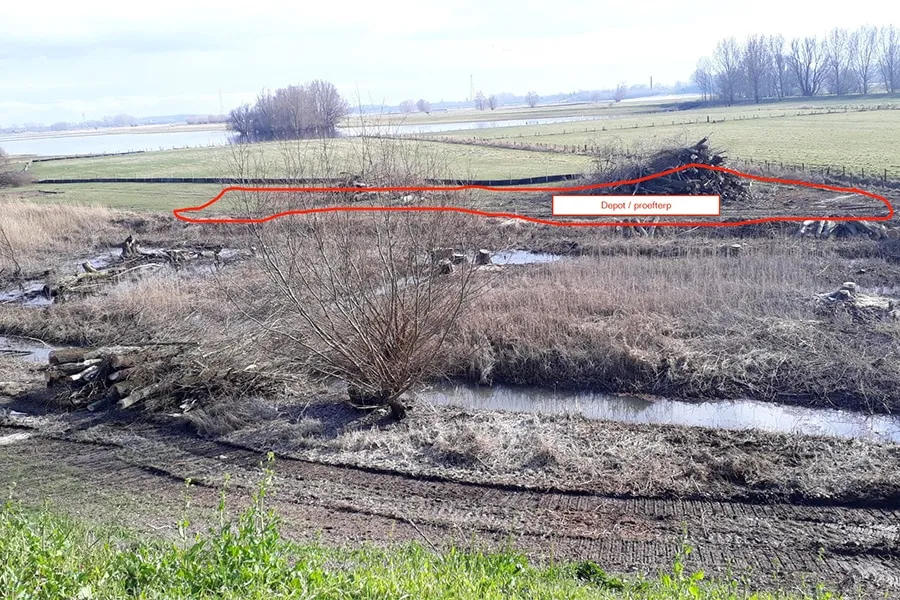
Ben was right to describe the DO phase as almost an Olympic challenge, given the effort Fugro and the project team put in over a short period. “On top of that, during the DO phase we also carried out preparatory work for the Detailed Design (UO), including constructing a trial embankment. This is intended to calibrate our settlement forecasts. We installed various instruments, including pore pressure sensors, and carried out the necessary cone penetration tests, boreholes and even laboratory tests. The results provided useful information that once again helped us optimise the design,” Ben explains.
Monitoring the surroundings
As well as linking the design to checks on site, Fugro is also monitoring neighbouring structures. “We compare data from on-site instruments, including vibration monitors, with our forecasts. These insights are extremely valuable when deciding whether to install the sheet piles by vibration or pressing,” says Olaf Duizendstra, Senior Project Manager at Fugro. “Vibratory installation is much faster than pressing, so the surrounding area is affected for less time, and it is cheaper too. But it has to be done safely. We therefore continuously check that construction remains within the specified limits. Before work began, we also installed survey bolts and carried out baseline surveys on the most critical neighbouring structures. During construction, we measure any settlement or subsidence in the X, Y and/or Z direction. We also have data from standpipes to check that the impact on groundwater levels is indeed negligible.”
Field laboratory
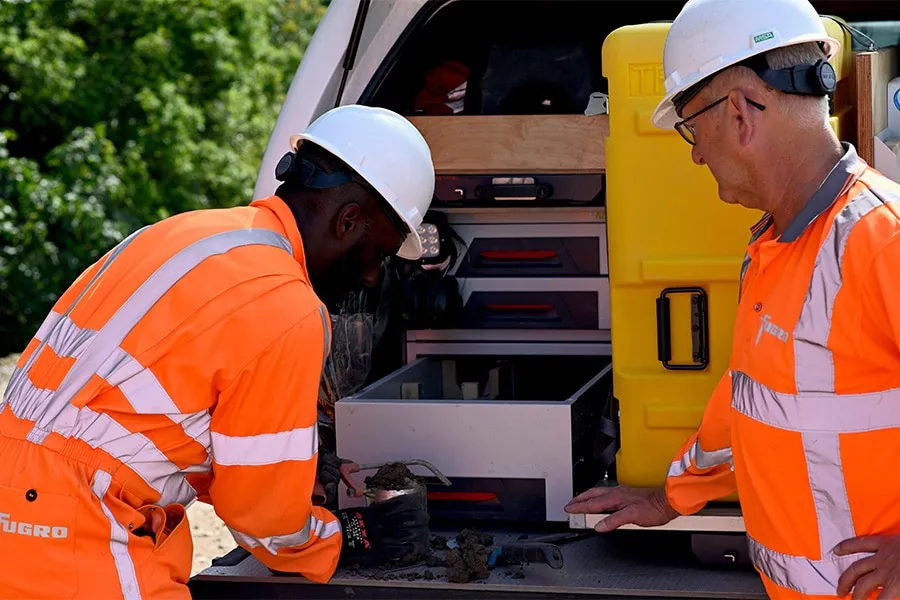
Fugro has also stationed its mobile field laboratory at the Tiel-Waardenburg dike reinforcement project. “We use Mekante Diek’s programme to carry out on-site compaction tests. We take core samples and conduct Proctor tests to assess whether the fill has been placed properly. These variables, together with data from the pore pressure sensors, determine whether the next layer of fill can be placed,” Olaf explains. “Ultimately, Waterschap Rivierenland needs confirmation that everything has been placed correctly, and that is the purpose of these inspection tests. From the field laboratory, we also assess the quality of incoming soil, including the clay used for the dike.” Ships are unloaded continuously. In the meantime, the clay can become wetter or drier. Fugro checks whether it is too wet or too dry to handle properly and advises on measures if necessary, so the contractor can quickly get back to work. “By working closely with the project through our laboratory, we can support Mekante Diek quickly and effectively during construction and avoid unnecessary transport movements.” Fugro’s field laboratory is the only one in the Netherlands accredited by the Dutch Accreditation Council.
The Tiel-Waardenburg dike reinforcement project is a clear example of Fugro’s expertise in flood safety and ground-related risks during both design and construction. “This is familiar territory for us,” says Olaf. “We have also been involved in earlier dike reinforcement projects on the north bank of the Waal, and have a wealth of geo-information covering the area from Gorinchem to Sprok. All that knowledge and experience is proving very useful here too.” ■
A business enquiry for Fugro? Get in touch
Wie aan Dijkversterking Tiel-Waardenburg werkte
- construction consortiumMekante DiekIn this story
- temporary bridge elements
 Retro BridgeMentioned in Laad- en losplatform van tijdelijke RHB-brugelementen
- conversion
 Van den HeuvelMentioned in Gebr. De Koning installs 9 kilometres of sheet piling with zero emissions
- constructionGebr. De KoningMentioned in Gebr. De Koning installs 9 kilometres of sheet piling with zero emissions
- construction consortiumBouwcombinatie Mekante DiekMentioned in Gebr. De Koning installs 9 kilometres of sheet piling with zero emissions
- electric drive systemeQuipMentioned in Gebr. De Koning installs 9 kilometres of sheet piling with zero emissions
- clay suppliesAannemingsbedrijf J. den BoerMentioned in 200,000 tonnes of high-quality clay for dykes
Keep following this
Get an email when a new story is published. No account needed.
- ProjectDijkversterking Tiel-Waardenburg
- ThemeFlood protection and climate-resilient water management
- SubjectWater infrastructure
- CompanyFugro
- CompanyMekante Diek







