









From Spanish cargo ship to Dutch dredger: “Schenge”
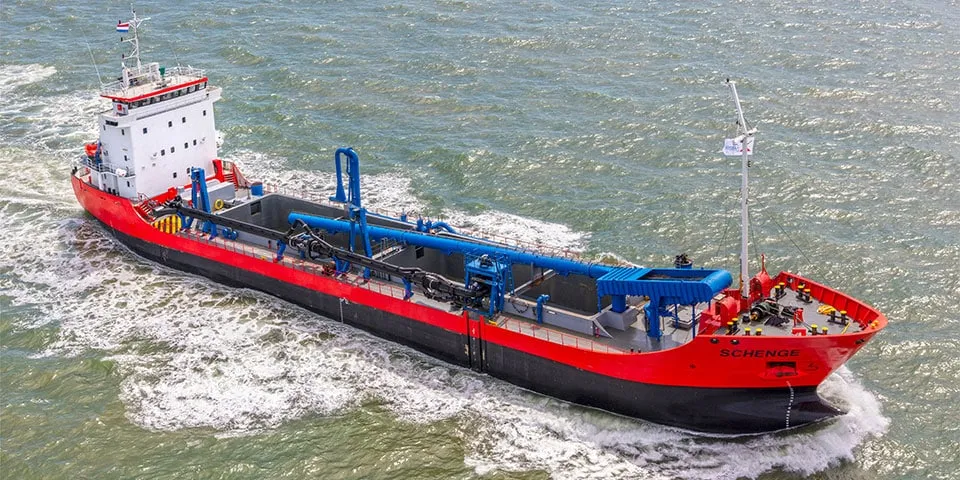
Until two years ago, Faasse Groep of Goes operated two smaller trailing suction hopper dredgers. The company, however, saw a strong need for a third and took action. In Spain, it found a suitable cargo ship, named Mandeo, to convert into a dredger. Gerard Visser, shore captain at Faasse Groep, explains: “Mandeo was the perfect hull for us. In terms of size, tonnage and other characteristics, the vessel met our requirements. Mandeo was also originally a Dutch ship, named De Alblas, which was a sign to us that we were dealing with a quality vessel.”
Faasse Groep first drew up the conversion plans, waited for approval from the classification society and then went in search of a suitable shipyard. “We presented our plans to various shipyards, and eventually joined forces with Holland Shipyards in Hardinxveld-Giessendam. Their pricing was very attractive and their service first-rate.”
Cut from the same cloth
Leendert Hoogendoorn, fellow director at Holland Shipyards, adds: “The great thing is that both our companies are cut from the same cloth. As a family business, run by my father, my brother and me, we have the same mindset as Faasse Groep. We communicate openly and honestly, focus on finding solutions and contribute ideas wherever we can.” Visser agrees: “We initially wanted to find contractors ourselves to supply the dredging equipment, but Holland Shipyards had the expertise in-house. We worked together to develop the solution, and it was a success.”
Reflagging to red, white and blue
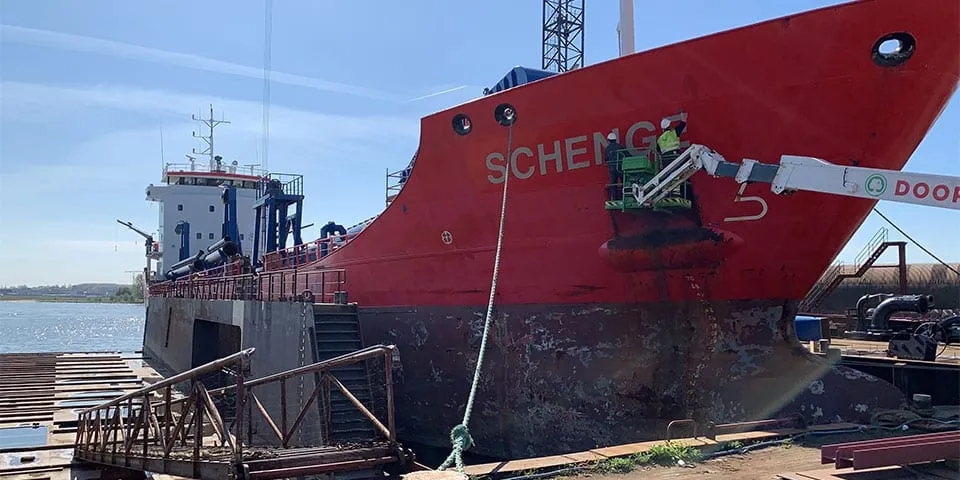
The conversion was a complex project. Mandeo was purchased in January 2019 and delivered by the seller in Hansweert. The vessel eventually travelled to Hardinxveld-Giessendam in July. Hoogendoorn explains: “The construction period was expected to run until the end of March 2020, but final delivery took place on 8 June. All the steelwork was completed on time. Progress was delayed slightly because we had to wait for several subcontractors.”
“After delivery, the vessel had to be commissioned and classed by Lloyd’s Register. This was a time-consuming process, but fortunately the vessel was able to remain at Holland Shipyards from delivery until all the paperwork was completed, making use of the facilities there. Everything has now been completed and we have christened the new dredger ‘Schenge’. Where does the name come from? Faasse is a 150-year-old family business. Our founder started out in Goes, at a site called ‘Het Schenge’. The new vessel was named after it as a tribute. And for those who are curious: Het Schenge was a small river that ran from the Veerse Meer to Goes, around 1600.”
Conversion into a dredger
“Schenge is fitted with a DN700 pipe. That meant we had to think in a different class. We engineered everything together with Faasse, from the steelwork in the hopper through to the dredging equipment and loading pipe. It was all developed in-house, and was a great opportunity for us to expand into this segment,” Hoogendoorn explains. “The steelwork for converting the hopper amounted to around 300 tonnes. We asked Faasse whether we could offer the complete package as well, and they had no objections. This meant we were able to develop the entire hopper, the hopper coaming, the drainage system, part of the jet system, the complete suction pipe, the screen, the loading pipe above the hopper, and all the piping and steelwork in-house. We are proud of that!”
Putting it to the test
The existing main engine is used to drive all the newly installed dredging equipment. An additional shaft generator is coupled to the main engine, supplying all the electrical power needed to drive the dredge pump, jet pumps and hydraulic systems. During a trial voyage from Hardinxveld to Antwerp, the engine was optimally tuned for this purpose. “The vessel was then given a fresh coat of paint in Antwerp, where the final class tests were also carried out. From there, it made a trial voyage to our own sand extraction areas on the Steenbank, off the Zeeland coast,” says Visser. Aside from its dredging capabilities, Schenge’s self-discharging capability was also important. We loaded sand into the hopper and set course for Breskens, where we turned the sand back into slurry before pumping it into an inland vessel. The system was fine-tuned during several voyages of this kind.
More than 100 voyages already…
Schenge has now been in operation for some time and has already completed more than 100 voyages to the company’s satisfaction. “Schenge’s speed is also looking good, which makes it particularly attractive economically,” Visser concludes. “We average two voyages a day at a good pace. And to think that the conversion took around 40,000 hours
of work.”
Question about this story? Ask your question
Keep following this
Get an email when a new story is published. No account needed.
- ThemeFlood protection and climate-resilient water management
- SubjectWater infrastructure







