









Waterschap Rivierenland continuously balances technical requirements with the desired appearance of the Tiel dike reinforcement
Text Suzanne van Gaale Beeld Waterschap Rivierenland
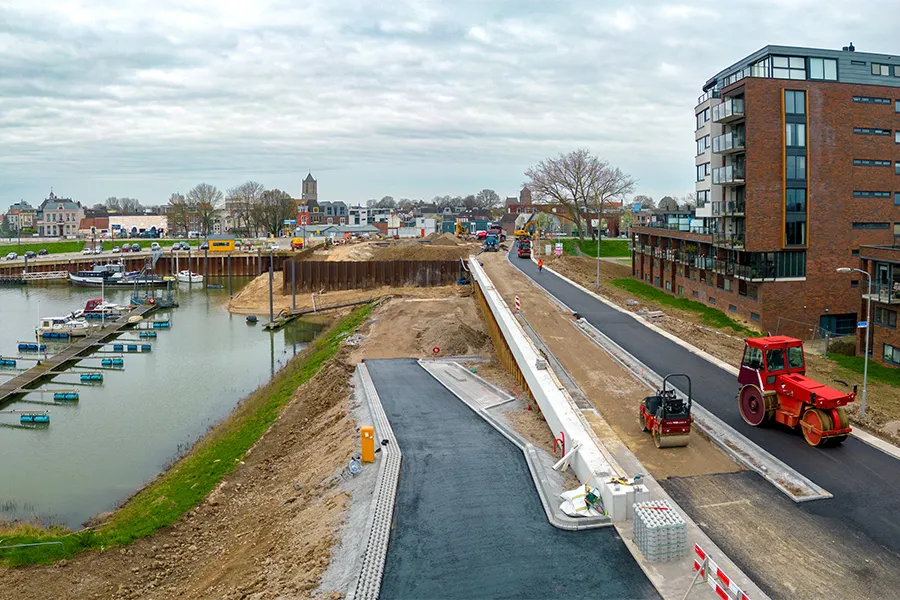
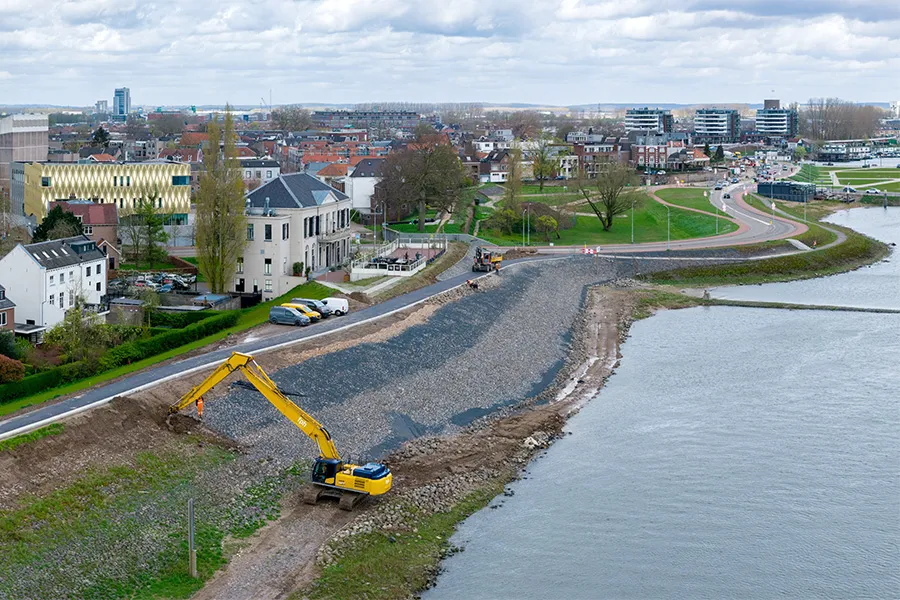
Since late 2022, work has been under way on strengthening the dike by the city of Tiel, commissioned by Waterschap Rivierenland. Before a single spade could go into the ground, a lengthy process of planning, problem-solving and design had to be completed. Every section of the dike was considered: what is technically necessary, and what does the surrounding area need? The result is a fully developed design. Even so, during the construction work there is still a regular need to balance technical requirements with the desired appearance.
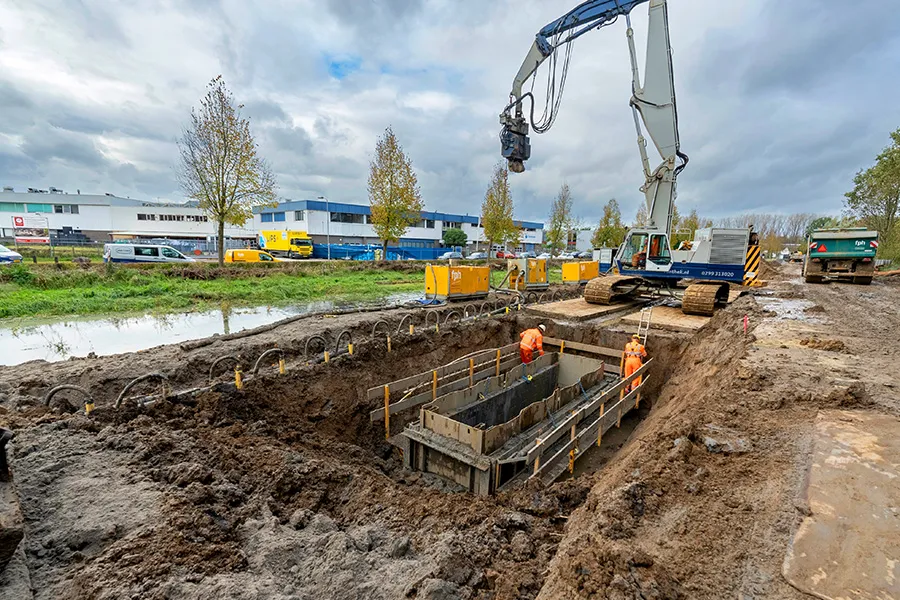
“Together with engineering firms Tauw and Iv-Groep, we spent just under four years on the design,” says Koen van Gerven, technical manager at Waterschap Rivierenland. “The advantage of a well-thought-out and further-developed design is that it provided clarity during the tendering phase, including on the risks.” Speaking of the tendering phase, it took place during the Covid-19 pandemic and the outbreak of the war in Ukraine. The result was a sky-high price for steel. “Given the many steel sheet piles required, we deliberately decided, in consultation with the Hoogwaterbeschermingsprogramma (HWBP), to fix the steel price in the tender and subsequently adjust it to the current price. This created a level playing field for all tenderers, and the financial risk did not fall on the market parties. By also taking responsibility for the sheet-pile design as the water authority, we enabled contractor FPH Ploegmakers to purchase steel at an early stage and allowed work to start on schedule.”
An active role for the water authority
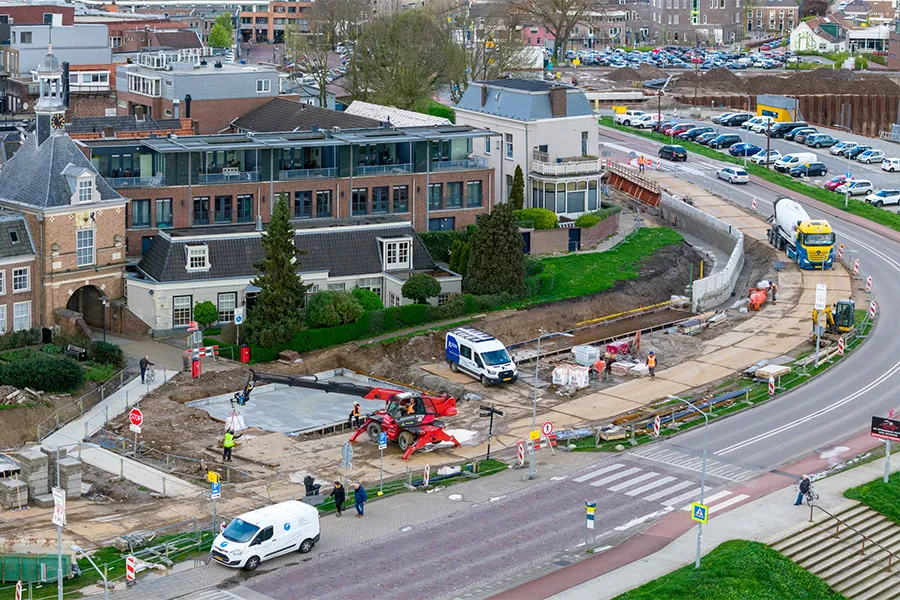
According to project manager Hans van Kooten, the dynamic balance between what is technically possible and what the surrounding area needs, including the municipality, local residents and other stakeholders, calls for an active role from the water authority. “We need to contribute actively and be critical, because there are many interfaces. The design of the fortified town wall is an example of a safe dike that fits its surroundings. We could have opted for a steel wall here. The dike would have been safe, but given the listed status of the town wall, that was not really an option. Together with the municipality, the monuments committee, FPH Ploegmakers and the Hoogwaterbeschermingsprogramma, we explored a suitable solution for the area in depth, one that also meets the technical safety requirements. The result is a new wall built with authentic stone, giving Tiel a very attractive appearance. Another example of where we took particular account of the surroundings is a section of the route near Grand Café Bellevue. Here, we made the dike lower than planned. A higher dike would also have to be wider. However, we were constrained here by the river on one side and the adjoining back gardens of local residents on the other. To avoid everyone having to give up part of their garden, which would have a major impact, we decided to plan for a dike lifespan of 25 rather than 50 years. Very early in the process, we signed a cooperation agreement with the municipality of Tiel. We then began discussions about the municipality’s requirements and planned works, so these could be incorporated into the project work from the outset. We, as the water authority, are responsible for carrying out the work, while the municipality contributes financially. Throughout the project so far, we have worked very closely together, meeting every two weeks.”
Milestone
One of the milestones in the project so far is the coarse-sand barrier (GZB), an innovation developed by Waterschap Rivierenland. Koen: “This coarse-sand technique uses the natural materials coarse sand and clay. As a result, the coarse-sand barrier has a very long lifespan. As a water authority, we are leading the way in the Netherlands. We even organised a special day where other water authorities, provinces, municipalities and other interested parties could learn how to build this type of barrier.”
Goodwill built on close communication
Koen and Hans are very satisfied with the collaboration with FPH Ploegmakers. Hans: “It was quite an exciting moment for us when they came on board the project. After years of preparation, our role changed. The contractor took the lead and work began. Looking back on that period, though, everything went very well. The great thing about a relatively small team like the one at FPH Ploegmakers is that communication lines are very short. All it takes is a phone call and it’s sorted. That applies not just to us, but also to local residents. It has certainly earned us a lot of goodwill. They are also very solution- and results-focused, which has certainly been useful on the project.”
A business enquiry for FPH Ploegmakers? Get in touch
Companies in this story

Keep following this
Get an email when a new story is published. No account needed.
- ThemeFlood protection and climate-resilient water management
- SubjectWater infrastructure
- CompanyFPH Ploegmakers
- CompanyTAUW | Consultancy and engineering firm







