









Taking account of archaeology and cultural heritage
Text Roel van GilsImage RAAP
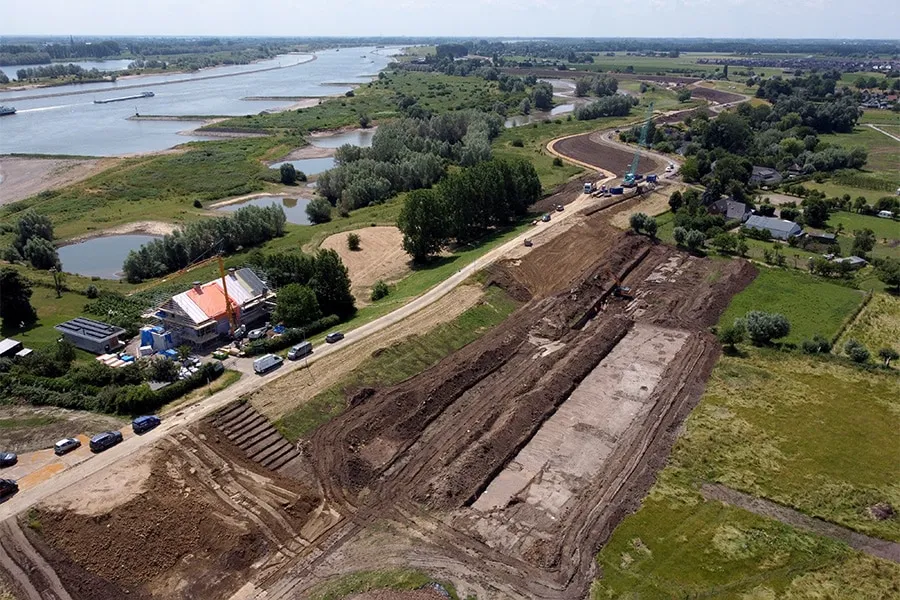
Under the Heritage Act, contractors planning ground works are required to commission archaeological research. This also applies to the Mekante Diek consortium on the dike reinforcement project between Tiel and Waardenburg. The project area has a rich history. RAAP’s archaeologists are tasked with dealing with it appropriately within the framework of the dike reinforcement project.
RAAP is a long-standing partner of the Mekante Diek consortium members. The Netherlands’ largest archaeological and cultural heritage research and consultancy firm is well versed in projects of this scale. “There are so many factors at play in a project like this. As well as looking after the heritage, our main task is to prevent archaeology from holding up the consortium. In other words, to ensure the whole process takes no longer than strictly necessary,” says Adam Haarhuis, branch manager at RAAP. “Our company is organised to do just that. We employ not only archaeologists, but also historical geographers, soil scientists, building historians and unexploded ordnance specialists. This breadth of expertise strengthens the archaeologists’ findings.”
High archaeological potential
The archaeological process starts with desk-based research. “If this initial stage clearly shows that there is nothing there, the process ends,” says Erik Verhelst, senior project manager at RAAP. “Where archaeological remains may be present, further investigation can be carried out in consultation with the competent authority and the client. We continue until we have identified the areas with the highest archaeological potential.” Adam adds: “We effectively narrow down the entire project area using landscape data and historical records, then focus on zones with high archaeological potential through trial trenching. We then excavate test pits there to investigate further. As the research progresses, the ‘target area’ gets smaller, but the investigations become more intensive. The final step is to excavate important archaeological sites.” There are quite a few of these along the route between Tiel and Waardenburg.
Making work go hand in hand
RAAP’s desk-based and auger surveys identified around 20 locations for trial trenching. “Normally, this is done well before construction starts, but sometimes the contractor has already begun work,” says Erik. “That is also the case here, due to the complexity of a dike reinforcement project, for example in Tiel, where we are working in a fairly narrow strip at the foot of the dike. It helps that we have known each other for many years, because the logistics are quite complicated. We could easily get in each other’s way, but thanks to good coordination and planning, everything is running smoothly. For example, we are making work go hand in hand by having the contractor remove the topsoil ‘in advance’. They understand the archaeological aspects of the project and take them seriously, as does Waterschap Rivierenland, which is fulfilling its responsibilities for heritage. That helps the process run smoothly.”
Hidden treasures
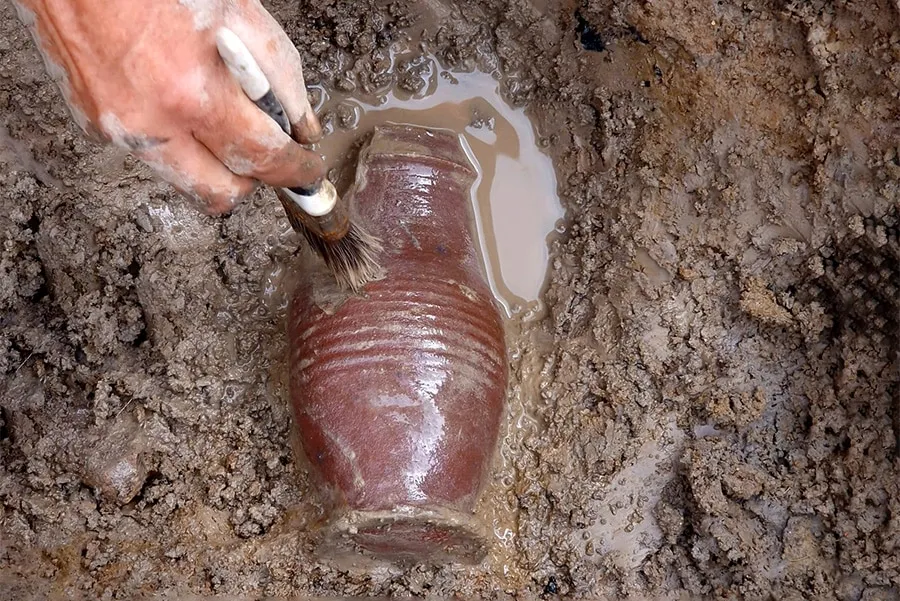
RAAP’s research has shown that the project area conceals a considerable number of archaeological ‘treasures’. “We are now finding actual remains, mainly from the Roman period and the Middle Ages,” says Erik. “These are very special finds that we are currently investigating and trying to understand. It is an archaeological adventure, but also a challenge for the project.”
Mekante Diek has allowed time in the schedule for unexpected developments, Adam explains. “It’s a matter of starting on time and taking archaeology into account at an early stage. That way, it need not cause any scheduling problems during construction, and Mekante Diek can deliver the reinforced dike right on time. A renewed dike with an ancient history.”
Question about this story? Ask your question
Keep following this
Get an email when a new story is published. No account needed.
- ThemeFlood protection and climate-resilient water management
- SubjectWater infrastructure







