









Tailor-made dredging equipment for major reservoir project
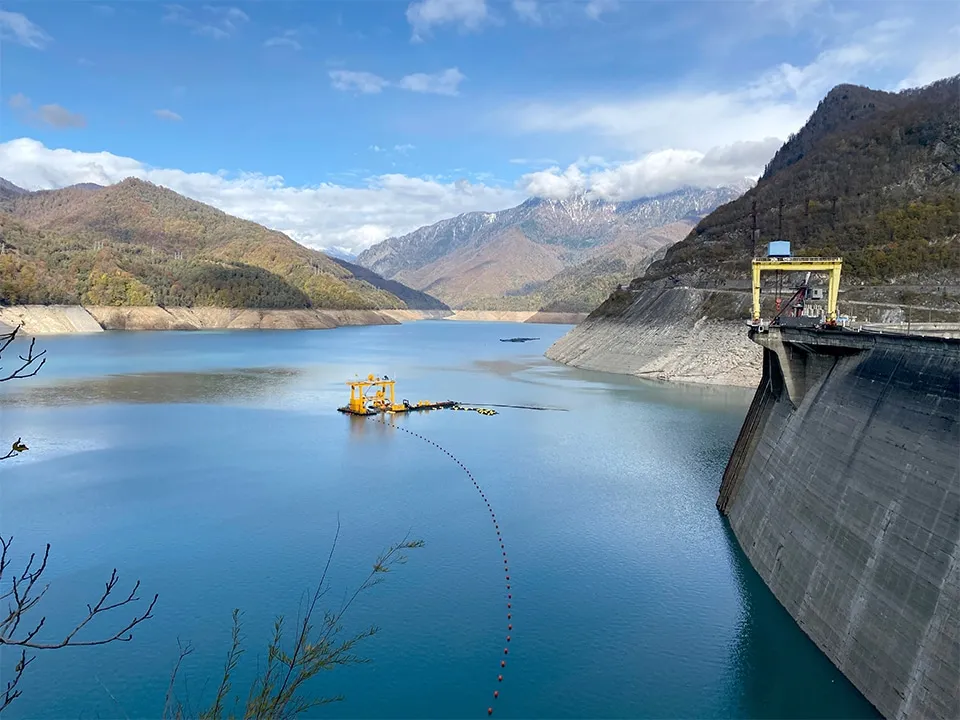
When you are faced with a major reservoir project involving dredging at a depth of around 200 metres, and you do not know exactly what you will encounter, it pays to be well prepared before starting work.
DCN Diving BV knows this too, which is why it called on the expertise and equipment of Bell Dredging Pumps. The global manufacturer of dredge pumps and dredging equipment knows how to handle challenges like these.
“A reservoir is used to generate energy. Over time, sediment has built up, probably to a depth of around twenty metres, reducing its generating capacity,” says Thijs van den Outenaar, sales engineer at Bell Dredging Pumps.
Customer-specific solution
“DCN Diving bought three electric Bell 300E pumps from us, each rated at 300 kW. In consultation with the customer, we mounted two of them in series in a frame that also houses a high-pressure water jet pump. The bottom of the frame is fitted with a specially adapted suction head.” The entire installation is lowered from a pontoon on the surface to a depth of 200 metres. “The head will jet water at high pressure, creating a cloud of sand and silt that the pumps can easily suck up.” A Bell 300E Booster Station, also rated at 300 kW, is installed on board the pontoon. “With a total installed dredge pump capacity of 900 kW, we can dredge almost any material we encounter at great depth and pump it over a long distance. In this case, well over a kilometre at a flow rate of 1,800 cubic metres per hour.”
Self-cleaning suction head
“We do not know exactly what lies at a depth of 200 metres in the reservoir. The high power, combined with the 155 mm passage of the Bell 300E, means that larger pieces of stone and other material can also be pumped to the surface. We are always looking at how to achieve the best possible results for the customer, so we are also developing a self-cleaning suction head that can spray itself clean if debris gets stuck in the suction basket. The main advantage is that the pump can stay underwater. Ideal for any application at great depth,” says Van den Outenaar.
Sensor package
The underwater installation is equipped with various sensors, allowing everything to be monitored effectively from above the water. “In addition to temperature and water detection sensors in the electric motors, the installation includes a depth gauge, a suction pressure gauge and several discharge pressure gauges. This gives you ‘eyes and ears’ at great depth, so you can intervene at an early stage if necessary.” Van den Outenaar concludes: “There is nothing better than providing solutions to the challenges of complex projects!”
Question about this story? Ask your question
Keep following this
Get an email when a new story is published. No account needed.
- ThemeFlood protection and climate-resilient water management
- SubjectWater infrastructure







