









Specialist underwater surveys for perfectly fitting lock gates
Text and images IV-Groep
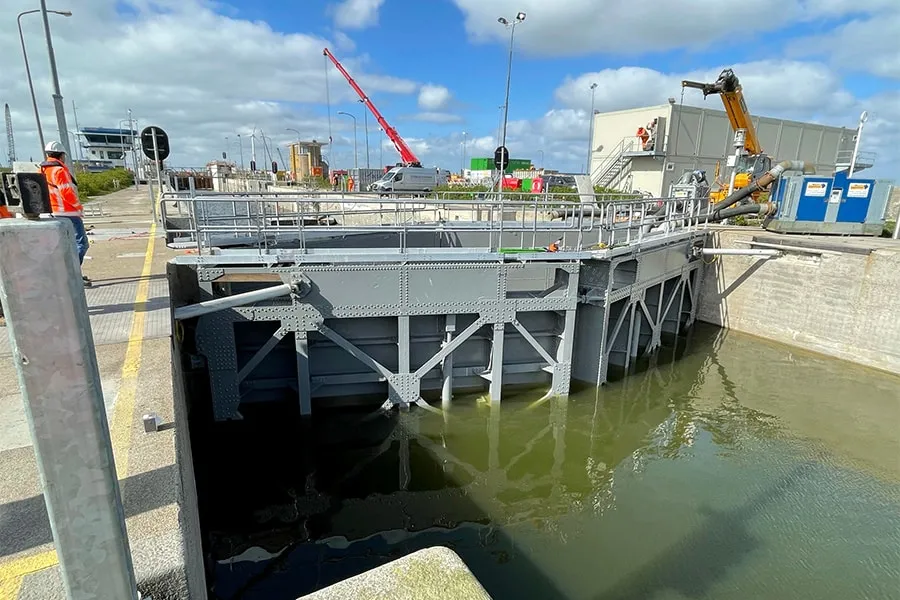
The Netherlands has almost two thousand locks. Around 140 of these are part of the main waterway network and are managed by Rijkswaterstaat. Regular inspection and maintenance of these lock gates and their associated operating mechanisms are crucial to prevent highly undesirable or even dangerous situations for society. The reliability and availability of locks are essential for shipping and the economy. This applies not only to unplanned failures, but also to planned maintenance. During maintenance work on lock gates, disruption to shipping must be kept to a minimum. To achieve this, Iv carries out specialist underwater surveys of all key components before maintenance work begins. This ensures that new or refurbished lock gates fit perfectly first time.
3D underwater survey
Surveying and creating 3D models of relevant lock-gate components underwater is no easy task and requires extensive knowledge and expertise. We call this ‘if you can measure it, you can know it’. Thorough knowledge of the different gate types is essential for surveying lock gates efficiently.
Iv has developed a millimetre-precision 3D survey method for all underwater components of locks. This uses highly accurate surveying equipment. The instruments used are Leica TDRA6000/TS60 industrial total stations, with an angular accuracy of 0.5’’ and distance accuracy of < 1mm. A measuring frame is also used to survey the sill for all gate types. By accurately surveying the part of the frame above water, its position underwater can be determined. This gives us the 3D position of the sill to millimetre accuracy.
An industrial high-precision level is used to determine the position of all vertical components underwater. The diver positions it underwater, and the surveyor records its position above water. This gives us the 3D position of the vertical components. A dive team, made up of divers with years of experience surveying lock gates, provides continuous assistance during these surveys.

3D fit assessment
The measurements of the lock head are processed to create a 3D model. This model is used to assess how the associated lock gates can be made to fit. To do this, the gates must also be fully surveyed in 3D before installation. This is done either with the gates standing vertically in the gate chamber or at a temporary storage site. In the latter case, the gates are laid horizontally and must be supported without introducing torsion. This is particularly important for mitre and lift gates.
By fitting the 3D models of the gates into the lock-head model, the harrs for the various types of lock gate can be manufactured to exact dimensions. The most suitable method is to install the timber in the lock gate with an allowance, so that once marked out, it can be planed to the exact size.
Benefits of surveying in advance
As everything is surveyed in advance and the gates are made to size beforehand, the closure required to replace the lock gates can be kept to a minimum. Any defects and/or damage are also identified during the surveys. This makes it possible to decide in advance whether the lock needs to be dewatered, or partially dewatered using stoplog caissons.
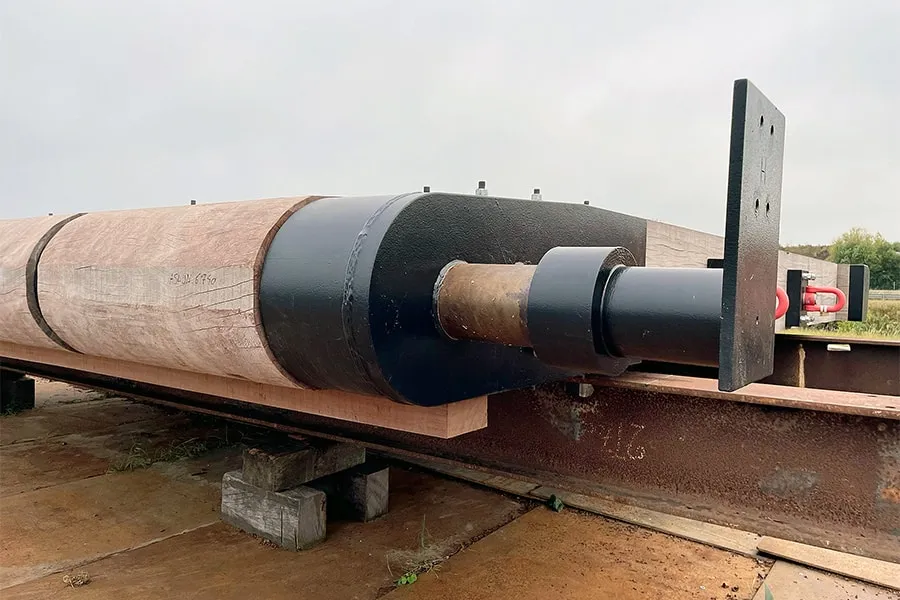
Measure to know
To ensure that refurbished lock gates and all their associated components continue to function properly for years after refurbishment, Iv has devised a monitoring system. The key measure is whether the gate moves correctly when opening and closing.
The details vary between lock-gate types, but the principle is always the same: the gate must follow the correct 3D movement during operation, in accordance with the original design. If it does not, long-term damage is inevitable. High-frequency 3D surveys of the gate’s movement make it possible to monitor all its components. These include the opening and closing movements of rolling gates and their upward movement under water pressure; the opening and closing of lift gates and their upward movement; and the rotation of mitre gates and their upward movement where the pivot is free to rotate.
Asset management: DREAM
To help deliver smart, circular locks, Iv has developed the DREAM® method: Data-driven and Risk-based Enterprise Asset Management. Iv uses this method to analyse all possible failure mechanisms in a lock. The measured data can be used to closely monitor the condition and failure behaviour of the lock gates. The expected time to failure can also be predicted for each possible failure mechanism, albeit with some uncertainty. This information is then used to optimise the inspection, monitoring and maintenance of locks in light of the familiar triangle of performance, risk and cost. With this maintenance strategy, Iv safeguards the performance of its asset portfolio at the lowest possible cost and with an acceptable risk profile.
Question about this story? Ask your question
Keep following this
Get an email when a new story is published. No account needed.
- ThemeExtending the life of roads and civil engineering structures
- SubjectWater infrastructure







