









Rockflow: smart water storage made from fully circular stone wool
Text Suzanne van Gaale Images Rockwool Lapinus

How do you make a city rainproof? With cloudbursts becoming more frequent, it is a pertinent question that many authorities, landscape architects, engineering firms and policymakers are grappling with. ROCKWOOL Rainwater Systems has an answer: stone wool. Corinna May, Marketing Manager, and Daan Los, Urban Climate Adaptation Adviser, explain how and why it works so well.
Stone wool in the fight against flooding during cloudbursts? “Absolutely. Stone wool is best known as an insulation material, but not everyone knows that it is also highly effective in tackling excess water,” explains Corinna. “It acts like a sponge for water, in this case underground. Stone wool’s dense fibre structure not only captures large volumes of rainwater, it also filters runoff, helping to keep groundwater and surface water cleaner. It kills two birds with one stone, protecting the city’s natural water cycle at the same time.” ROCKWOOL Rainwater Systems uses its Rockflow product for this purpose: smart water storage units made from fully circular stone wool. ROCKWOOL is driven by a desire to think differently about climate change. “We talk about climate adaptation. We are seeing increasing urbanisation and a changing climate, resulting in more severe cloudbursts and prolonged periods of drought. Our message is: rethink urban water. That is why we embrace the concept of sponge cities: cities that use their green infrastructure to prevent flooding, as well as heat and drought.”
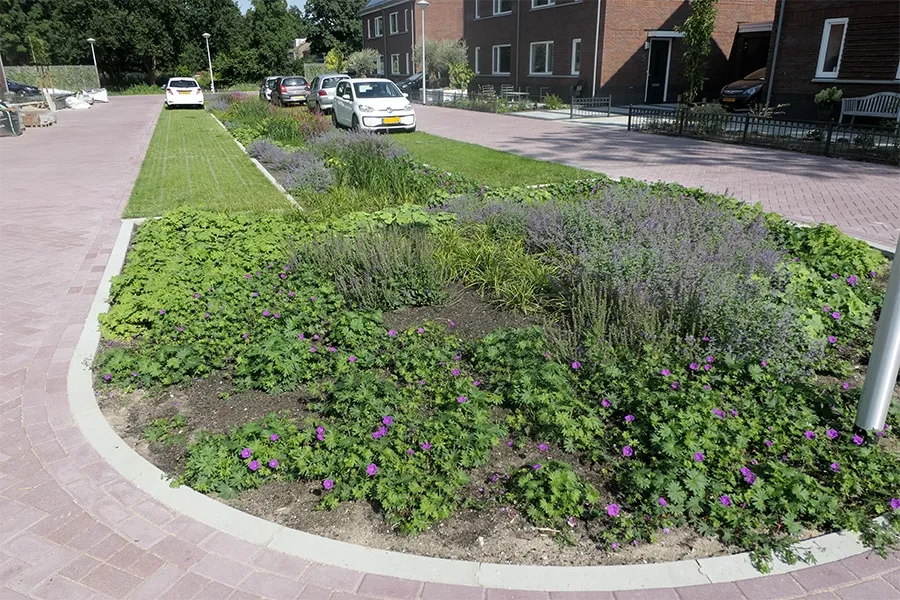
Climate-adaptive bioswale in Zoeterwoude
Rockflow is being used in more and more cities as part of climate adaptation, both to prevent flooding and to retain rainwater as a reserve for drier periods. In the new-build Klaverweide neighbourhood in Zoeterwoude, these two functions are cleverly combined in what is known as a climate-adaptive bioswale. Daan explains: “Only a narrow strip was available for the bioswale at Klaverweide, between the carriageways, the (green) parking bays and all the cables and pipes. Beneath the bioswale is a Rockflow infiltration system that can receive runoff from the surrounding paved surfaces, with gullies as a back-up. We installed a capillary break in the form of a gravel layer on top of the infiltrating Rockflow system. This allows water to be retained for longer. On top of the gravel layer is an extra layer of Rockflow, around 10 cm thick, followed by a relatively thin layer of soil for the plants. Thanks to the extra layer of Rockwool, plants can draw moisture from it for around 4 weeks during drier periods.”

Strong enough for tram tracks
The redevelopment of Nieuwezijds Voorburgwal in Amsterdam is another example of stone wool’s versatility. The Rockflow water storage and infiltration system lies beneath the tram tracks. As part of Amsterdam Rainproof, the tram tracks and greenery had to be replaced and the area redesigned. The plan also included capturing rainwater during heavy downpours. Daan says: “The only space available for storing and infiltrating water was beneath the tram tracks. What makes this project unusual is that concrete was poured directly onto the stone wool elements, with heavy trams then running over it. That is certainly not something you see every day.”

Tackling the challenge together
These projects show that ROCKWOOL is keen to think outside the box and explore possible solutions with its partners. Corinna says: “Stone wool is a proven product with a track record of 80 years, and it also works brilliantly as a water sponge. We are always keen to talk to partners who are willing to experiment and take on the challenge of climate adaptation with us. Our message to everyone responsible for or involved in climate adaptation, water and green spaces is: dare to explore new approaches and talk to one another. There is great capacity for innovation and a willingness to help in the market. We need to harness that to build the broadest possible toolkit for climate adaptation together. And if you are interested in managing rainwater with stone wool, please get in touch!”
Een zakelijke vraag aan ROCKWOOL Rainwater Systems? Get in touch
Companies in this story
Keep following this
Get an email when a new story is published. No account needed.
- ThemeLower emissions and more reuse
- SubjectWater infrastructure
- CompanyROCKWOOL Rainwater Systems







