









Rijnhaven: demolition works
Text Piet Andries Image Adex Groep
“Working from the water is a discipline in its own right”
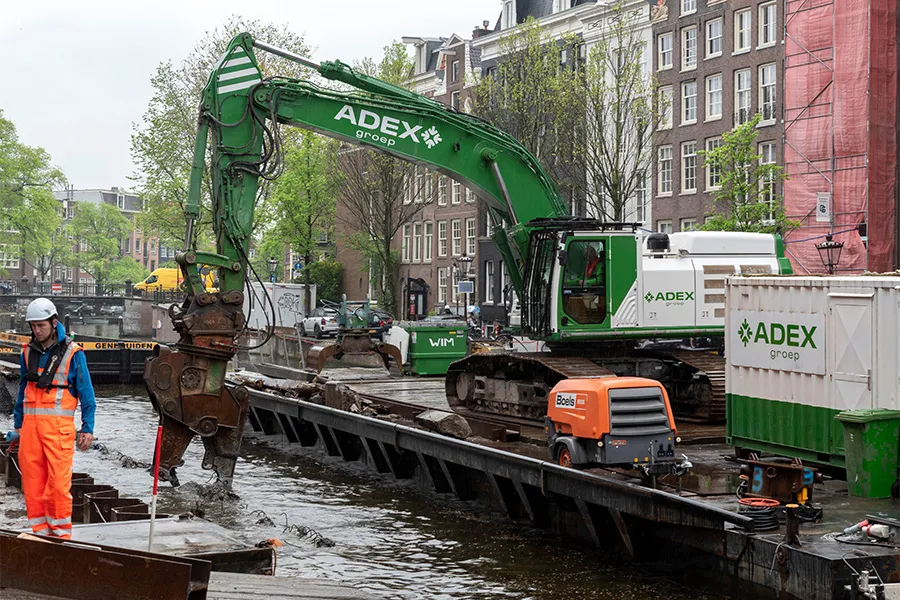
For the demolition and subsequent processing of materials from Rijnhaven’s old maritime infrastructure, the expertise of Adex Groep was brought in, a renowned specialist in circular demolition. With major infrastructure projects such as the Royerssluis in Antwerp and the widening of the A9 near Amsterdam, Adex Groep had an impressive track record to draw on. After working from the water in the first phase, the project in Rotterdam is now in the second stage of dismantling. The company transports materials for reuse to the nearby municipal works depot at Keilehaven.
Demolition today is no longer about destruction, but about giving materials a new lease of life. This is also the policy and core activity of Adex Groep, which is an important partner in the Rijnhaven project thanks to its focus on sustainability. The demolition work required for the reconstruction of the harbour basin is at an interim stage. “The first phase, working from the water, was completed at the end of 2022,” says Adex Groep project manager Willem-Jan Wagteveld. “For this, we positioned a 50-tonne crane on a 50 by 14-metre pontoon to reach the quays to be removed. Using smaller auxiliary pontoons, we first dismantled the wooden walings and stairs, then transported them to the municipal works depot at Keilehaven for reuse. Our crane then began removing the granite copings and basalt facing. Some of these materials were also placed in storage at the municipal depot.”
“Working from the water is a discipline in its own right,” Willem-Jan continues. “The tidal range of around one and a half metres is particularly important to factor into your planning. By planning our work carefully around the tides, everything went smoothly.” Because the work in the first phase was carried out from the water, it caused no vibration or noise nuisance for the surrounding area. For other scenarios, such as protecting the old lock building during demolition work at the Royerssluis in Antwerp, Adex Groep uses high-tech sensor systems to monitor the impact of the work and make adjustments if necessary.
Second phase on dry land
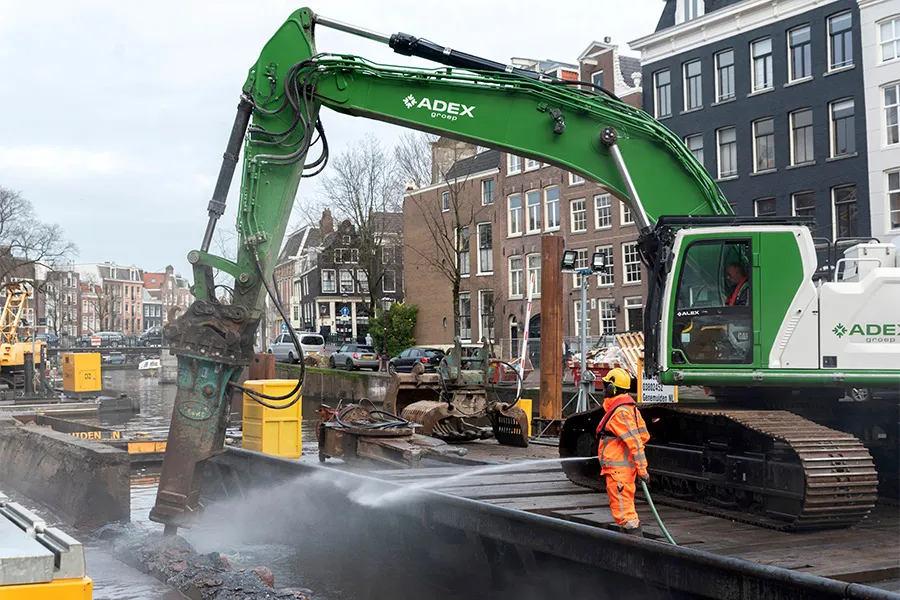
In Rotterdam, work is now continuing from the drained dock, requiring a different approach. The demolition contractor has already processed 1,793 tonnes of materials, mostly concrete and rubble (1,250 tonnes), basalt (320 tonnes) and hardwood (172 tonnes), all of which is sorted and reused to a high standard. Much of the material was removed using the CAT352NG, which meets the Tier 4 Final/Stage V emissions standards and has a maximum digging depth of 8.7 metres. Automated reporting checks fuel consumption and operating hours against the specified limits. The demolition hammer is an Atlas Copco HB4100, weighing 4.1 tonnes.
One-to-one reuse
The second part of the demolition work is taking place at Hillemakade. “Given the working depth of 4.75 m1, excavation is carried out in two stages. Boskalis handles the first excavation, down to approximately groundwater level. From there, we demolish the basalt blocks in the quay wall in sections of around 25 metres and move along a 100-metre stretch of the site to remove the remaining infrastructure from the second excavation level,” says Willem-Jan. “The wooden floor and king piles are then removed, and everything is cleared.” To minimise disruption to the surrounding area during recycling, the rubble is crushed on site and the resulting aggregate is repositioned on site to form a haul road.
High-grade reuse of recovered materials is always the starting point for Adex Groep’s projects. For its work on buildings, this often means dismantling building components for direct reuse; infrastructure projects more often involve high-grade recycling. “By working in the right way, we can recover clean material streams from projects that are suitable for recycling,” says Adex Groep commercial director Axel Hendriks. The company is increasingly demonstrating, however, that direct reuse can also be a solution in infrastructure. “When demolishing the flyover over Keizer Karelweg in Amstelveen to make way for the A9, we sawed out concrete beams that were reused in their entirety at another site. Continuing to innovate, in reuse but also in modern, low-emission equipment, for example, is one of the pillars of our business,” Axel concludes.
Have a business enquiry for Boskalis Nederland? Get in touch
Who worked on Rijnhaven
- architectural practiceVan Valkenburgh AssociatesMentioned in From port to homes: the dock becoming a new urban district
- demolition worksAdex GroepIn this story
Keep following this
Get an email when a new story is published. No account needed.
- ProjectRijnhaven
- ThemeLower emissions and more reuse
- SubjectWater infrastructure
- CompanyAdex Groep
- CompanyBoskalis Nederland







