









New research shows dike reinforcement can be much cheaper
Text Roel van GilsImage Fugro
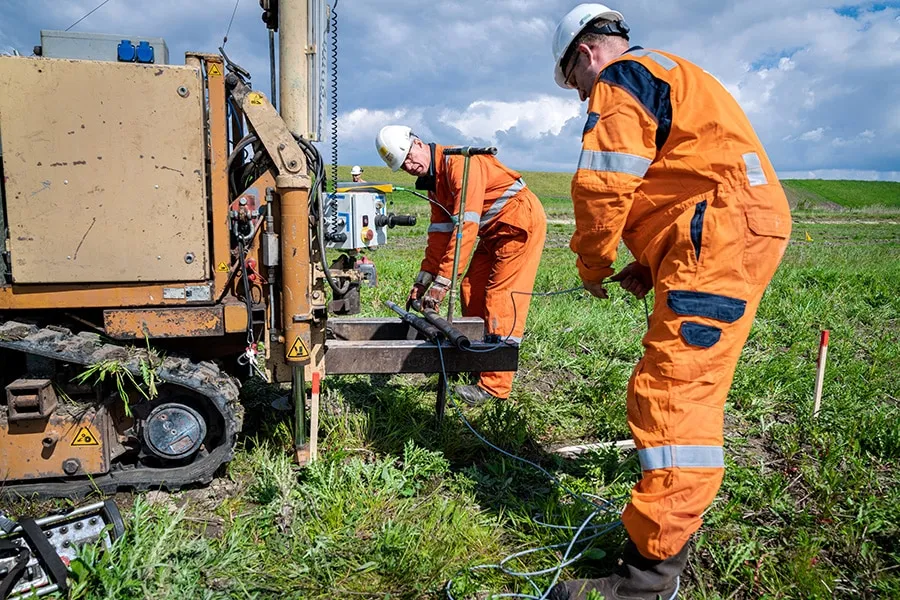
The Netherlands has a unique system of primary and regional flood defences that protect us from flooding. To ensure flood safety in the future, the Flood Protection Programme (HWBP) is working to reinforce 1,500 kilometres of dikes and 400 locks and pumping stations by 2050. New findings from research by Fugro, together with the Hollandse Delta water authority (WSHD), the Flood Protection Programme (HWBP) and Deltares, show that dike reinforcement can be much cheaper in areas where tidal sand lies beneath the dikes.
Dutch dikes are periodically assessed for, among other things, the failure mechanisms of piping, height and stability. “Piping, or the formation of unwanted channels beneath a dike, is a regular occurrence in the Netherlands,” says Gert-Ruben van Goor, Senior Project Manager Water Engineering at Fugro. “When there is a difference in water level on the outer and inner sides of a dike, water carrying sand particles flows beneath it. Small amounts pose no problem. But a larger flow carrying sand can seriously weaken a dike or even cause it to collapse.”
A huge impact
Until now, assessment rules dating from 2011 have been used to determine whether the risk of piping is sufficiently low. The dike reinforcement programme under the Flood Protection Programme, an alliance of the 21 water authorities and Rijkswaterstaat, is based in part on these rules. As a result, around 1,500 kilometres of dikes are slated for reinforcement by 2050. “It’s a huge undertaking,” Gert-Ruben says. “One way to prevent the effects of piping is to increase the seepage length by building so-called piping berms. This increases the resistance to flow. Usually, this requires a lot of space, which is often unavailable alongside the dike. An alternative is therefore often used, such as installing steel sheet piles in the dike. Steel sheet piling is an expensive solution, and installation is often complex because of the limited space.”
Piping tests
The Flood Protection Programme funds all dike reinforcement projects in the Netherlands. “They are aware of the huge impact of this undertaking and encourage the development of knowledge and innovations that can reduce it. An annual budget of €10 million is set aside for this,” says Gert-Ruben. The assessment rules for piping are based on relatively coarse sand, representative of river sand. Tidal sand, by contrast, found along the coast, has a different composition, consisting mainly of finer material interspersed with coarser grains. This makes it more resistant to piping, as Deltares had previously concluded in laboratory tests. Based on this hypothesis, a full-scale piping test was carried out at the Vijfhuisterdijk in Friesland in 2020. More recently, the collaboration conducted two full-scale piping tests in the Hedwigepolder in Zeeland.
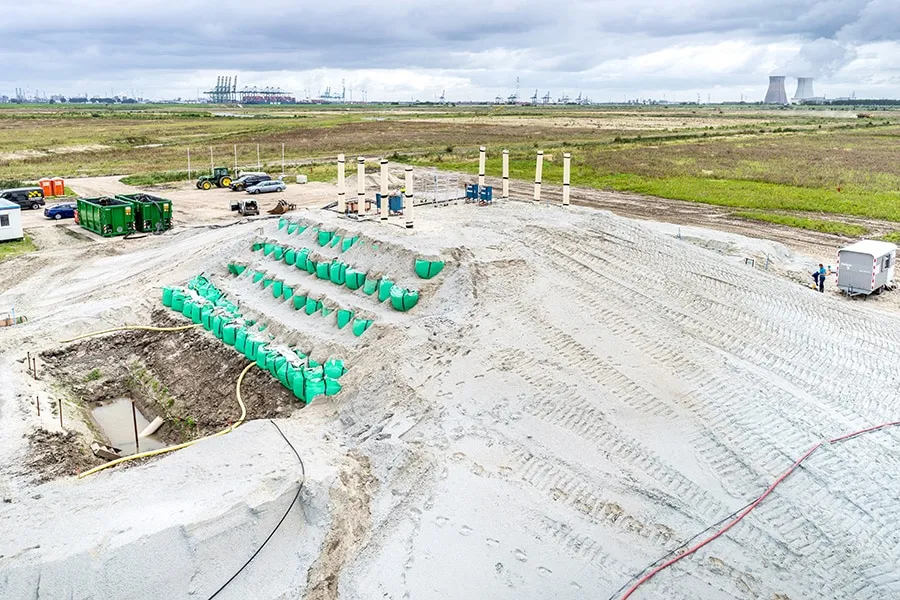
Hedwigepolder
The Hedwigepolder has been depoldered and made available as a test site for large-scale research into dike safety before the dikes are removed. “A range of studies into incidents, overtopping and other topics have been carried out here as part of a European programme. Given the scale of the piping challenge facing the Hollandse Delta water authority, it took part in the research and provided project and stakeholder management. Initially, the plan was to carry out the tests on a primary flood defence, but the ground conditions made that impossible. So, in an area of the polder where the soil was suitable, we built a full-scale ‘model dike’ using local soil. Large-scale tests were then carried out in accordance with a detailed research plan,” Gert-Ruben explains. “A comprehensive monitoring system, including more than 200 pore pressure sensors, enabled us to track the progression of piping very precisely during the test. Using our HPT-AMPT® technology, we determined the horizontal and vertical permeability, allowing us to translate the complex ground structure and its properties into a calculation model. This enabled us to determine very precisely how resistant the tidal sand is to piping.”
CSI phase
After the test, the research team excavated the dike down to the level of the pipe. “This was to verify and validate the measurements and expose the progression of piping at an archaeological level. We also called this the CSI phase,” says Gert-Ruben. “And the results matched exactly. The predictions and measurements were therefore consistent. Dikes on tidal sand are less susceptible to piping than those on river sand. Tidal sand is much less permeable than river sand and contains far more clay particles and layers, so water flows more slowly and sand grains are less easily mobilised. A useful additional finding was that a pipe never develops in a straight line.” But just how much stronger is tidal sand? “Our research found it to be slightly more than a factor of 2. Nevertheless, we use a conservative calculation factor of 1.4, which can be applied anywhere in the Netherlands where tidal sand lies beneath a dike. This will greatly reduce the scope of piping-related work, particularly in coastal areas. On some sections, the need for reinforcement is eliminated altogether or substantially reduced.”
The Expertise Network for Flood Protection recommends the new calculation rules, which will be incorporated into the new assessment and design framework. “The Hollandse Delta water authority and Wetterskip Fryslan are already applying the new knowledge in their dike reinforcement projects,” says Gert-Ruben. “So it’s already paying off. The Flood Protection Programme has also congratulated our research team, comprising Fugro, Deltares and the Hollandse Delta water authority, on its proactive approach, and says the business case is very easy to make. It’s great to have been able to contribute to this from Fugro.” This project will save at least €160 million within the Flood Protection Programme, reduce disruption to local residents from any works and lessen the environmental impact. Fugro calculated that the saving in CO2 emissions will be at least 97 tonnes, equivalent to 776 transatlantic flights. Finally, Gert-Ruben reveals that plans are under way for similar tests in river areas. To be continued! ■
A business enquiry for Fugro? Get in touch
Companies in this story

Keep following this
Get an email when a new story is published. No account needed.
- ThemeFlood protection and climate-resilient water management
- SubjectWater infrastructure
- CompanyFugro







