









New flood barriers protect the hinterland of the Afsluitdijk
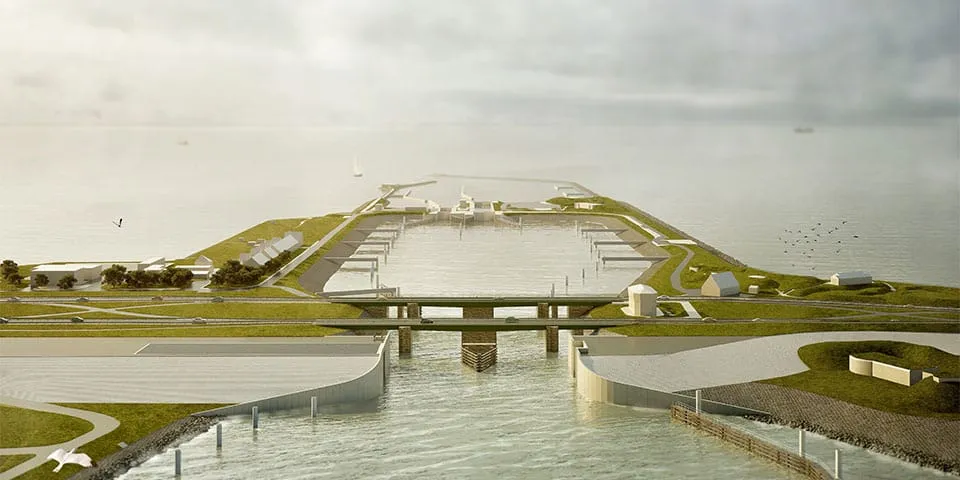
To protect the Afsluitdijk’s navigation locks and the hinterland from exceptionally high water levels and the force of the water, consortium Levvel (BAM, Van Oord and Rebel) is building two flood barriers on behalf of Rijkswaterstaat. These are also known as storm surge barriers. The work is taking place at Den Oever in North Holland and at Kornwerderzand in Friesland, on the Wadden Sea side. In normal conditions, the barriers will remain open. When water levels are exceptionally high, they will be closed, temporarily preventing all vessels from passing through.
We spoke to Jens Wijnants (BAM), work planner for the Kornwerderzand flood barrier, and Johan Bentlage (Van Oord), site supervisor for the Kornwerderzand flood barrier and the Vismigratierivier (VMR) cut-through.

Jens Wijnants (BAM), work planner for the Kornwerderzand flood barrier.
Minimising disruption throughout the works
“We started work on the flood barrier at Den Oever two months ago,” Wijnants begins. “Levvel is building both barriers with ‘minimum disruption’ as its guiding principle. That means minimising disruption to road traffic, shipping and the environment. During the first phase, the sheet piles are being installed from the water, with as little disruption to shipping as possible. Our vessels remain outside the navigation channel, and, for example, we do not lift loads while a vessel is passing. Safety comes first, and we make sure vessels can use both waterways for as long as possible. Once the sheet piles are in place, we will backfill behind them with sand until the area is dry, then continue working from the land.”
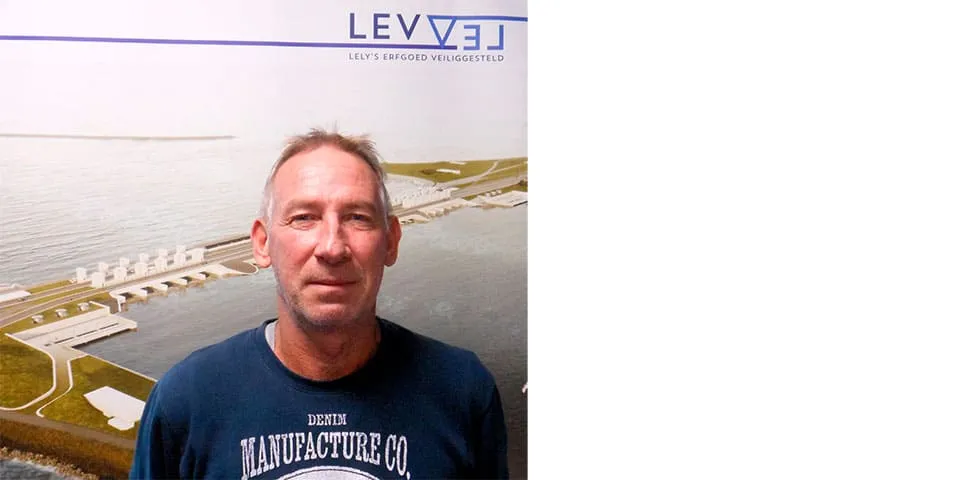
Johan Bentlage (Van Oord), site supervisor for the Kornwerderzand flood barrier and Vismigratierivier cut-through
Bentlage adds: “Temporary guide structures are also being installed to prevent collisions with the temporary cofferdams and avoid damage to passing vessels.” For now, all the work is being carried out from the water. “The equipment includes a pontoon carrying an excavator for dredging, two split hopper barges to remove the dredged material, a pontoon with a crawler crane to drive in the temporary cofferdams, a pontoon to deliver the steel sheet piles and several tugboats. A survey boat is also taking depth measurements of the dredged areas,” Bentlage lists. From the end of October, the waterway at Den Oever will have to be closed completely for several months. “That’s when the concrete work will be carried out,” Wijnants explains. Vessels will be able to divert via Kornwerderzand. “At Kornwerderzand, we are currently making the final preparations to get started, which is expected to be at the end of this summer.”
The flood barrier at Den Oever
Bentlage says: “The flood barrier at Den Oever is being built on the Wadden Sea side, in front of the navigation lock. It will have mitre gates, a common type of lock gate. The gates are made of steel and operated by hydraulic cylinders. They will be closed when water levels are exceptionally high, protecting the navigation lock and the hinterland from the force of the water. In other words, they will act as a storm surge barrier. In normal weather conditions, they will remain open to allow vessels to pass through. The barrier is expected to close a few times a year. As the climate changes and sea levels rise, we expect closures to become more frequent in the future. When water levels are exceptionally high, vessels will be temporarily unable to pass through.”
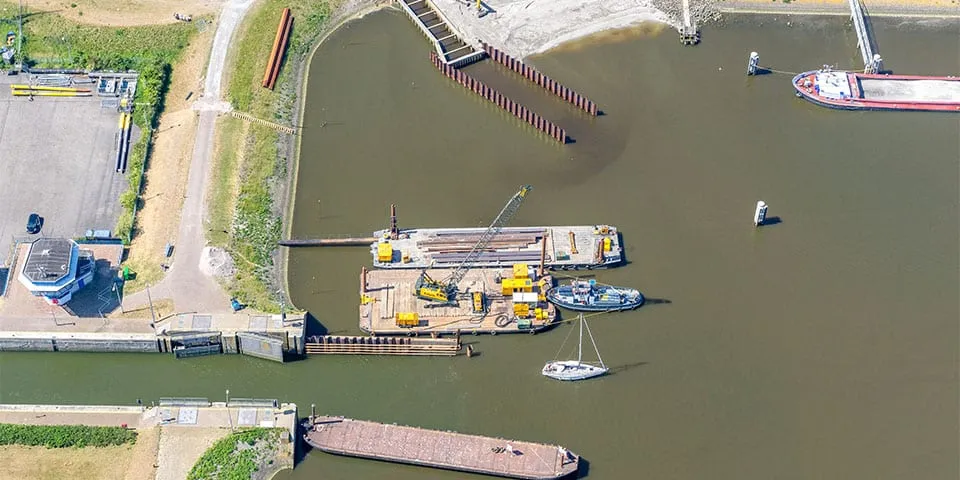
Aerial view of the work on the flood barrier at Den Oever.
The flood barrier at Kornwerderzand
The flood barrier at Kornwerderzand is being built on the Wadden Sea side of the bridges. A rolling gate is being used at Kornwerderzand. Made from steel sections and plates, it is operated hydraulically using winches and cables. Bentlage explains: “We chose a rolling gate because of the width of the navigation channel. The gate weighs no less than 900,000 kg, is 56 metres wide and 12 metres high, and will be rolled shut when water levels are exceptionally high. As with the barrier at Den Oever, this will protect the navigation lock and the hinterland from the force of the water. The concrete rail beams for the concrete runway will be manufactured elsewhere, then installed as prefabricated units using a floating sheerleg crane. This method will significantly shorten the construction period, allowing vessels to pass through sooner. The concrete mix for the units has also been carefully designed. It is high-strength concrete, formulated to withstand the heavy loads rolling over the runway and ensure a long service life for the structure. Another time-saving measure is the use of prefabricated concrete aprons on the waterside of the permanent sheet-pile walls. The sheet-pile walls will later be filled with concrete.”
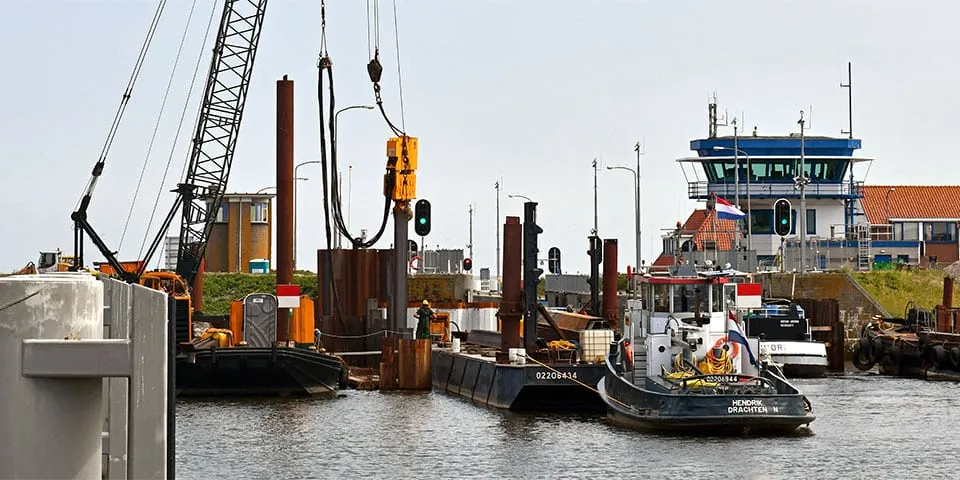
Construction of the flood barrier at Den Oever
Innovative and sustainable working methods
Levvel is taking an innovative, sustainable and environmentally responsible approach across the board. Wijnants gives the temporary flood defence needed to build the dike opening, or cut-through, at the Vismigratierivier as an example. It is made from Levvel-blocs. “Once the temporary flood defence has served its purpose, we will move the Levvel-blocs to their permanent position on the dike. Another innovation is the concrete runway planned for the flood barrier at Kornwerderzand. Rolling gates normally run on steel rails, but these are prone to deformation and require maintenance. Concrete is much more durable in this respect and extends the service life of the flood barrier. Using a concrete runway for a rolling gate is entirely new.”
Taking ecology into account
To conclude, Wijnants and Bentlage explain how carefully ecology around the Afsluitdijk is being considered. “Levvel has gone a step further by deploying an ecology team at both flood barrier sites. The team assessed the impact of each barrier on the local flora and fauna. The conclusion is positive: neither barrier will have more than a minimal impact on the surrounding ecology.”
Have a business enquiry for Van Oord? Get in touch
Companies in this story
Keep following this
Get an email when a new story is published. No account needed.
- ThemeFlood protection and climate-resilient water management
- SubjectWater infrastructure
- CompanyVan Oord







