









New De Poel pumping station: a remarkable feat in the Zeeland polders
Text Suzanne van Gaale Beeld Van Boekel Bouw & Infra / Waterschap Scheldestromen
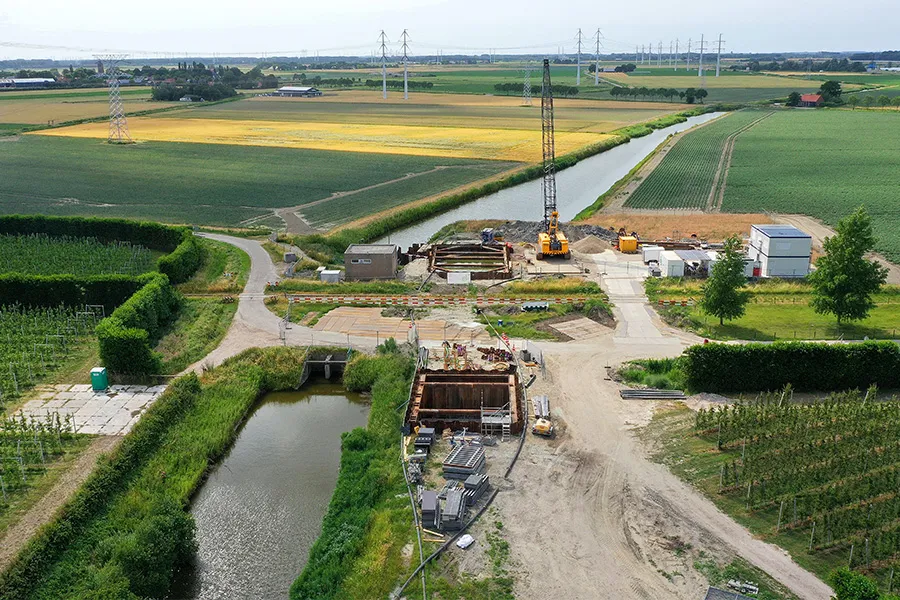
In less than a year and a half, the old De Poel pumping station in ’s-Heer Abtskerke, Zeeland, near Goes, was replaced by a completely new, larger station. A remarkable feat: as well as increased pumping capacity, it now has two fish-friendly pumps, a fish pass and a return-flow pipe. The new pumping station will help keep Goes and the surrounding area dry for the next 100 years.
“What makes the new polder pumping station unique is the number of different aspects involved,” says Noud IJzerman, project coordinator at Van Boekel Bouw & Infra. The construction company was the project’s main contractor. “A complete cofferdam had to be built. The pumping station is also next to the railway line used by the steam train between Goes and Borssele, its pumping capacity has been increased, and the new station is fish-friendly. Each of these elements presented its own challenges.” Van Boekel has plenty of experience in building and refurbishing pumping stations. The company is involved, among other projects, in the Vier Poldergemalen project for Hoogheemraadschap van Rijnland; it has worked for Waterschap Brabantse Delta to make a number of water structures in West Brabant fish-friendly; it is responsible for refurbishing Poldergemaal Besjeslaan in Leiden; and it is carrying out the raamovereenkomst Poldergemalen for Hoogheemraadschap van Rijnland.
Why a new pumping station was needed
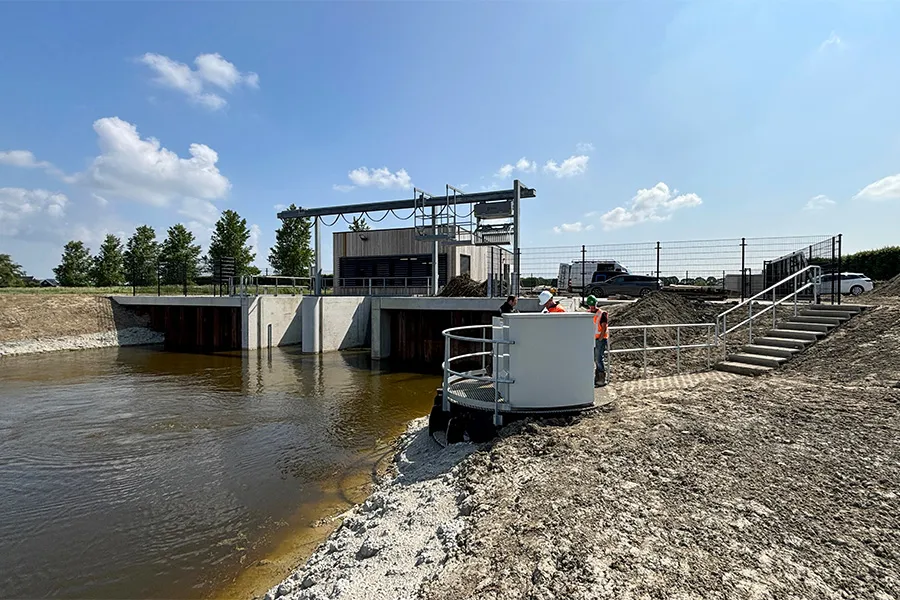
Van Boekel Bouw & Infra built De Poel pumping station in Zeeland for Waterschap Scheldestromen. The main reason for replacing it was that the old station’s capacity no longer met the current standards set by Waterbeheer 21ste eeuw. The new station is intended to help create a robust, future-proof water system. “To ensure the water system remains fit for purpose for the next 100 years, its capacity needed to be increased,” explains Marnix van den Manacker, project manager at Waterschap Scheldestromen.
“The old system of polder drainage consisted of two Archimedes screw pumps. This screw-pump station had proved vulnerable in the past. If the water level in the upper reach became too high, the screw could not discharge the water, which could even flow back over the screws.” If Waterschap Scheldestromen had left the existing situation unchanged, various problems could have arisen. These included excessively high groundwater levels affecting agriculture, agricultural land being inundated during extreme rainfall, problems with the supply and discharge of surface water, and water-quality issues. The new pumping station has two pumps that can discharge 270 m3 of water per minute, an increase of 50 m3 per minute compared with the old station. “This means we can manage and discharge water levels even in extreme conditions,” says Marnix. The project cost around €9 million, of which €3,350,000 was received in E-POP-3 subsidy.
A robust water system
Alongside the increased capacity, there was another key requirement: contributing to the clean-water objectives of the Water Framework Directive (WFD). Marnix explains: “We want to create an ecologically robust water system with ample opportunities for fish migration. In the old system, fish could not migrate. The two new pumps are fish-friendly, and the two old discharge pipes have been put to new uses. One is used as a return-flow pipe, allowing us to bring water in during dry periods. The other now serves as a fish pass, with a fish lift, so fish entering the polder from the Westerschelde via Maelstede pumping station can continue swimming towards the area around Goes. These are mainly European eels (glass eels) and three-spined sticklebacks migrating inland from the sea. The fish pass also allows species such as perch, pike-perch, roach, giebel and carp to move between polders.” What is unusual about the fish pass is that it uses a so-called fish lift. Whereas a pumping station normally blocks fish from swimming upstream, the lift now creates a continuous attraction flow on both sides of the two water-level zones. It also has a built-in camera that can identify and count fish.
Design
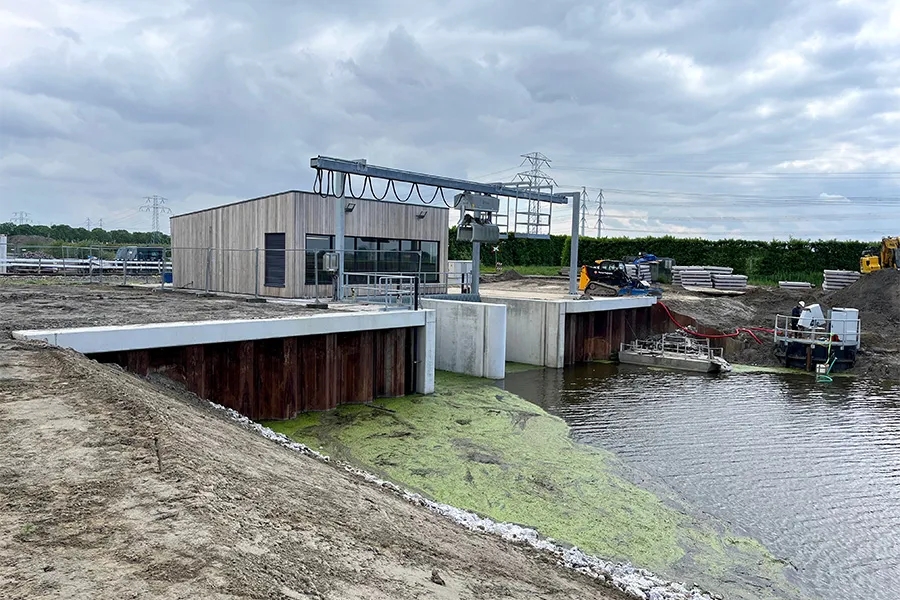
The water authority had prepared a preliminary design for the new building. Van Boekel developed it into a detailed design. Noud says: “The pumps are essential to a polder pumping station. Their dimensions are fixed, and you design the concrete shell around them. It is easy to build a large structure so you have plenty of room, but that also adds significantly to the cost. The challenge is to create a compact building that everyone is happy with and that strikes the right balance between the space required and the cost.” The final result is a sustainable building that fits well into its surroundings. Marnix says: “It is a simple but attractive building. The old pumping station was built of brick, but for the new one we chose timber cladding and a sedum roof.”
Railway line
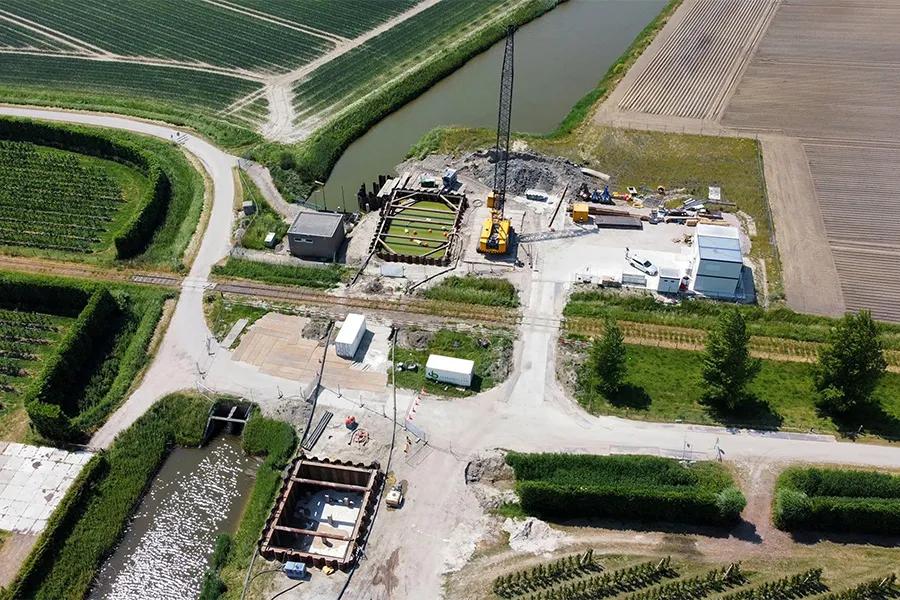
As Noud mentioned at the start of this article, the construction project presented several challenges. In his view, the railway line was the biggest. “The line is managed by heritage railway operator Stoomtrein Goes-Borssele. We had a month to lay the discharge pipes. The heritage railway operator removed the track itself. We designed the foundation piles so that they fell outside the track, allowing us to install them at an earlier stage. That saved a lot of time. We then began excavating. It was November 2023, a very wet period. With all that water, we certainly had our work cut out for us at the bottom of the cofferdam.”
Unexpected hard layer of ground
Speaking of the cofferdam, during excavation of the inlet structure the team unexpectedly encountered a very hard layer containing oysters and shells. Noud says: “Despite thorough ground investigations, this came as a surprise. We had to change our excavation method as a result. Instead of jetting the soil loose and sucking it out into a separate silt basin, we used an excavator. To avoid striking the foundation piles, we also brought in extra divers to guide the excavation.”
Working together
Work began in March 2023, and the new pumping station came into operation in June 2024. Both parties are very pleased with the collaboration. “It is a pleasure working with Waterschap Scheldestromen,” says Noud. “Together, we managed to deliver a well-functioning pumping station in a relatively short time. We enjoyed working on this project as main contractor.” Marnix is also proud of the end result. “A small team got the job done in a short time. The two pumps have already each run for more than 500 hours. They will certainly prove their worth in the years to come.”
Question about this story? Ask your question
Who worked on Gemaal De Poel
- clientHoogheemraadschap Hollands NoorderkwartierMentioned in Architectural superstructure for De Poel pumping station
- architectArchitecten- en ingenieursbureau H.W. van der LaanMentioned in Architectural superstructure for De Poel pumping station
- construction consortiumVOBI InfraMentioned in Architectural superstructure for De Poel pumping station
- construction consortiumGebr. Beentjes GWWMentioned in Architectural superstructure for De Poel pumping station
- soil protection
 Van AalsburgMentioned in Fascine mattresses provide bed protection at De Poel pumping station
- construction consortiumConstruction consortium De PoelMentioned in Fascine mattresses provide bed protection at De Poel pumping station
- structural engineeringIngenieursbureau Verhoeven en LeendersMentioned in Smart combination of permanent and temporary works at De Poel pumping station
- main contractorVan Boekel Bouw & InfraMentioned in Smart combination of permanent and temporary works at De Poel pumping station

Keep following this
Get an email when a new story is published. No account needed.
- ProjectGemaal De Poel
- ThemeFlood protection and climate-resilient water management
- SubjectWater infrastructure







