









N737 set to become the smartest road in the Netherlands
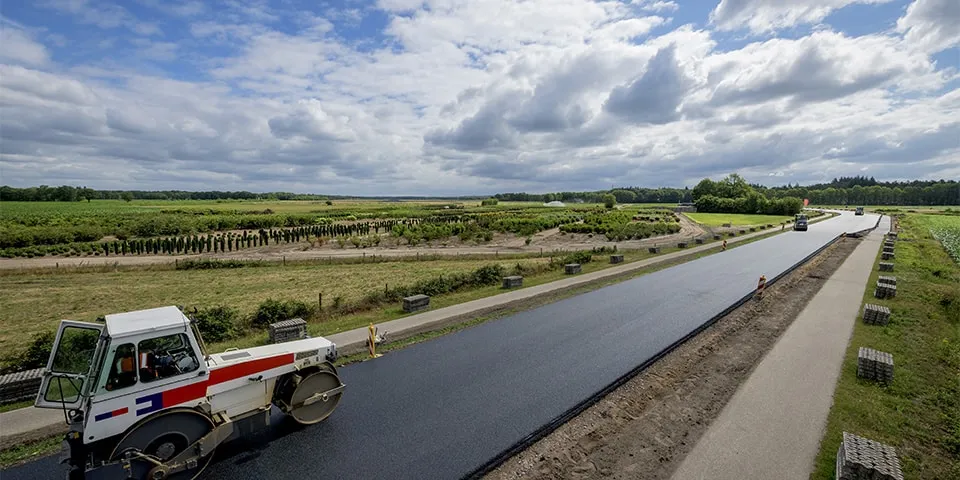
The N737 provincial road between Enschede and Deurningen (Overijssel) is to undergo major works. From mid to late 2019, major maintenance work will be carried out along a 6 km stretch, with the aim of creating a safe, sustainable and most innovative road in the Netherlands.
The N737 is a provincial road that Strukton Civiel Noord & Oost is to make safe, sustainable and innovative on behalf of the Province of Overijssel. To achieve this, Strukton has developed innovations with several regional partners, including MOTIS. This will help ensure sustainable and smoother traffic flow. The road will have a smart junction with traffic signals that ‘think along’ with the traffic. At this intelligent traffic signal installation, vehicles are detected using sound sensors. Jan Hendrik Fischer, area manager at Strukton Civiel Noord & Oost, describes this as a unique development: “The traffic signals can be linked to an app that ‘recognises’ you if you pass at the same time every day. Using the SMART+ app and sound-sensor detection, the signals know exactly when traffic is passing, whether it is slow-moving, fast-moving or heavy traffic. The aim is to reduce waiting times at traffic lights and manage traffic flows in an environmentally friendly way.”
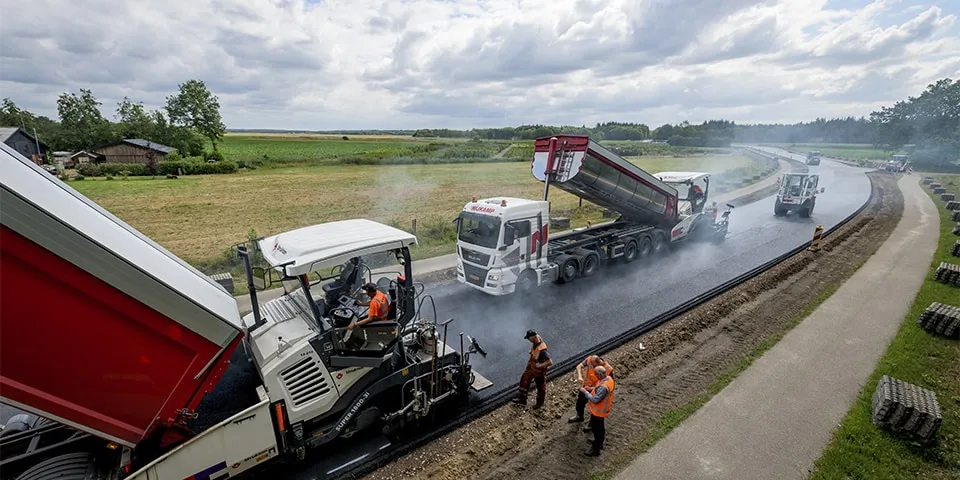
Laying the asphalt surface course on the N737.
Dynamic lanes
Strukton will also install a dynamic lane layout. Two lanes will operate dynamically, which means traffic will be directed in different directions depending on demand. For example, during rush hour the lane for straight-ahead traffic will be used by large volumes of left-turning traffic, improving traffic flow. Strukton has also come up with a solution for slow-moving traffic. “Passing bays for agricultural vehicles, equipped with sound detection to monitor traffic,” says Fischer. “When a tractor is on the road, other road users receive an alert. The agricultural vehicle can then safely pull into a passing bay, while other traffic can continue without dangerous overtaking manoeuvres.”
Circularity and lower CO2 consumption
The road will also be surfaced with asphalt containing 97% secondary materials. This Greenfalt will be used for all layers, including the surface course. Fischer says: “It’s very sustainable. This asphalt mix, made from recycled porous asphalt and railway ballast, results in lower CO2 consumption.”
Sustainable widening
Finally, the asphalt road will be widened sustainably using cement-free concrete, minimising the amount of existing asphalt that has to be removed. “It is the same material as that used for the first cement-free concrete roundabout in Europe, which we developed and built on the N737 a year and a half ago,” says Fischer.
A business enquiry for Strukton Civiel? Get in touch
Companies in this story

Keep following this
Get an email when a new story is published. No account needed.
- ThemeLower emissions and more reuse
- SubjectWater infrastructure
- CompanyStrukton Civiel







