









Making currents visible to ensure safe diving operations
Text Roel van Gils Photography Aqua Vision
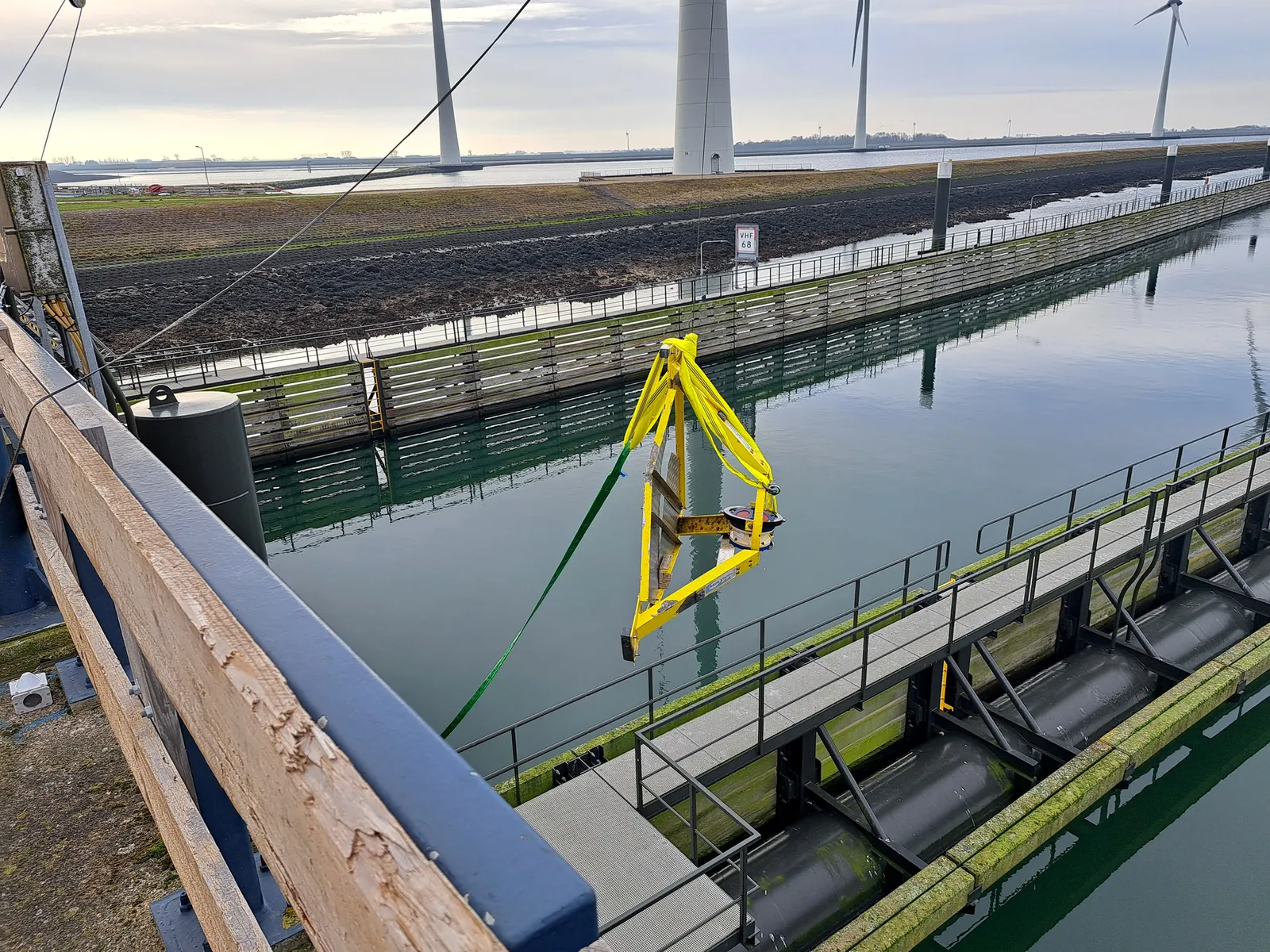
How safe is it to carry out diving work right next to the entrance to a busy lock chamber? That was the key question for the ZEEKR consortium, as divers had to install a steel connection plate for a future cofferdam. To map the risks objectively, Aqua Vision, a specialist in water-column measurements, carried out an extensive measurement campaign.
Aqua Vision has specialised in measuring currents in the water column using acoustic Doppler equipment for almost thirty years. “For this project, we installed a measuring frame at three strategic locations,” says Jeroen van Dam, sales manager at Aqua Vision. “The aim was to establish the current speeds generated by passing boats and whether additional safety measures were needed for safe diving operations. At current speeds above 0.5 metres per second, divers must work from a protective diving cage.”
Doppler effect
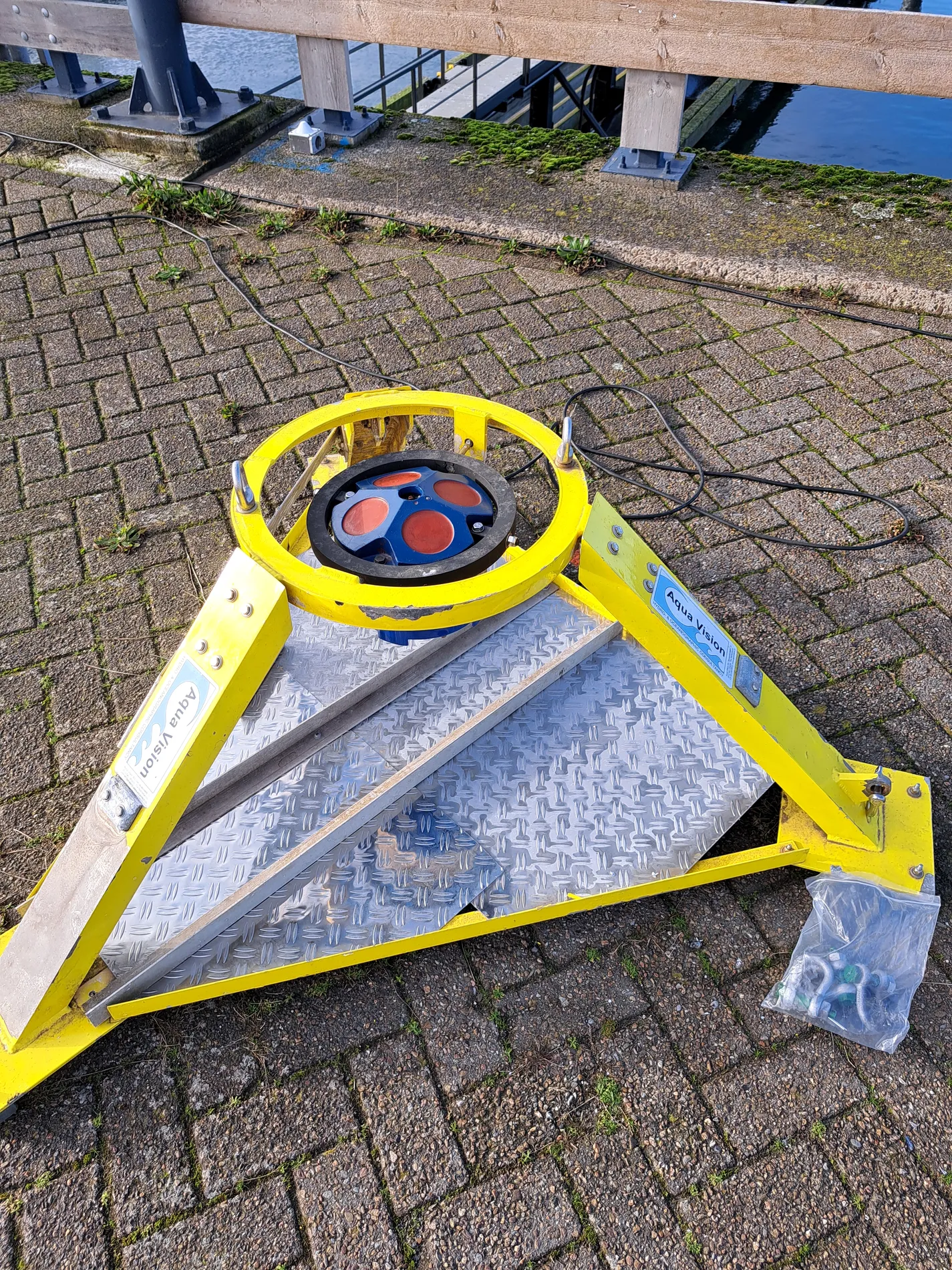
A diving cage protects the diver from being drawn in and from strong currents, but it also significantly restricts freedom of movement. “That is why it was important to establish objectively whether this costly measure was necessary,” says Almar Bijlsma, project manager at Aqua Vision. “To do so, we installed three seabed frames fitted with an Acoustic Doppler Current Profiler (ADCP), which measures current speed throughout the water column. The equipment emits sound waves into the water, which are reflected by small particles such as air bubbles, sand or algae. By analysing the distortion of the returning signal, known as the Doppler effect, we can determine very accurately how fast the water is flowing and in which direction.” Measurements were taken every twenty centimetres throughout the water depth.
Correlated with AIS data
The measuring frame was connected to the shore by a data and power cable. “This allows us to check, when installing the frames, that each frame is correctly positioned and that the ADCP is recording valid data. As the measurements were taken close to the quay, the beam facing the quay was deliberately excluded. Interference from the quay would have produced poor-quality data,” says Almar. “We then correlated the measurements with AIS data from passing vessels. This made it possible to establish exactly which currents were generated by vessels entering and leaving the lock. The ZEEKR consortium interpreted the data to determine control measures for safe diving operations.”
Aqua Vision’s measurements showed that passing vessels generate strong currents in the upper part of the water column, particularly near the navigation channel. “Divers therefore have to work from a cage in this zone,” says Wouter Sloven of the ZEEKR consortium. “However, currents generated by shipping decrease rapidly with distance from the navigation channel. This means the work can be carried out safely without a diving cage in the middle of the flood defence. Markers have now been installed based on these results to indicate the safe working zone.”
A business enquiry for Aqua Vision B.V.? Get in touch
Companies in this story
Keep following this
Get an email when a new story is published. No account needed.
- SubjectWater infrastructure
- CompanyAqua Vision B.V.







