









Major cofferdam for the Fish Migration River
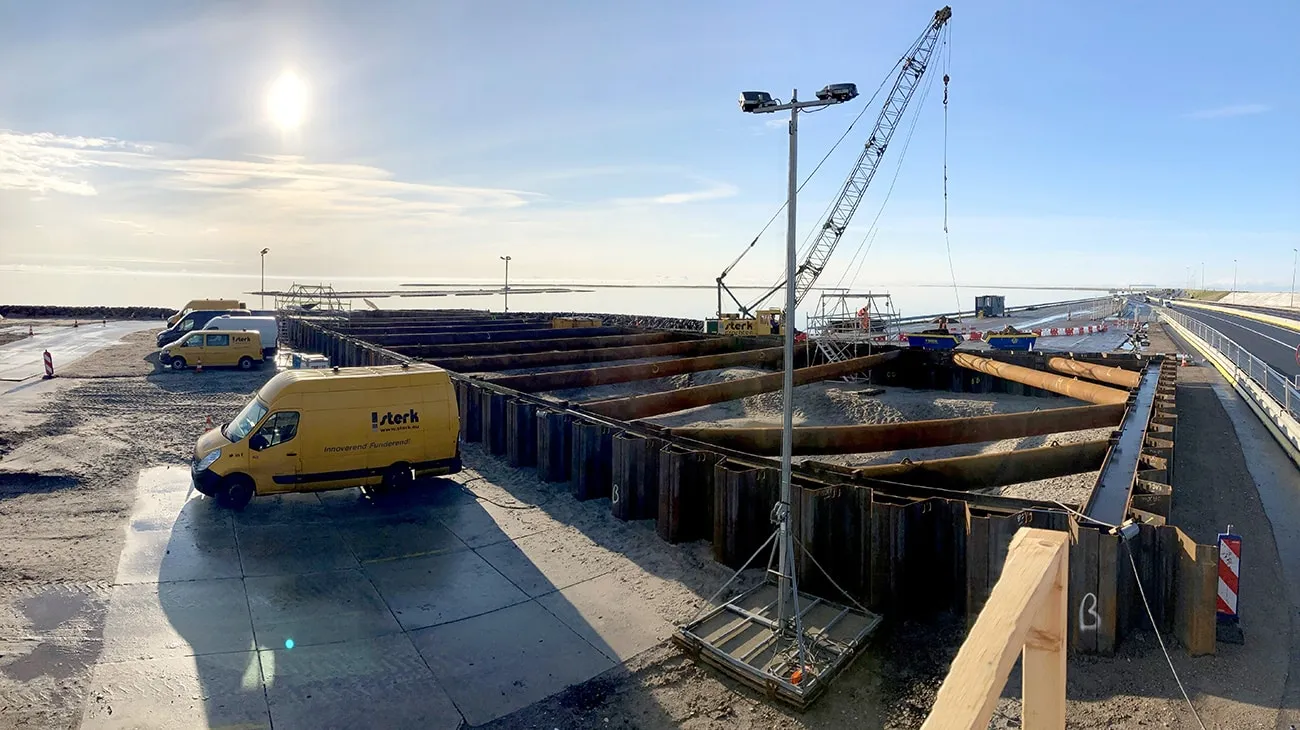
Steel sheet piling
One of the distinctive features of the upgraded Afsluitdijk is the Fish Migration River: a 4-kilometre-long, meandering ‘river’ running right through the Afsluitdijk. This allows migratory fish to swim between the saltwater Wadden Sea and the freshwater IJsselmeer. To make this possible, a hole literally has to be cut through the dyke for the river to flow through. Foundation specialist Sterk BV built the substantial cofferdam beneath the A7 for Levvel, on behalf of Rijkswaterstaat. It is also responsible for all the cofferdams, strut frame structures and anchoring at the navigation locks in Kornwerderzand and Den Oever.
Cofferdams built using steel sheet piling are what Sterk does best. A 140-year-old family business with the distinction of ‘By Royal Warrant Holder’, Sterk knows that no two contracts are the same. Finding solutions is its strength. “We are committed to quality and have a wide range of techniques at our disposal for building cofferdams,” explains Harm Wammes, project manager at Sterk. “We decide on the best construction method for each project. Where is the site? What is the ground like? Are there sensitive structures underground? Our versatility is precisely what makes us strong.”
Under the A7
For the Fish Migration River, Sterk built a substantial cofferdam measuring approximately 126 by 20 metres, running beneath the A7. The cofferdam consists of two sections: the northern cofferdam on the Wadden Sea side and the southern cofferdam on the IJsselmeer side. The sheet piles between the two cofferdams were removed in early 2022. Since then, work on the passage for the Fish Migration River at Kornwerderzand has continued from a single cofferdam. “We handled the complete package for these cofferdams. That means installing the steel sheet piles, then supplying and installing the strut frame.” Sterk also carried out the detailed design of the strut frame.
Safety measures
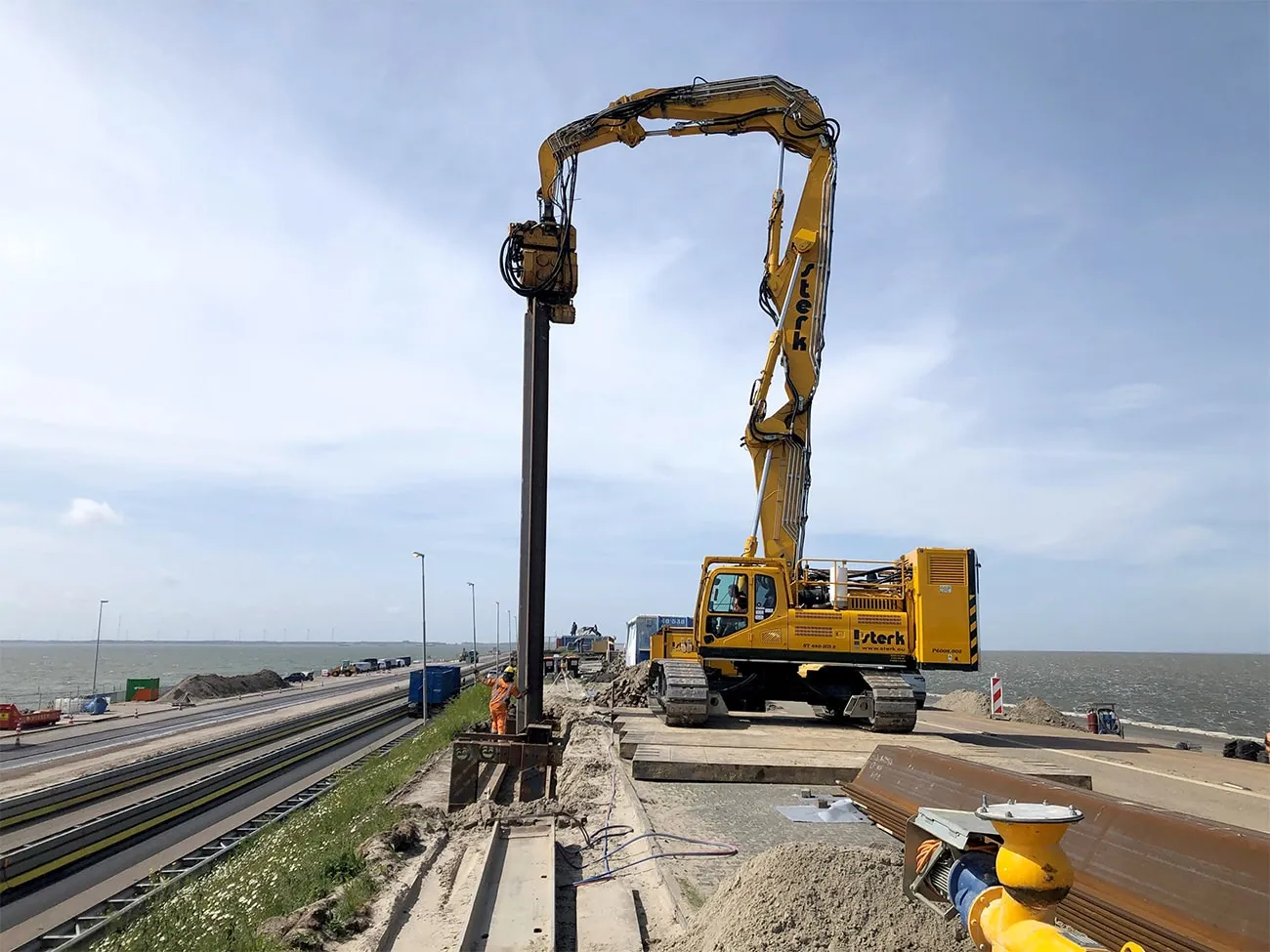
According to Wammes, one of the best things about the work is operating heavy machinery. “It’s always exciting to see how things go, because you can’t see what’s underground. The sheet piles are very heavy (AZ36-700, 24 metres long) and don’t always go into the ground easily. Sometimes heavy piling is needed. For the Fish Migration River cofferdams, for example, we used 90-tonne crawler cranes with large vibratory hammers (2350 VM). We also used fluidisation in several places to get the piles down to the required depth. This calls for the necessary safety measures, particularly given that the work had to be carried out only a few metres from the A7. To protect road users, we closely monitored settlement of the road surface and took every conceivable safety precaution during piling.”
Dual-purpose machine
The family business’s slogan is ‘Innovative Foundations’. The innovative aspect also came into play at the Afsluitdijk. Wammes explains: “At the Lely Monument, halfway along the dyke, we also installed a sheet-pile structure with anchoring. For this, we used a machine we developed ourselves that can install sheet piles and also function as an anchor drilling rig. We can reconfigure the machine in under an hour. That saves a lot of time, transportation and costs.” The sheet piles were installed during the day, and the anchors were installed at night using the same machine. Everything was completed within 24 hours.
At Sterk, they are proud of their contribution to the Afsluitdijk’s upgrade. “It’s wonderful to work on a structure so distinctive and iconic for the Netherlands.”
A business enquiry for Sterk BV? Get in touch
Who worked on it
Vismigratierivier
- foundation specialistSterk
Keep following this
Get an email when a new story is published. No account needed.
- ProjectVismigratierivier
- ThemeUnderground construction
- SubjectWater infrastructure
- CompanySterk BV







