









Keeping a close eye on emergency repairs to Amsterdam’s quay walls and bridges
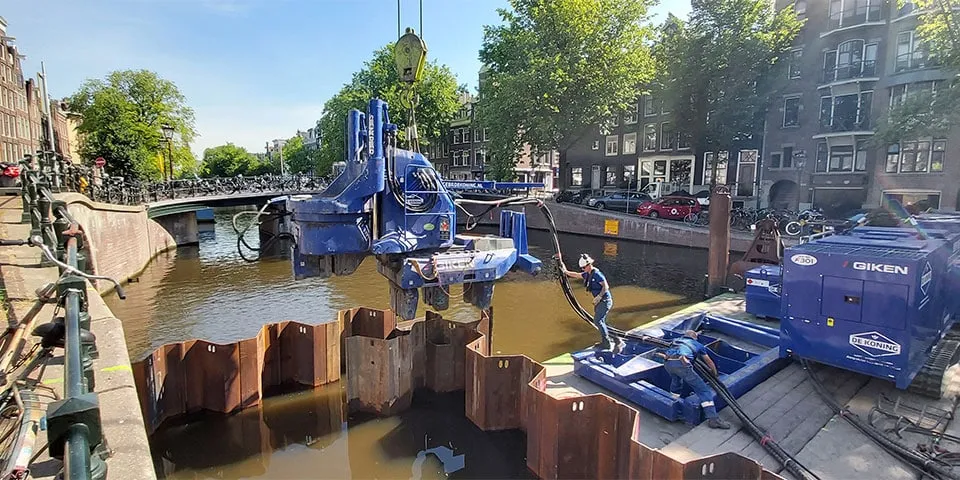
Amsterdam is embarking on a major programme to repair numerous quay walls and bridges in the historic city centre. Monitoring the impact of construction work on the surrounding area is essential, particularly when installing steel sheet piles in the historic canals. For BouwRisk, monitoring the effects of construction work is part of the daily routine.
The quay walls and bridges in Amsterdam’s Canal Ring are in a poor state. Since the 1980s, maintenance of this centuries-old infrastructure has been systematically cut back. The timber pile foundations are now simply reaching the end of their life. What is more, the quay walls and bridges were originally designed for pedestrians and horse-drawn carts, not heavy goods vehicles and parking alongside the water. In many places, the consequences are now becoming apparent. The city has since taken central control from the district councils and drawn up the Quay Walls and Bridges Programme. The repair programme is expected to take decades and cost hundreds of millions, if not more than a billion euros. But the work has to be done: nobody wants an inaccessible city centre or unsafe quay walls.
Safety structures
The most urgent problems must be tackled first. “Initial surveys showed that 190 kilometres of quay wall are in poor condition. Some sections are so bad that a safety structure must be put in place immediately to prevent collapse,” says Yvo Hollman, managing director of BouwRisk, an engineering consultancy in Eindhoven specialising in monitoring the impact of construction work on the surrounding area. “A permanent solution requires a long lead-in time, but something has to be done to ensure the safety of the quay walls until renewal begins. That is why safety structures are being installed along a number of quays to provide protection until the work can be carried out. Sheet piles are installed some distance in front of the quay wall, the gap is then filled with sand and the quay wall is propped against the sheet piles. BouwRisk has been asked to monitor settlement, noise, vibration and tilting at the quay walls and adjacent buildings before, during and after the work.”
Vibrating and pressing
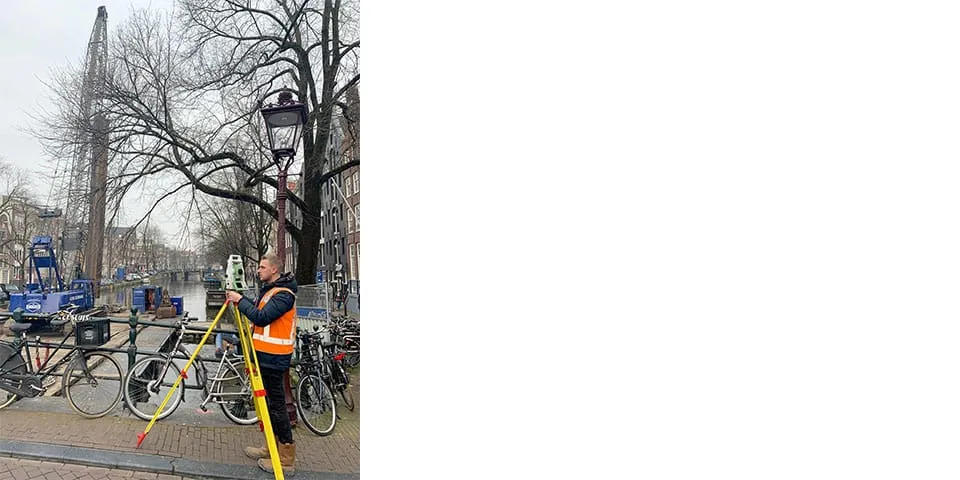
BouwRisk was previously involved in replacing a section of quay wall near the Anne Frank House and the Westertoren, and in recent months has monitored construction of the safety structure on the eastern side of the Prinsengracht, between the Rozengracht and Reestraat. Hollman: “We worked with CRUX Engineering BV, which made predictions about deformation, noise and vibration. CRUX also drew up a protocol specifying what should be monitored and where. This includes looking at the effects of site traffic and other work, particularly the installation of the sheet piles. Some of the sheet piles are installed by vibration, while others are pressed into place to the required depth using static force. Keeping a close eye on the buildings is the most important thing. We start measuring the natural settlement behaviour of buildings two years before renewing a quay. Unfortunately, that is not always possible when installing a safety structure. You need a good baseline survey. This is one reason why work on quay walls cannot be started at a moment’s notice. We mainly monitor quay walls for tilting. Within a few months, badly damaged sections can move a centimetre further out of plumb. A safety structure stabilises this kind of movement.”
Pulitzer Hotel
Every effort is made to minimise disruption during the work. Hollman: “Where possible, the sheet piles were installed by vibration. In locations where this was not possible because of noise or vibration, the sheet piles were installed by static pressing, which produces little vibration. We monitored the effects of vibration at every location where sheet piles were installed. Thanks to this approach, residents and guests at the Pulitzer Hotel experienced minimal disruption. The sheet piles were installed during the off-season, and the canal-facing rooms were kept empty during that period. A beautiful terrace was also built for the hotel on the safety structure. We are making the best of a difficult situation.”
BouwRisk, working with RPS and IV-Infra, has several framework contracts with the Municipality of Amsterdam to monitor deformation of vulnerable quay walls. This involves tens of kilometres of quay wall being closely monitored. The future of the temporary safety structures has recently become clear. The Municipality launched a call for proposals for an innovative, fast-track approach to the complex quay wall problem, selecting three consortia. They have now begun the research and development phase to renew quay walls. Pilot projects will start in 2021.
Question about this story? Ask your question
Keep following this
Get an email when a new story is published. No account needed.
- ThemeExtending the life of roads and civil engineering structures
- SubjectWater infrastructure







