









Is sustainable water management possible in urban areas?
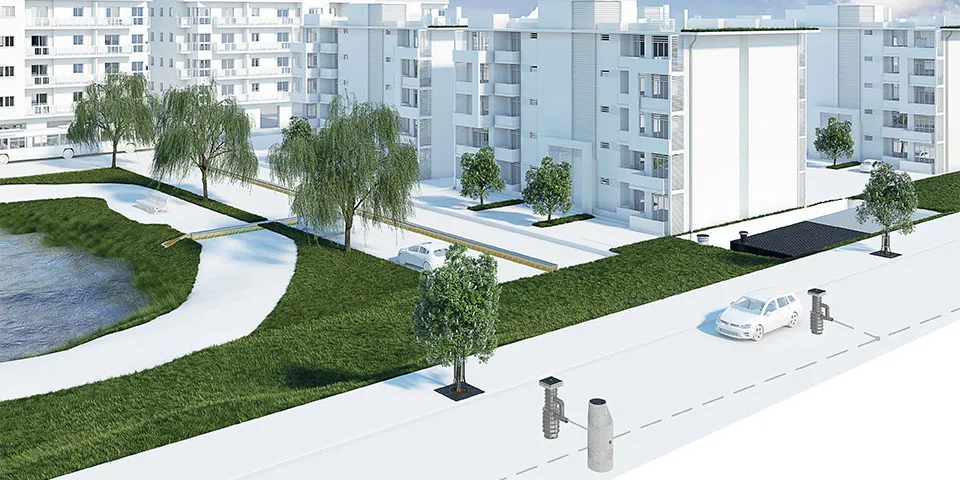
The effects of climate change are visible everywhere. Extreme downpours and long periods of drought cause disruption and damage. That is why many local authorities are already informing residents about ways to make their gardens climate-resilient, and even offering climate grants for garden infiltration solutions. But is that enough? Could local authorities take a broader approach? In this article, we take you along on our search for the solution.
Making smart use of rainwater
It is well known that, in urban areas, all the buildings and paved surfaces mean rainwater cannot always be conveyed to swales or surface water. This will only become more problematic, as the expectation is that 70% of the world’s population will live in cities in 5 years’ time. This will mean more buildings and fewer options for draining rainwater, with all the consequences that entails. Climate change is making downpours more intense, putting greater strain on the sewer system and increasing the risk of flooding. How can we ensure urban areas remain as liveable as possible?
ACO Stormbrixx, a CO2-friendly infiltration and storage system.
A conversation with Rieks Hulst of ACO, a company that supplies innovative, high-quality drainage products and systems, provides some answers. “Everything ACO does is focused on enabling people and nature to benefit from water as much as possible. Since drying out of urban greenery is just as significant an issue as water storage, ACO has developed the Sustainable Urban Drainage System (D-SAS) concept. This system combines drainage and storage with returning rainwater to nearby green spaces. To make D-SAS possible, we offer a range of solutions that keep trees and shrubs green while relieving pressure on the sewer system during heavy rainfall. We often meet clients at an early stage to develop an integrated vision together for ‘managing’ rainwater. Infiltration, in particular, has been approached differently in recent years. Today, the preference is to infiltrate rainwater on site. In cities, however, space is limited, and shallow infiltration solutions are preferred because of all the cables and pipes underground. That is why we recently developed the infiltration channel, which can even be driven over by lorries.”
Cross-section of the ACO infiltration channel.
Infiltration channel
During rainfall, the infiltration channel collects rainwater and infiltrates it locally into the soil, close to the surface. This relieves pressure on the sewer system. The infiltration channel is fitted with bottom outlets and vertical infiltration wicks made from environmentally friendly, sustainable stone wool. These wicks allow rainwater to infiltrate the soil and then be released into the subsoil, preventing the soil from drying out. The infiltration channel can be fitted with various grating covers, including custom-made gratings.
CO2-friendly infiltration and storage system
To collect large volumes of water, ACO offers Stormbrixx, a CO2-friendly infiltration and storage system for urban areas and areas subject to heavy traffic. This proven system of stackable plastic units can store and infiltrate large volumes of water. The lightweight, stackable Stormbrixx offers the advantages of minimal transport costs and significantly fewer handling operations on site.

This system combines drainage and storage with returning rainwater to nearby green spaces.
Conclusion
Thanks to the ACO D-SAS concept, local authorities can now also take measures to make streets and neighbourhoods climate-resilient. They are no longer dependent on garden infiltration solutions, although ACO also offers some excellent options for gardens through its EasyGarden programme. I’m curious to see which local authority will be the first to install the infiltration channel. No doubt we’ll hear more about that in the future.
Question about this story? Ask your question
Keep following this
Get an email when a new story is published. No account needed.
- ThemeFlood protection and climate-resilient water management
- SubjectWater infrastructure







