









Installing bank protection at temporary unloading sites
Text Roel van GilsImage Van Dijke Maritime Services
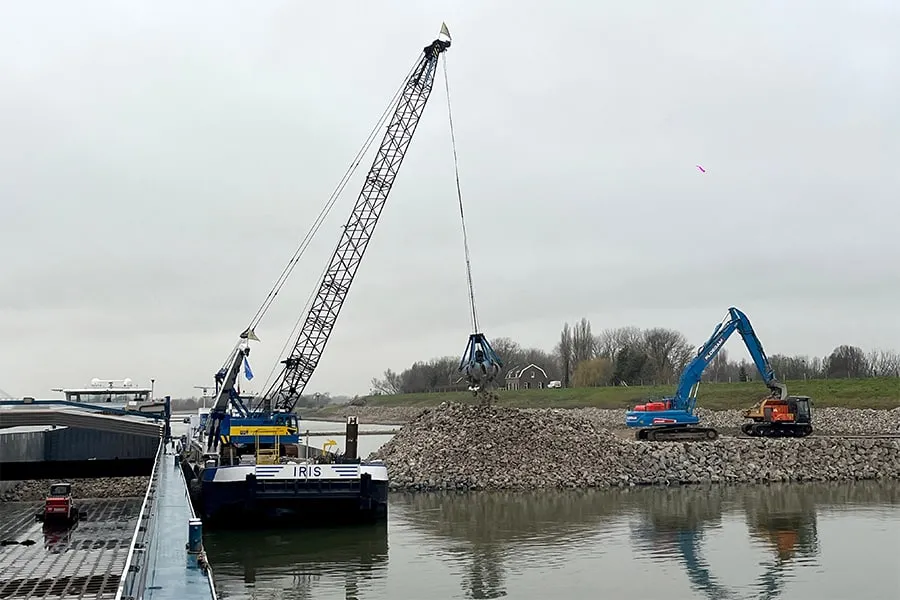
To minimise disruption to the surrounding area, the Mekante Diek construction consortium is carrying out most of the dike reinforcement work between Tiel and Waardenburg from the water and via temporary unloading sites. Van Dijke Maritime Services laid the foundations for two of these sites using its ‘Green Award’ crane vessel.
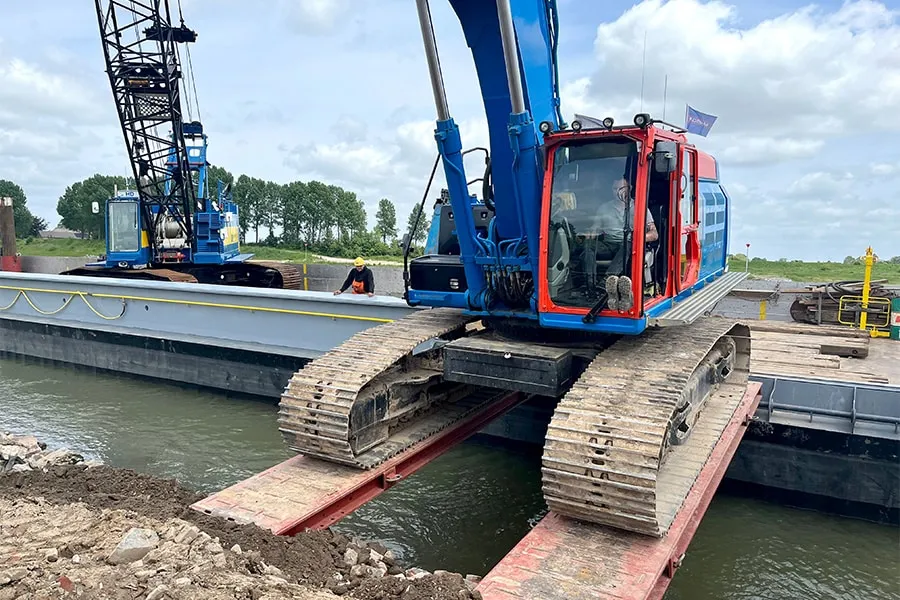
Van Dijke Maritime Services is a family business with a long history, founded in 1885. Dick van Dijke proudly tells us that his son is already learning the ropes, so the next generation is assured. “Our crane vessel specialises mainly in all kinds of lifting work on the water,” he says. This ranges from installing sheet piles or posts to bank protection work and transporting machinery by water. We have a long-standing relationship with Ploegam (which forms Mekante Diek together with Dura Vermeer and Van Oord, ed.) on projects, and we also regularly transport heavy machinery by water from one project to another.”
Green Award
Van Dijke Maritime Services’ crane vessel is equipped with state-of-the-art engines. “Our crane vessel is certified with a Green Award, a quality mark for vessels that meet stringent safety and environmental requirements,” Dick explains. “Using specialised software, we can calculate CO2 emissions for each engine and at different engine speeds. The engine speed varies depending on the activity. This gives the main contractor an accurate figure for the CO2 emissions, in kilograms, from the work carried out.”
Bank protection
Here at Mekante Diek, Van Dijke Maritime Services laid the foundations for bank protection at two unloading sites, consisting of fascine mattresses and riprap. “Fascine mattresses are large mats made of willow branches and fabric, and serve as bed protection,” says Dick. “They were assembled ashore, then picked up by our crane vessel and lowered into place at the exact position using GPS coordinates. The fascine mattresses were then covered with riprap, which we also supplied. We were responsible not only for unloading around 3,500 tonnes of riprap, but also for shaping the dam or bank.”
Versatile in its work
The two unloading sites are now fully operational. Vessels come and go carrying clay and other materials. Heavy equipment is also transported by water wherever possible, and Van Dijke Maritime Services is called in for this too. “During the preparatory phase, soil samples were also taken from our vessel,” Dick adds. “We offer a very versatile service and, wherever possible, try to combine tasks. And of course, we hope to be called in again at the end of the project to dismantle the unloading sites.”
Question about this story? Ask your question
Companies in this story
Keep following this
Get an email when a new story is published. No account needed.
- ThemeFlood protection and climate-resilient water management
- SubjectWater infrastructure
- CompanyVan Oord







