









Innovative: MV piling rig with free-hanging leader
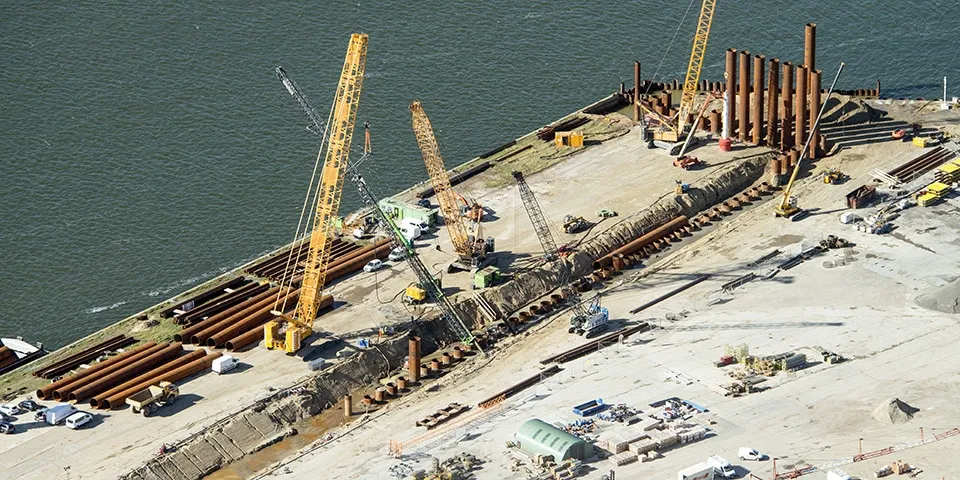
The Port of Antwerp is growing steadily. To accommodate larger vessels at the new tank terminal in future, the existing quay wall in Kanaaldok B2 is being transformed into a deep-water quay. Jan De Nul Group invested in the technology for installing the anchor piles (MV piles) for the new combi wall. Meet the MV piling rig with its 60-metre free-hanging leader, unique in the Benelux.
47 sections
The new quay wall is 800 metres long and is being built in stages in front of the existing quay wall. It is a combi-wall structure comprising 280 tubular piles, each with a diameter of 2 metres, and an equal number of sheet piles. The combi wall is anchored by a total of 240 MV piles installed over the tubular piles. The whole structure is finished with a concrete capping beam. “We divided the new quay wall into 47 sections, each 24 metres long, comprising six tubular piles and 360 m3 of concrete,” says Jan Landuyt of Soetaert-Soiltech, which is 100% part of Jan De Nul Group. “The entire project is managed and carried out within the group.”

Instead of a fixed frame, we use a free-hanging leader.
600-tonne cable crane
Driving combi walls is nothing new for Jan De Nul Group. Landuyt says: “We have extensive expertise in installing combi walls in the Netherlands and Belgium, and even in Poland. Installing MV piles, on the other hand, was new for the group. Only a handful of companies in the Benelux have mastered the technique. The technique was specified in the public tender for this project, and after the contract was awarded, we invested in the appropriate equipment. The main difference with our system lies in the equipment. Instead of a fixed frame, we use a Liebherr free-hanging leader hoisted by a 600-tonne cable crane. This means we do not have to lay tracks to move the MV piling rig. That is always a very time-consuming task.”
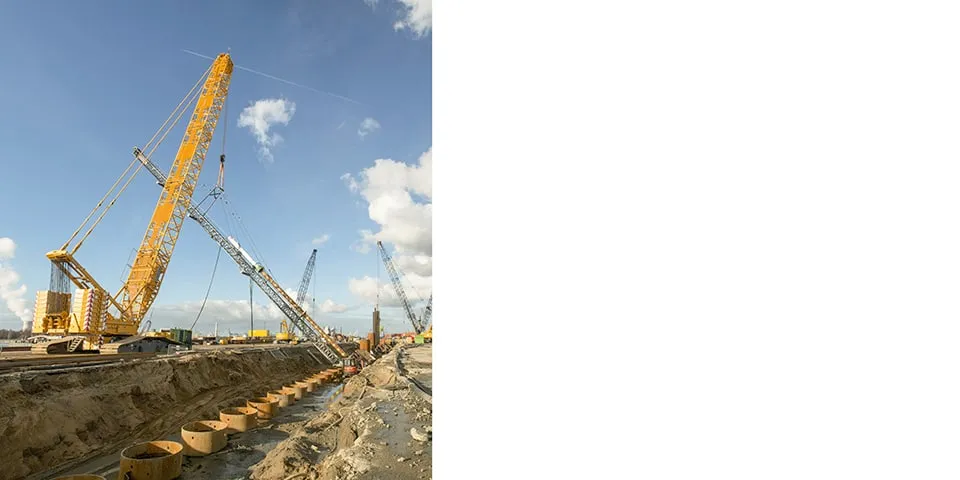
Jan De Nul Group invested in the technology for installing the anchor piles (MV piles) for the new combi wall.
Driving piles over the top
The cable crane holds both the leader and the MV pile at the correct angle (45 degrees) and in position using guy cables. Landuyt describes the method: “We lower the leader to the ground, which allows us to slide the section into place very quickly. These are substantial sections, HEM600 profiles 43 metres long and weighing 12.5 tonnes each. The profile, hammer and leader together weigh around 72 tonnes. We then hoist the assembly up above the tubular pile. We clamp the foot, which we engineered ourselves, onto the tubular pile, allowing us to manoeuvre and align the leader freely. This means we can install the profiles from various positions and even drive piles over the top, with the rig suspended above the water.”
Jan De Nul Group has made a very successful start with the new rig. “We drive four to five piles a day, which is a good rate,” says Landuyt. “Once the new quay wall has been fully installed, the old quay wall will be demolished and the water depth will increase from 6 to 18 metres. By the end of this year, large seagoing vessels will be able to berth at Kanaaldok B2.”
Question about this story? Ask your question
Keep following this
Get an email when a new story is published. No account needed.
- ThemeUnderground construction
- SubjectWater infrastructure







