









Innovative foundation method for urban areas
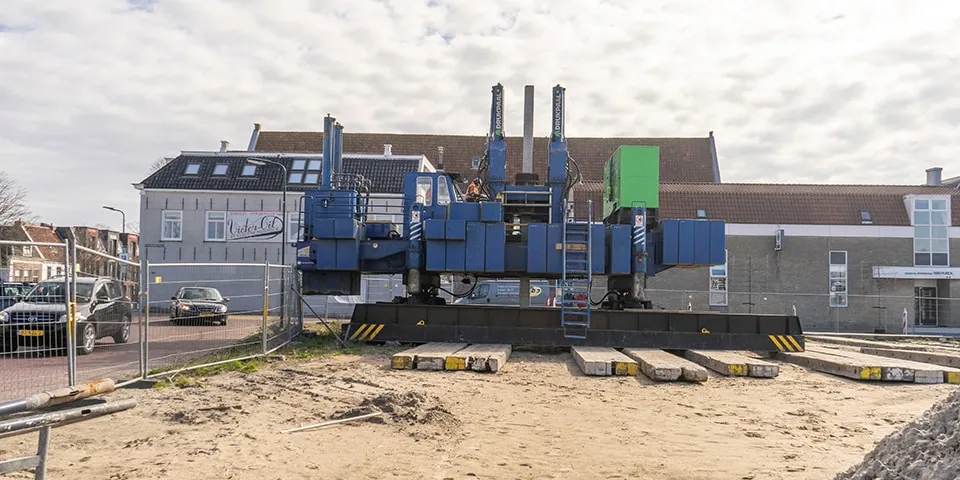
Piling foundation piles is often not an option in built-up areas. Vibration and noise are out of the question there. That is why piles are usually installed by drilling. Two years ago, a new foundation method was introduced: pressing precast concrete foundation piles into the ground. An increasing number of projects are now being founded using this method.
A great deal of construction is now taking place in urban areas. Contractors must meet the government’s requirement to minimise disruption, including when installing foundations. Precast foundation piles cannot be driven in these locations. The only suitable methods are drilling or screwing in foundation piles. However, contractors often have no way of checking the quality. “It is usually difficult to assess afterwards,” says Tahl Tekofsky, technical and commercial adviser at Drukpaal.nl. “The sometimes soft Dutch soil and the presence of groundwater can affect the casting of a pile. In addition, most drilling methods carry a risk of workers coming into contact with potentially contaminated soil.”
Press-in method
To avoid these problems, Drukpaal.nl, part of the IJB Groep, introduced a simple but innovative method in the Netherlands two years ago. High-quality precast piles are pressed into the ground by a hydraulically powered piling rig. These are usually square piles, with dimensions of 290, 320 or 250 mm, and available in various lengths. The process is completely silent and vibration-free. The method also displaces 100% of the soil and eliminates the risk of contact with contaminated ground. Pressing is not only better in terms of quality, it is also faster, at 15 to 20 piles per day, and cost-competitive compared with drilling. The press-in method has been a reliable solution in Asia for decades. Tekofsky therefore sees it as an excellent alternative to drilling or screwing.

A new foundation method: pressing precast concrete foundation piles into the ground.
Special hydraulic piling rig
A purpose-designed hydraulic piling rig is used to press the precast foundation piles into the ground. It has a press-in unit that grips the concrete pile with clamps and presses it into the ground in strokes of around two metres. Once the pile is more than three metres above ground level, the rig can no longer grip it. To drive the pile to the required depth, an extension is placed on top to push it down to the target level. Each pile is tested under load as it is pressed in, and the results are recorded. Afterwards, Drukpaal.nl reports the measured penetration force for each pile, plotted against depth. This measures the resistance and therefore the allowable load. This means you can be sure that every pile can provide the required bearing capacity.
Sint Sebastiaansbrug Delft
Tekofsky: “Until now, we have mainly worked on larger apartment complexes and commercial buildings. We are now working on an infrastructure project for the first time: the new Sint Sebastiaansbrug in Delft city centre. Our method was chosen because it produces no noise or vibration and is financially attractive.” A pile foundation is required for the approach roads on the north and south sides of the bridge. Large volumes of soil will be placed there, rising gradually from 4 to 8 metres towards the bridge’s highest point. Tram tracks, cycle and footpaths, and an asphalt road will be built on top. The approaches will therefore be founded on a pile mattress consisting of 400 piles. “Here, we will be pressing in 21 to 22 m long square piles with dimensions of 290 mm. This is a project that involves a great deal of groundwork, both literally and figuratively!” says Tekofsky.
Question about this story? Ask your question
Keep following this
Get an email when a new story is published. No account needed.
- ThemeUnderground construction
- SubjectWater infrastructure







