









Innovation in foundation engineering through collaboration
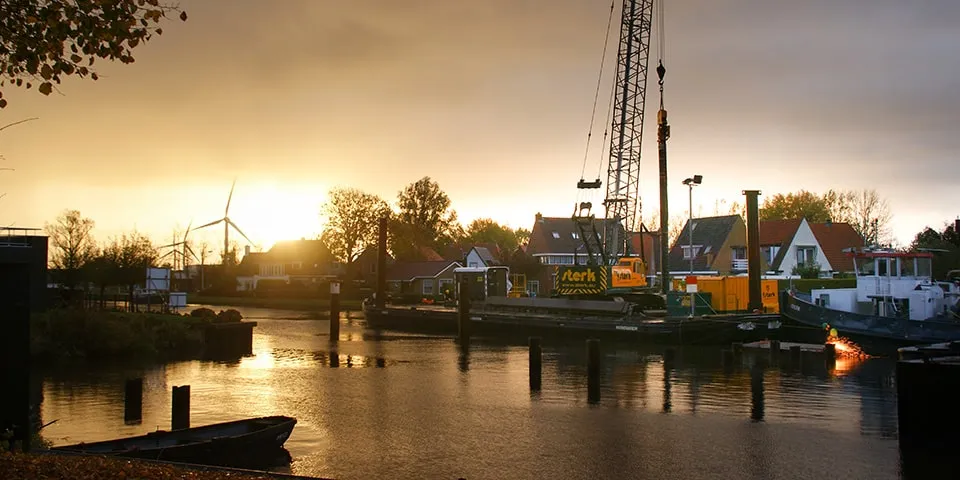
The association could be described as a think tank. Its members bring a wealth of expertise to the table, helping to ensure…
The association could be described as a think tank. With members bringing a wealth of expertise to the table, the Dutch Association of Foundation Contractors (NVAF) helps ensure continuity, progress and innovation in foundation engineering. “We are an association of, for and by foundation contractors,” says Jaap Estié as he opens the conversation. Estié is director of the NVAF.
“We are a professional organisation with two people in the office. Between 80 and 90 active members from our ranks take part in the working groups and committees that make up our association. The board consists of volunteers from member companies,” says Estié.
Collaboration and knowledge sharing
The volunteer board comprises chair Ton Groeneweg (Tubex), Peter Vroom (Vroom Funderingstechnieken), who is also chair of the working group on contractual relations, treasurer Eelco van der Velde (Bauer), Bartho Admiraal (Volker Staal en Funderingen), who is also innovation manager, Co van ’t Hek (Gebr. Van ’t Hek), responsible for working conditions and the environment, Hein van Laar (Hakkers), responsible for waterworks, and Thimo Verhoef (Funderingstechniek Noord), responsible for all matters relating to microtechnology. “Collaboration is at the heart of everything we do. Even former board members continue to lend a hand. We have several working groups and standards committees affiliated with NEN,” Estié continues. “One example is the Technical Committee for Foundation Equipment, which is also TCVT Working Chamber 6, where accident investigations are among the activities. Certification bodies that carry out inspections are also represented on this committee. The same accidents are investigated by the Occupational Health and Safety & Environment working group, which assesses them against occupational health and safety legislation and regulations. All findings from the investigations are taken into account when the guidelines are revised.”
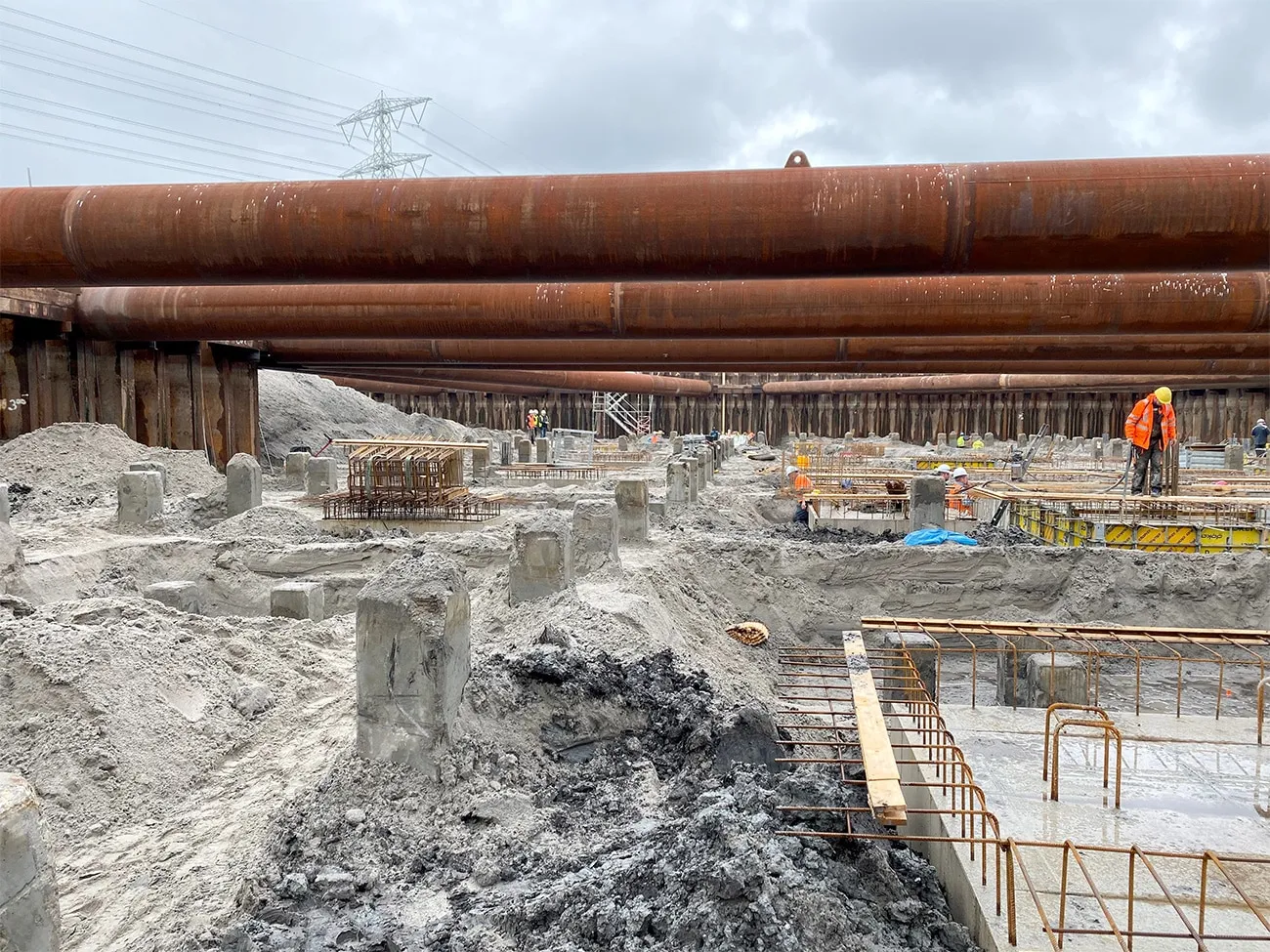
A complete construction pit in Nijkerk. (Image: NEW DIGIT Photography Al)
Giving new employees a sound grounding
The NVAF offers several training courses tailored to the sector. “This is how we want to give new employees a sound grounding. We work in partnership with Regiocollege Noord-Holland in Heerhugowaard to deliver a vocational education and training (MBO) course. The working groups develop guidelines for safe lifting, working safely from the water and working in public areas. “A revised guideline for working in contaminated soil is also in preparation. This is needed following the recent introduction of CROW 400.”
The third edition of the trade handbook “Veilig funderen” has recently been published. Estié says: “For every technique used in our sector, it describes what the technique involves and which guidelines apply. The book was funded through the occupational health and safety catalogue and by the NVAF. Parts of the book are included in the Foundations occupational health and safety catalogue. A print run of 3,000 copies was produced, and the aim is for everyone working in the foundation sector to have one.”
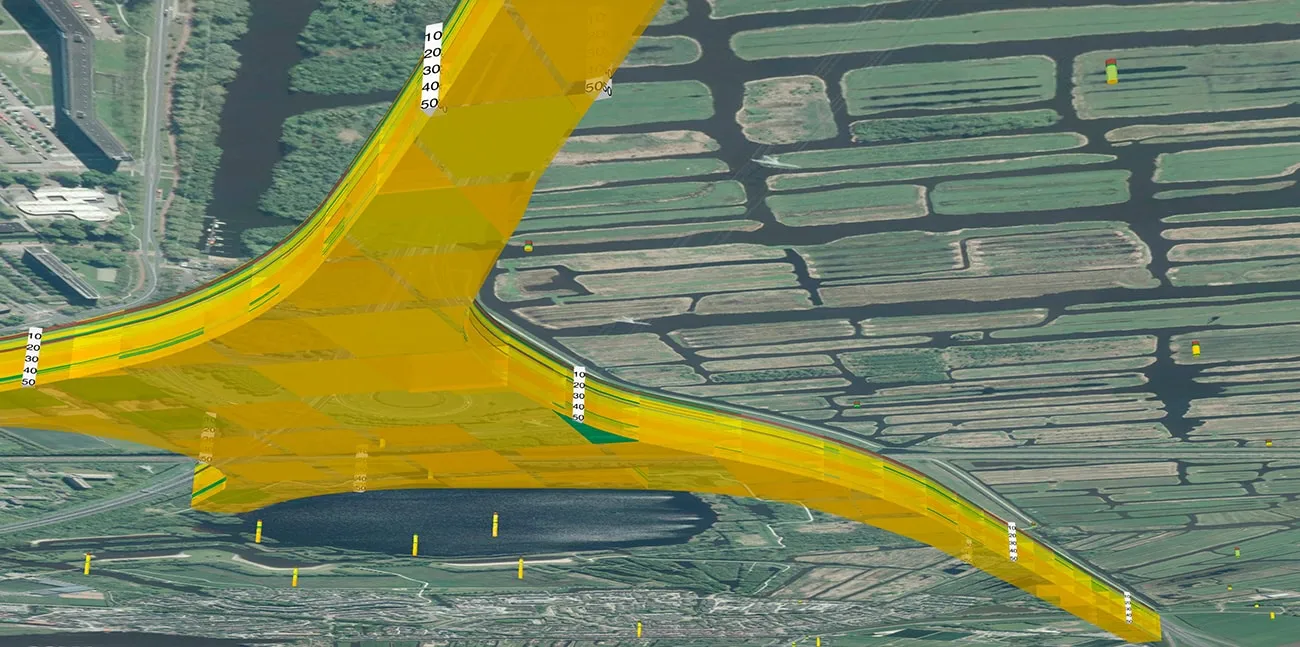
Pursuing sustainability means innovating, and that is driving some exciting developments. (Image: FotoMix.nl)
Sustainable employability of workers
“We are involved in the European Federation of Foundation Contractors (EFFC). The NVAF addresses sustainability issues there, among other things. The focus is currently on the sustainable employability of workers. We are also exploring ways to reduce CO2 emissions. Pursuing sustainability means innovating, and that is driving some exciting developments. One example is integrating a heat exchanger into a foundation pile, so it can be used with a heat pump in the home. Heat exchangers installed in sheet piles are another good example. Innovations in foundation techniques are highly varied. Several systems are being considered for vibration-free piling.”
New Practice Guideline
“Some time ago, the alpha-P standard for the Netherlands was lowered. As a result, we often use heavier piles than necessary in the Netherlands, requiring more concrete and steel and consequently generating more CO2 emissions. For this reason, the NVAF is now taking a collaborative approach to innovation and carrying out tests on scale-model piles. The aim is to build and share knowledge, while also sharing the costs of the research,” Estié explains.
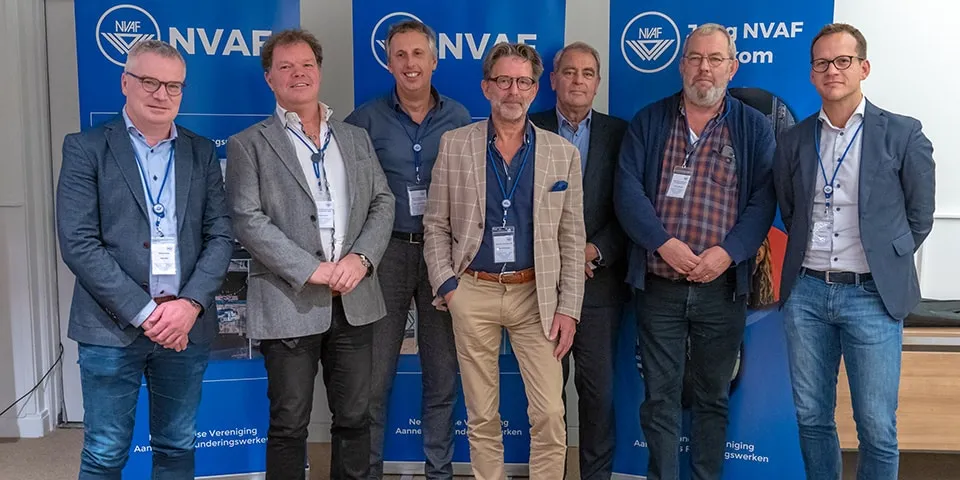
The board, from left to right: Jaap Estié, Peter Vroom, Eelco van der Velde, Ton Groeneweg, Co van ’t Hek, Thimo Verhoef and Hein van Laar.
Foundation repair
Estié also sees new developments in foundation repair: “Foundations are being restored from inside the home, made possible by smaller machines that fit through a standard doorway. This makes it possible to build a basement beneath a canal house in Amsterdam. In machine-building innovation, we are seeing major advances in monitoring, sensors and connectivity. However digital we become, our work remains adventurous. You can carry out as many cone penetration tests as you like, but as soon as we go into the ground, we are venturing into the great unknown.”
Een zakelijke vraag aan Vroom Funderingstechnieken B.V.? Get in touch
Companies in this story
Keep following this
Get an email when a new story is published. No account needed.
- ThemeUnderground construction
- SubjectWater infrastructure
- CompanyVroom Funderingstechnieken B.V.







