









How a ‘small’ project can be a big undertaking: Tiel dike reinforcement
Text Suzanne van Gaale Image FPH Ploegmakers
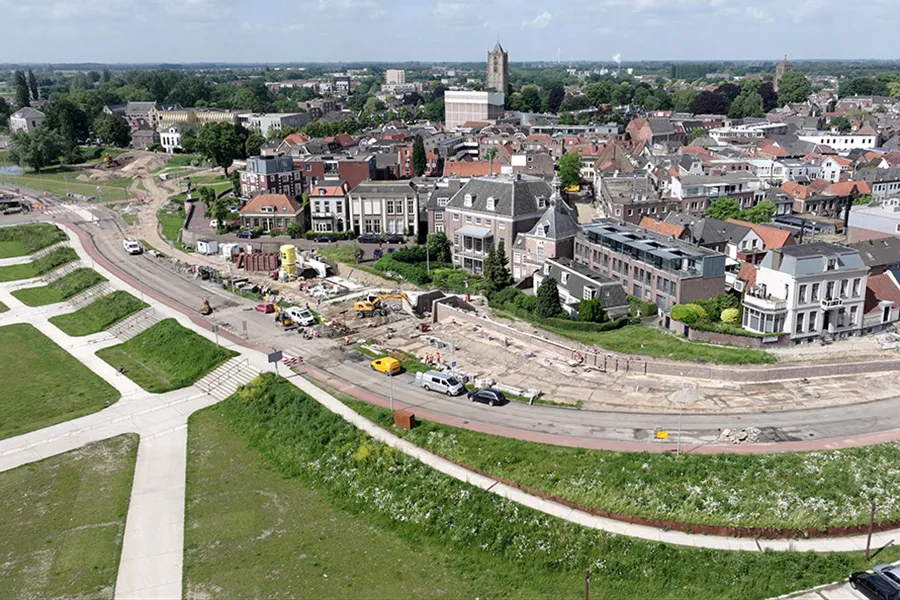
The dike alongside the town of Tiel is being reinforced along a 2.6-kilometre stretch. In terms of length, it is one of the smaller dike reinforcement projects, but also one of the most complex. A range of competing interests, a UNESCO World Heritage Site, historic buildings, the construction of an apartment block, residents going about their daily lives and the Appelpop festival, which took place amid the works, all require close cooperation. The upside is that this created opportunities to combine works with other projects. FPH Ploegmakers director Gerbert Ploegmakers and technical manager Robin van Dijk explain how it all works.
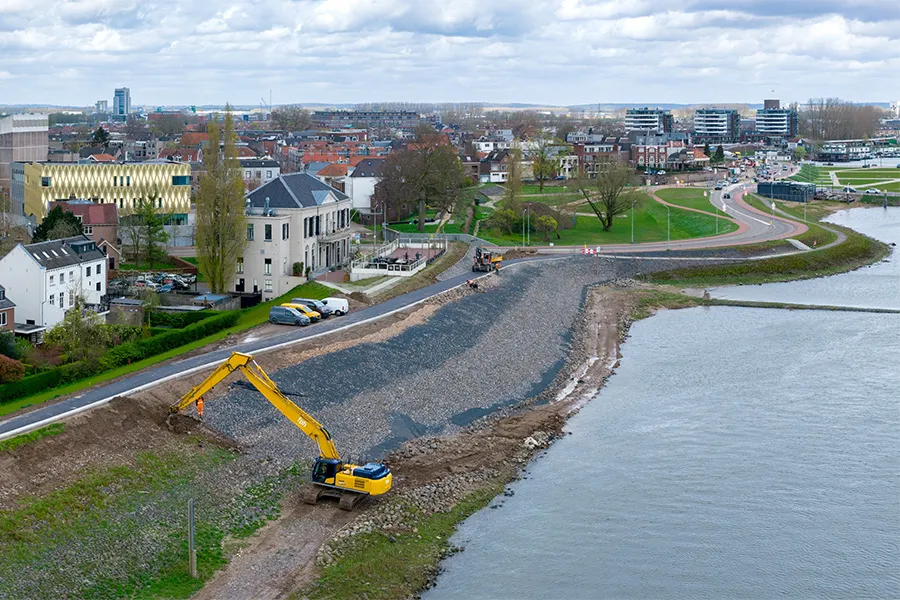
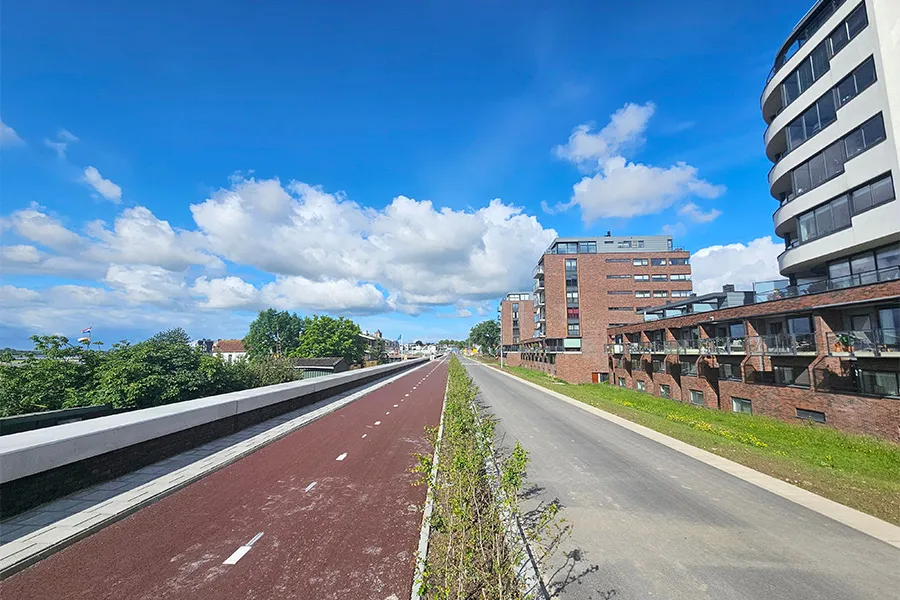
First, a brief overview of the dike reinforcement scheme: the dike between the Amsterdam-Rhine Canal and the Inundatiekanaal, alongside the town of Tiel, is being strengthened and raised. The work will improve flood protection for the town and its hinterland, but will also change the face of Tiel. The plans include a new quay wall and an outer sheet-pile wall. Work began at the end of 2022, and the project is expected to be completed after the summer of 2024, in line with the agreed milestones.
Different interests
“The collaboration on this project is quite unique,” says Gerbert. “Beyond the technical aspects, what makes it challenging is the range of partnerships and interests involved. The client is Waterschap Rivierenland, but we also work closely with the municipality of Tiel. Work in the harbour area brought in the interests of the developer building the new apartment block, as well as Rijkswaterstaat and the water sports association. And because we are working right in the middle of town, we have to take residents, businesses and events into account. All in all, a great deal is happening in a small area, involving a great many different interests.”
Early coordination
Waterschap Rivierenland, the municipality of Tiel and FPH Ploegmakers are working together on the dike reinforcement in Tiel. Tackling the project in stages, in collaboration with neighbouring residents and other parties, makes it possible to get a great deal done. Gerbert says: “The water board owns the dike, while the roads and the cycle and footpaths running over it are managed and maintained by the municipality. By coordinating the work at an early stage, we were able to incorporate opportunities to combine it with other projects. These are small, separate schemes, for example by the municipality, that are unrelated to the dike reinforcement but are convenient to carry out at the same time. For instance, we realigned the cycle path by Grand Café Bellevue and built a fully segregated cycle and footpath on Echtelsedijk.” There were also opportunities to combine works in the harbour area. A vacant plot there was on the river side of the dike, which meant that building was not permitted.
By rerouting the dike around the plot, it is now on the protected side, allowing the developer to build an apartment block there. Robin says: “Urban development in the harbour area was already part of the contract and had therefore been included by the water board, the municipality of Tiel and the developer as an opportunity to combine with our contract. Our main focus was on carrying out the works in a way that would manage risks during and after the construction phase. We changed the sequence of the work so that the apartment block’s foundation structure could not compromise dike safety. Together with all the parties involved, we decided to install the sheet piles first, then the building’s foundation piles, and finally the sheet-pile wall anchors. Coordination played a major role in this.”
Authentic bricks for the town wall
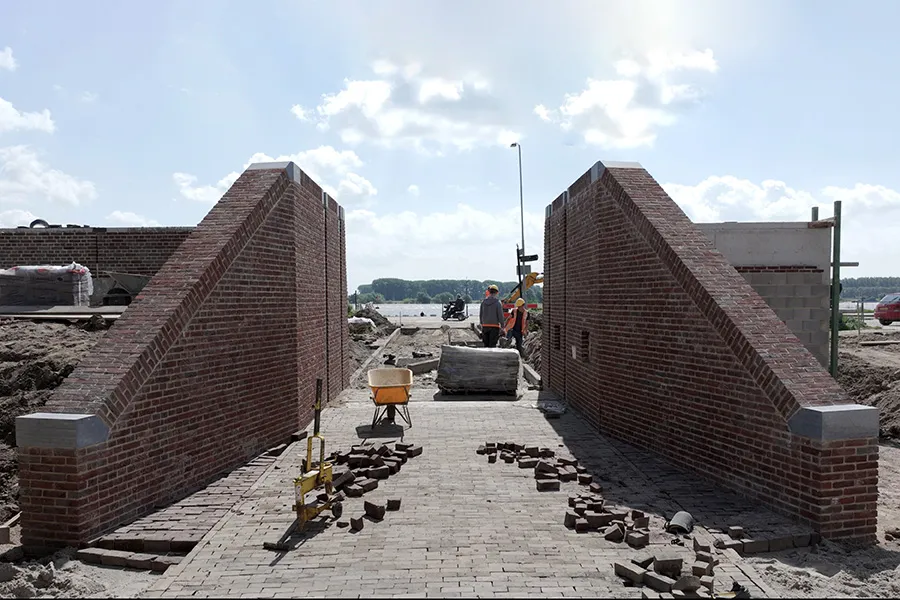
The apartment block is just one of many examples of how interests, safety and appearance are continually weighed against one another to find the best solution. Robin cites the design of the town’s fortification wall as another case in point. A final design was already in place, but FPH Ploegmakers nevertheless saw opportunities to improve it and make it more attractive. One point was the type of brick used for the historic fortification wall, a landmark along the river. The dike openings, or flood openings, connect the town to the area outside the dike. The quay incorporates the Waterpoort flood opening, which provides access to the town centre. “We built on the water board’s existing design, focusing on the layout and appearance. Here too, we worked closely with the municipality, the monuments committee and the city architect. We looked in detail at the type and colour of brick that would fit best. We even brought in a Space & Quality specialist to develop a design that would complement the old town wall while meeting the safety requirements and budget. In the end, we chose an authentic brick, complete with special pointing and bond, made by the Vogelensangh brickworks in Deest, where bricks are still produced using traditional methods. It certainly didn’t happen without a few bumps along the way, and it took considerable effort to bring everyone on board. But now that the result is visible, everyone is very pleased with it.”
Demountable flood barrier
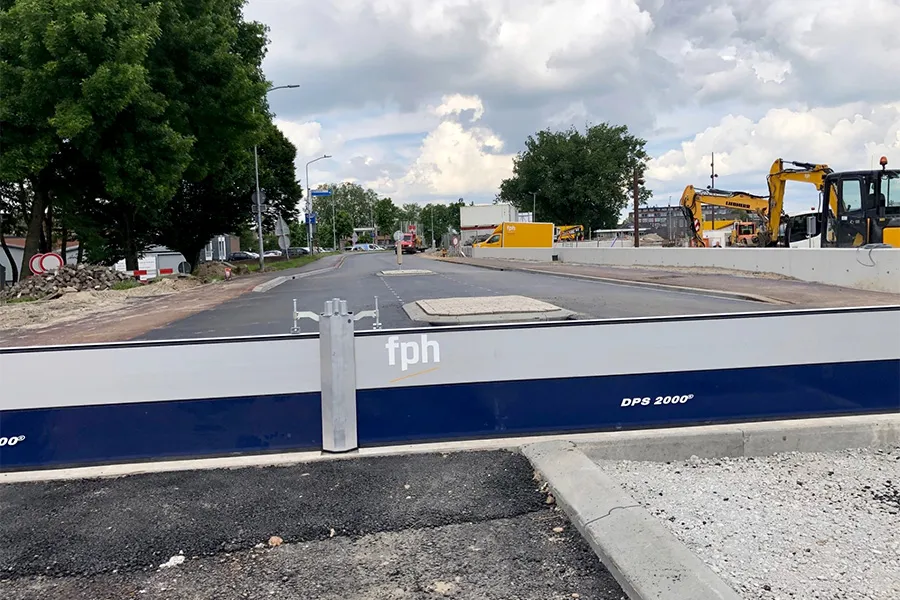
Another notable feature is that the section of dike through the town is being prepared for the installation of a demountable flood barrier. In this project, FPH Ploegmakers is installing demountable barriers on both new and existing concrete walls. This is a varied and complex undertaking. In extreme conditions, a demountable barrier can temporarily raise the dike, at 2 locations on the Ravelijn wall, or close off openings, at the 9 flood openings in Tiel. This solution is used mainly in built-up areas, where there is no space to widen or permanently raise the dike. Since these barriers have to be assembled by hand, they require specific management by Waterschap Rivierenland.
Innovation
Innovation has also been a focus throughout the project wherever possible. An innovative filter technique, known as a coarse sand barrier (GZB), has been installed on the section of dike by the Amsterdam-Rhine Canal to prevent piping. The coarse sand barrier stops the erosion channel from forming at the barrier. Groundwater can pass through, but fine sand is held back. Robin says: “We first used this at Gameren a year and a half ago, as a pilot commissioned by Waterschap Rivierenland. At Tiel, we have used it as a measure to prevent piping. This makes it the second site in the Netherlands. It shows the water board’s willingness to take a risk by applying a measure that it helped develop and which was still in the pilot phase during the tender process.”
The courage to get stuck in
FPH Ploegmakers is a small and medium-sized enterprise. This brings its share of challenges, as the company sometimes takes on a heavy workload. But its compact team also means it can respond quickly. Gerbert says: “We are pragmatic and quick to respond. Our greatest strength is our willingness to get stuck in. The close collaboration with the different parties is another great aspect of this project. Every day is different. When we look at how far we have come and how positive people are about how good it is looking, we are immensely proud. By getting involved at a very early stage, together with the water board, the municipality and other stakeholders, we have been able to keep the work on track. It has even made Tiel look better and become safer.”
A business enquiry for FPH Ploegmakers? Get in touch
Who worked on Dijkversterking Stad Tiel
- clientWaterschap RivierenlandMentioned in Kandt Aannemings- en Funderingsbedrijf’s knowledge, expertise and equipment on the Dijkversterking Stad Tiel project
- authentic stonesVogelensanghIn this story
- engineering consultancyABTMentioned in Tiel flood defence upgrade calls for innovative construction design by engineering firm ABT
- stakeholder management
 RPS advies- en ingenieursbureauMentioned in How early communication with local residents prevents complaints during the Dijkversterking Stad Tiel project

Keep following this
Get an email when a new story is published. No account needed.
- ProjectStad Tiel dyke reinforcement
- ThemeFlood protection and climate-resilient water management
- SubjectWater infrastructure
- CompanyVogelensangh
- CompanyFPH Ploegmakers







