









Hard at work in Harlingen on the future of the Afsluitdijk
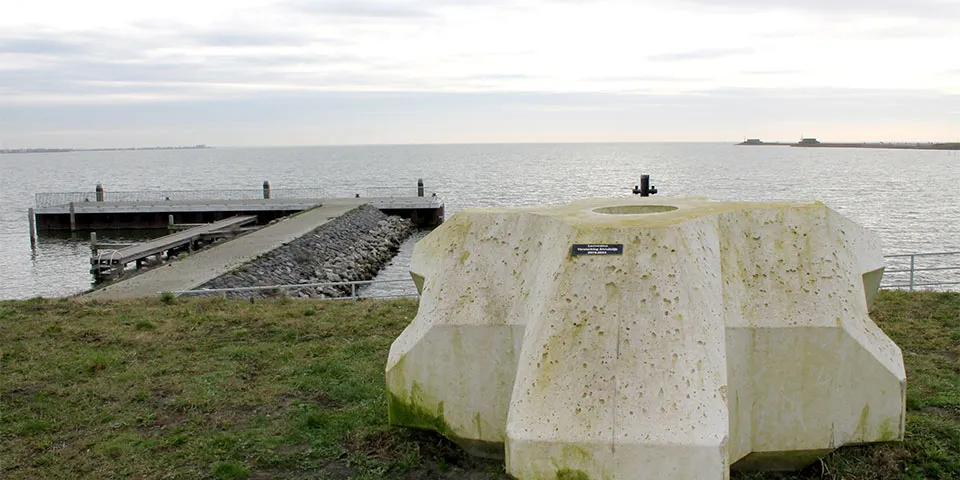
If there is one thing all Levvel employees have in common, it is the pride they take in their work on the renovation of the Afsluitdijk, commissioned by Rijkswaterstaat. This is certainly true of Martin Slagboom (Van Oord), Operations Manager Dijk, Dammen & Havens, and Frank van de Geijn (BAM), Manager Productiefaciliteit. Levvel is made up of Van Oord, BAM and Rebel.
We are on the site of the production facility for Levvel-blocs in Harlingen. In 2018, the site where the factory now stands was little more than a vacant field beside the water. Slagboom has been involved in the operation from the preparatory stage. He explains: “We leased this site from Port of Harlingen. It was a strategic choice. Harlingen is close to the Afsluitdijk, a sand and gravel supplier, Spaansen, is just around the corner, and being on the water makes transport by water possible.” Slagboom began the preparations in 2018. “I had to establish the site and set it up.”
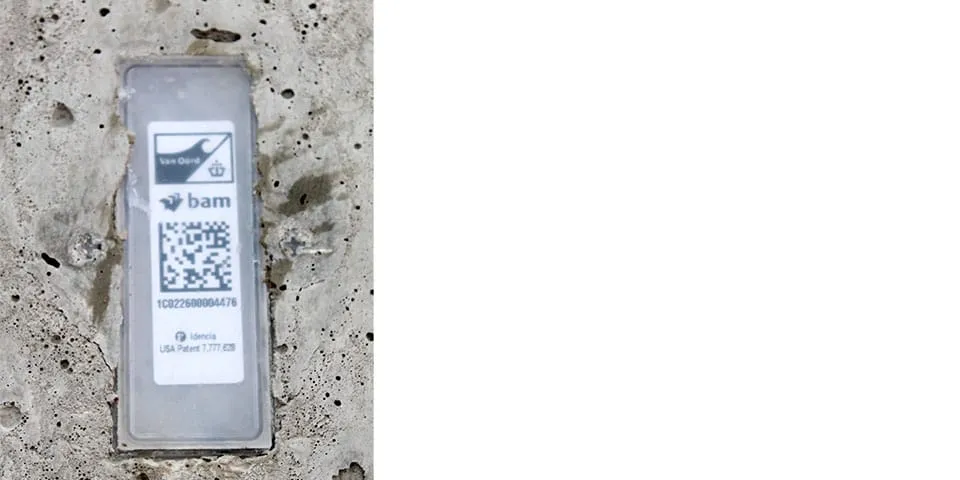
Close-up of an embedded RFID chip.
From field to port with production facility
For Slagboom, setting up the factory in Harlingen began with finding a suitable location. “The choice of this site was based on a combination of what was possible, what was needed and what fitted the budget. Its location helps reduce the ECI (Environmental Cost Indicator) and CO2 emissions thanks to the logistical advantages. As it was just a field, everything had to be done from scratch: installing the power supply, laying hardstanding, putting up site cabins and so on. First, the production area was built, followed by the logistics area and the site, which has its own unloading quay, separate from the access channel.” Slagboom acts as a link between the activities on site and those taking place off site.
Producing KOMO-certified concrete in-house
Levvel trained the people working in Harlingen itself. The Levvel-bloc made there was specially developed for Levvel, based on BAM’s patent for its ‘XblocPlus’. “This block is new, uses less material and is more environmentally friendly than other solutions for strengthening dikes,” explains Van de Geijn. Levvel recently received KOMO certification to produce the concrete for the blocks in-house. “A total of 75,000 Levvel-blocs will be made here, in two types: the Levvel-bloc and the Berm-bloc. We place the Levvel-blocs on the lower slope of the dike. For the top row, we use Berm-blocs to connect properly to the cycle path on the intermediate berm.”
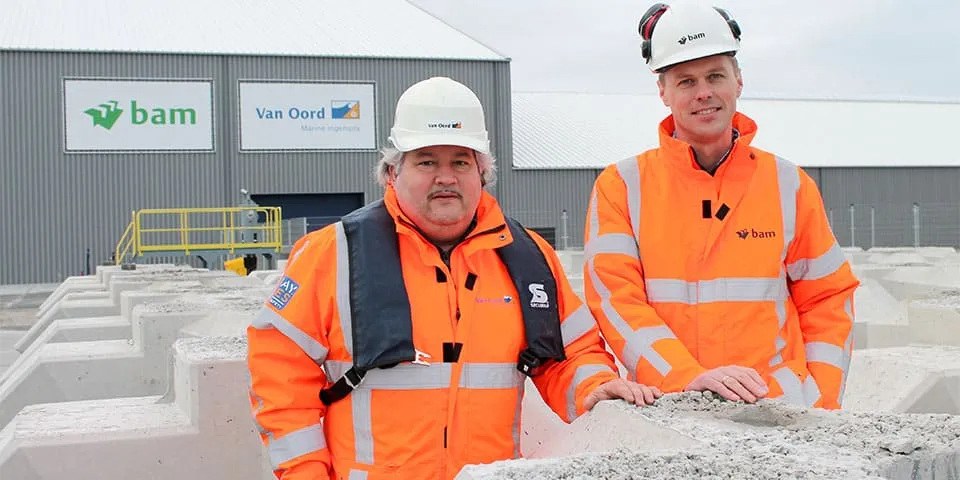
Martin Slagboom (Van Oord), Operations Manager Dijk, Dammen & Havens, and Frank van de Geijn (BAM), Manager Productiefaciliteit.
Each Levvel-bloc contains 2.5 cubic metres of concrete and weighs around 6 tonnes. “Berm-blocs use 5 cubic metres of concrete, so they weigh twice as much,” says Van de Geijn. The ingenious Levvel-bloc design features a hole in the centre to ensure optimal water drainage. The holes also accommodate the specially developed gripper. “It allows the blocks to be lifted and positioned,” Van de Geijn explains. The concrete is poured into two-part moulds, 107 in total, which travel around the production facility on a carousel. “160 trolleys move the moulds in and out. This carousel is unique in the world and was made by KTB Machinery,” explains Van de Geijn. “Ultimately, we need to reach a production rate of 150 Levvel-blocs a day. A Levvel-bloc is poured every 9 minutes, another comes out of its mould and a third is transported outside, ready to be picked up by crane and grouped in the storage area. The entire cycle, including curing, takes 24 hours, so we are talking about 160 cycles of 9 minutes.”
Levvel is made up of Van Oord, BAM and Rebel.
At the heart of the factory
An impressive sight unfolds before us as we enter the factory. We watch a Berm-bloc being stripped from its mould after arriving on a trolley along the rails. “The concrete mix is designed so that a Levvel-bloc or Berm-bloc can be demoulded after 12 to 16 hours, when it has reached a strength of 5 N/mm2. After 24 hours of curing, it reaches 10 N/mm2 and can be lifted with the gripper,” says Van de Geijn. Around 800 blocks had been made in Harlingen by Christmas.
The concrete used is not a typical precast mix, but a specially developed mix design. Van de Geijn explains: “Blast furnace cement is used, which has a lower environmental impact than Portland cement. The entire production process is automated, including stripping the moulds, except for loosening and tightening the mould bolts, and cleaning and oiling the moulds. Two employees work on the carousel at all times. There are also two supervisors, or process operators. The entire hall is essentially one large machine.”
Use on the Afsluitdijk
We ask Slagboom how exactly the Levvel-blocs and Berm-blocs are used. He explains: “We leave the existing revetment in place and lay a layer of rock armour over it, on which the Levvel-blocs are installed. This allows us to keep working through the winter. The Levvel-blocs are installed using a crane pontoon fitted with a special gripper. The crane picks up the blocks directly from the adjacent pontoon, which holds the working stock. The blocks are then placed on the slope in overlapping rows, interlocking like roof tiles. The Levvel-blocs are positioned using an automatic positioning system. Once the screen in the crane cab turns ‘green’, the ‘release button’ can be pressed. A digital layout is displayed on the crane’s screen, showing in real time how the blocs have been installed and how much work has been completed. Each Levvel-bloc is fitted with an RFID chip at the factory, which can be scanned. This makes every block identifiable and traceable. That is necessary to link the block’s position to the information stored about it, such as its production batch number.”
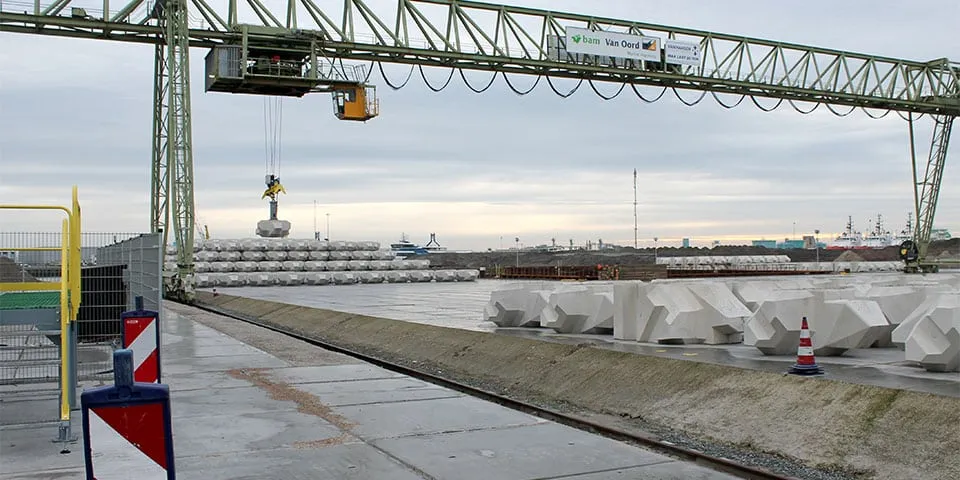
The Levvel-blocs are grouped in the storage area using a crane.
Finally, we ask what will happen to the factory in Harlingen once the Afsluitdijk renovation is complete. Slagboom replies: “The factory was built on circular principles. We will be producing Levvel-blocs for the next 2.5 to 3 years, after which the factory may have a new role to play.”
Have a business enquiry for Van Oord? Get in touch
Companies in this story
Keep following this
Get an email when a new story is published. No account needed.
- ThemeFlood protection and climate-resilient water management
- SubjectWater infrastructure
- CompanyVan Oord







