









Force sensors measure the impact of waves on flood defences
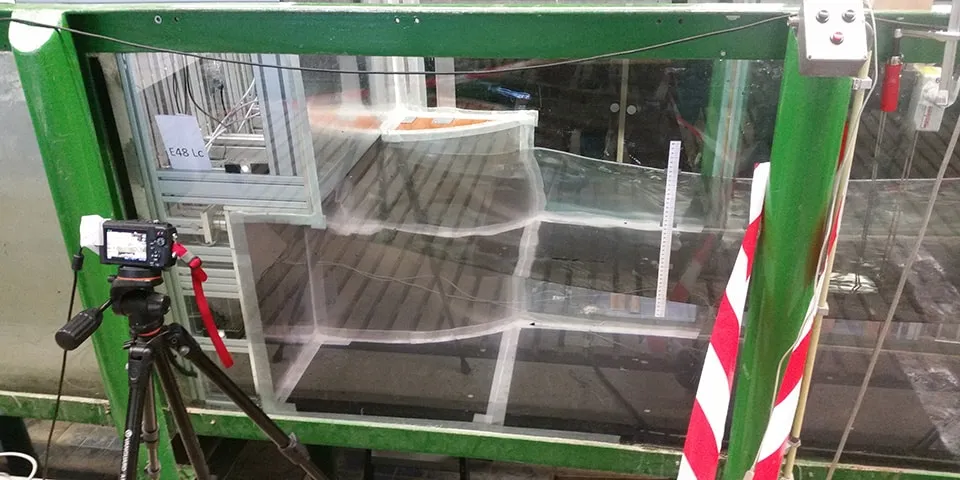
As sea levels rise, the design of flood defences is becoming increasingly important. A key part of developing new flood defences is measuring the impact of waves on the structure. Ermano de Almeida, a Brazilian researcher, carried out a project at the Fluid Mechanics Laboratory in the Faculty of Civil Engineering at TU Delft to measure the impact of waves on overhanging flood defences. He used force sensors from HBM. Other project partners included NWO, Rijkswaterstaat, Witteveen + Bos, PT Structural and Deltares, the Dutch knowledge and innovation institute for water and the subsurface. The research findings are important for developing modern hydraulic engineering structures, such as the new water outlets in the Afsluitdijk.
De Almeida quickly reels off a long list of floods and dike breaches that have caused widespread disruption and damage around the world. New Orleans and Houston are still etched in everyone’s memory, but Germany and Southeast Asia have also suffered severe flooding in recent decades. “Developing effective flood defences is becoming increasingly important as rising sea levels and subsiding land put more areas at greater risk of flooding. The likelihood of severe storms is also increasing. That is why research into the quality of flood defences is becoming ever more important,” he stresses.
As part of his doctoral research at TU Delft’s Hydraulic Engineering department, De Almeida is studying the impact of waves on models of steel flood defences. He studied civil engineering in Madrid and Aachen and completed his master’s degree at TU Delft. When he was offered the opportunity to carry out the flood defence research project there, he seized it. Not only did he find the project interesting from both a theoretical and practical perspective, but water management is also one of the greatest challenges facing us in the coming decades.
Vertical metal or concrete flood defences with an overhang
De Almeida’s ongoing research focuses on vertical metal or concrete flood defences with an overhang. These are common in ports, at locks and water outlets, and are also widely used in Dutch flood defences along the North Sea coast. In these locations, they are used in combination with hydraulic and mechanical systems to close off water outlets or waterways during high water or storm surges. This type of structure is particularly suitable as a flood defence where an opening is needed for water flow or transport, but must also be capable of being closed to prevent flooding during storms and high water.
The aim of the research project is to measure the force exerted by waves on the vertical structure. These forces are particularly great on vertical structures with an overhang, because the force of the wave cannot be directed upwards.

De Almeida’s tests were carried out in one of the largest flumes in the laboratory.
This also increases the pressure on the vertical part of the flood defence. The waves also exert enormous force on the overhang. This could be a concrete protective ledge above the flood defence, for example, or the ceiling of the opening in which the gates are suspended. De Almeida also believes it is worth investigating the effect of resonance and vibrations in the relatively thin metal plates on the service life of the structure and the materials used under such loading conditions. “There have not been many cases of hydraulic engineering structures of this kind failing,” De Almeida explains, “but several are known in which a lack of knowledge about the characteristics of the loading and the structure’s response to it has led to unsafe situations, and sometimes even to the failure of the flood defence. By gathering more information about the force of wave impacts, we can design robust and safe structures without overengineering them, as is sometimes done today. This will save time, materials and costs during construction. Research could even help us develop new ways of building this type of flood defence.”
Flume and force sensors
The tests were carried out at TU Delft’s Fluid Mechanics Laboratory. The laboratory covers around 5,000 m², of which 1,700 m² is used for experiments. It has eight flumes for experiments, capable of delivering a water flow of 2 cubic metres per second. De Almeida’s tests were carried out in one of the largest flumes in the laboratory. It is 42 metres long, 80 centimetres wide and 1 metre high. At the end of the flume is a solid concrete block measuring 80 x 80 x 100 centimetres. An aluminium plate 1 centimetre thick is attached to it using aluminium profiles. Nine HBM U3 force sensors, each with a capacity of 1 kN, are installed in a row between the aluminium frame and the metal plate. HBM recommended these load cells to the researchers because they are made of stainless steel, are not sensitive to temperature changes and are therefore ideally suited to the wet test rig. They also have high stiffness, compensate for bending moments and are insensitive to lateral forces, making the measurement results highly reliable.
The sensors are connected to measurement amplifiers developed in-house at TU Delft. They record the impact of the waves at a sample rate of 5000/s. De Almeida can view the measurement data in real time on a monitor. The screen shows the height of the waves and their impact on the structure. The test rig is flexible: De Almeida can adjust the height of the metal plate, the dimensions of the overhang and the position of the force sensors.
De Almeida can view the measurement data in real time on a monitor.
A wave maker generates series of regular and irregular waves of varying heights in the flume. It is equipped with active reflection compensation, which neutralises returning waves so they do not affect the measurement data. Eight sensors are suspended in the water a few metres in front of the metal plate, around forty centimetres apart, to measure the characteristics of the waves. Three cameras record the tests so that the footage can be reviewed when unusual measurement results occur.
IJsselmeer sluices in the Afsluitdijk
The IJsselmeer sluices in the Afsluitdijk were initially used as a reference when designing the test rig. There are sluices at two locations in the Afsluitdijk, which are closed with steel gates during high water and storms. Waves striking the gates beneath the horizontal protective structure are suddenly blocked, exerting enormous forces on the structure. The structure was designed eighty years ago and is being renovated along with the rest of the Afsluitdijk. De Almeida also hopes to apply the knowledge gained through his research at other locations around the world, for example in the United States. Given the severe flooding in recent years and TU Delft’s strong reputation in hydraulic engineering research, there could be considerable interest there in his work.
De Almeida cannot yet present final results, as the tests are still under way. The raw data will be analysed over the coming months, and the findings will be presented in his thesis in the coming years. He expects his research to provide valuable information for the engineering and construction of new flood defences.
Question about this story? Ask your question
Keep following this
Get an email when a new story is published. No account needed.
- ThemeFlood protection and climate-resilient water management
- SubjectWater infrastructure







