









Everyone benefits from improvement
Text Tony VosImage Van Dijk Maasland
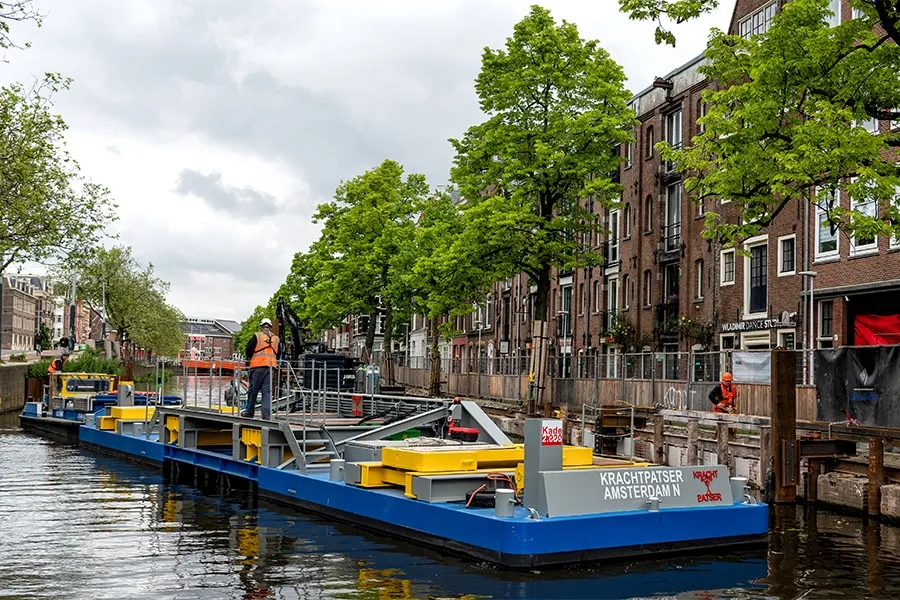
At Lijnbaansgracht in Amsterdam, the Kade 2.020 consortium is completing its pilot project to renew the quay wall. The innovation developed by this group of companies involves replacing the quay wall in sections of just 5 metres, without a traditional cofferdam. Project manager Jack Dekker explains the method.
The Kade 2.020 partnership consists of engineering and consultancy firm Sweco, Bouwadviesbureau Strackee BV and contractors Koninklijke Oosterhof Holman and Combinatie Midden Delfland Civiele Werken (CMD).
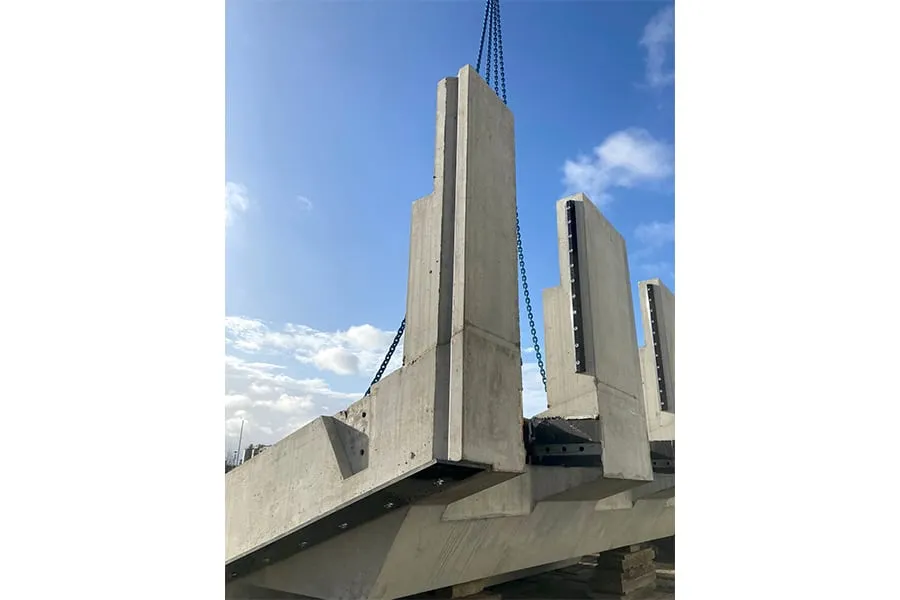
Jack: “Our solution for replacing quay walls is based on an inverted L-shaped wall. The concrete elements used are 5 metres long, allowing us to move along the canal like a kind of train (EZ-Flow), without closing off the entire quay. We keep work at ground level to a minimum to avoid disruption. This meets the municipality’s wishes and requirements, while taking account of flora and fauna, houseboats and groundwater levels.”
Concrete elements
‘De Krachtpatser’ was developed specifically for positioning the precast concrete elements and is moved by an electric pusher tug. The elements are transported and positioned using a lifting bridge between two pontoons. As a result, lifting operations are rarely, if ever, needed.
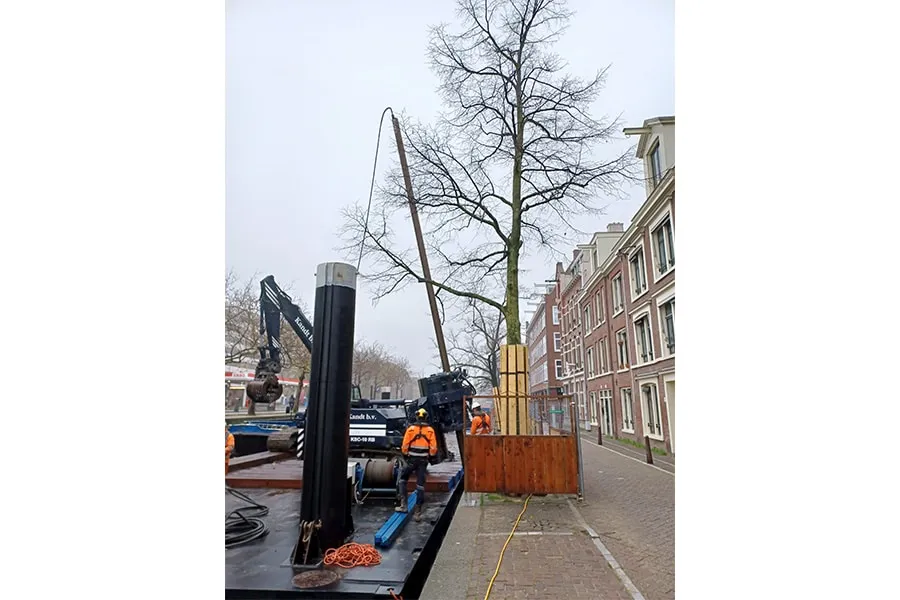
In the preparatory phase, the coping stones and paving are removed first. The road remains open throughout, although the parking spaces are temporarily unavailable. Kade 2.020 needs only a narrow strip of land on the shore side, with most of the work carried out from the water. The steel piles supplied by Kandt are installed partly through the quay and partly in front of it.
Jack: “The idea of an L-shaped element is not new, but this is the first time such a structure has been installed not in the quay wall, but in the water on the other side. We temporarily support the existing quay wall with a yoke. Then we saw off a 30-centimetre slice from the front of the quay to make room for the concrete element.”
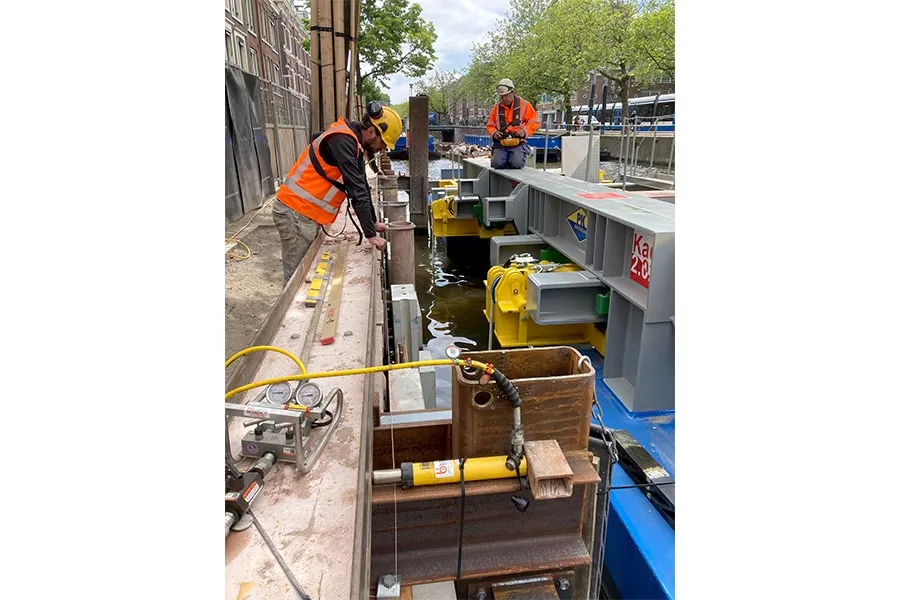
The concrete elements have recesses, and bearing plates are fitted onto the piles. Finally, the gap between them is filled with grout, a method derived from the offshore industry. The technique is used here on a smaller scale. Grout bags fill the space between the saw cut in the old wall and the new element.
Jack: “The elements have passages for species including eels and bullheads. To maintain groundwater levels, the elements incorporate round holes fitted with filters that hold back sand while allowing water to pass through. There are three such openings for every 5 metres of wall. As a consortium, we will continue monitoring groundwater levels for up to a year after completion, because they are so important to the foundations of the buildings.”
A substantial development period
A raising beam is fitted on top of the elements, with its height adjusted to suit the height of the quay. This makes the system suitable for quays of any height. The hollow spaces behind the elements are filled with water-permeable sand. For this, Kade 2.020 uses a relatively small hopper, developed following an extensive period of work. On projects of this kind, the participating parties’ areas of expertise complement one another well.
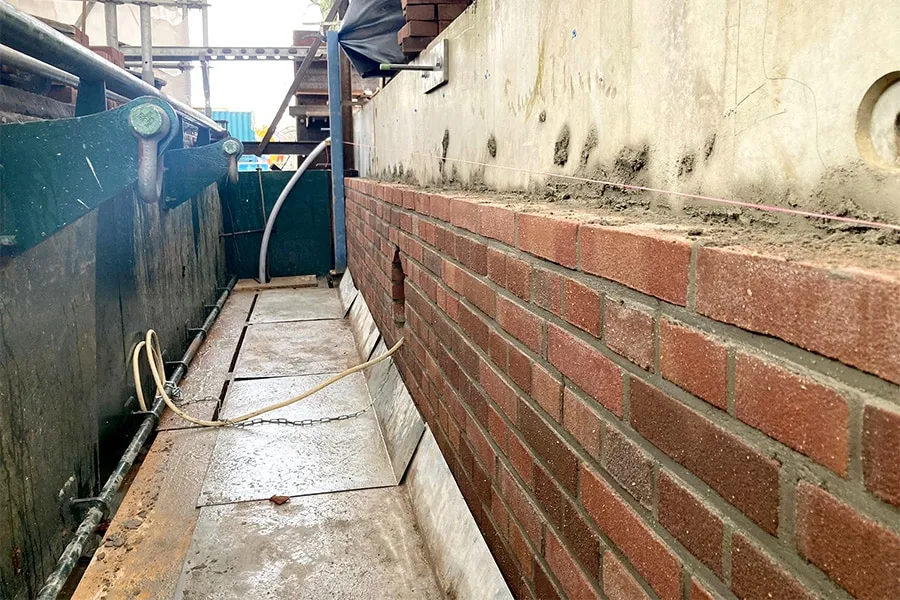
“We do not use precast brickwork for the finishing,” Jack explains. “We use an enclosure that is pulled up against the wall. We pump it dry so the brickwork can be laid in a dry space.”
During construction, work is regularly paused to check that all the components fit together properly. This is important if we are to continue working under the framework contract over the next eight years.
The final stage of the project is installing the coping stones. The sound existing stones are reinstated as part of the reuse effort. New stones are being laid in the pilot project because the original stones have not stood the test of time. The pilot project as a whole is due to be completed during March 2024.
Kade 2.020 not only meets the municipality’s wishes and requirements, but also aims to deliver added value, for example by preserving the trees. Jack: “Before starting, we test the existing trees together with Bomenwacht and carry out pull tests. We repeated the tests after storm Polly, but their condition was unchanged. We will carry out the tests for a third time once the pilot is complete.”
MKI score
The municipality has not yet set requirements for the MKI score compared with traditional quay renewal, but it has expressed a preference. Kade 2.020 already has a significantly better score, partly thanks to using less steel.
Jack has found the whole process particularly instructive. “All the partners are involved and keep making improvements, both large and small. For example, we have made changes to the pontoon and the strut angles, and we are working with the client on an optimisation process. Everyone benefits from improvement.”
Other developments are also being investigated. One example is integrating aquathermal energy into quay walls. Another is installing a multi-purpose cable duct to make it easier to lay pipes and cables in the future.
There is still progress to be made towards an emission-free construction site. The main bottleneck is how to secure enough power. The options for quick charging at the construction site are still limited. The electric pusher tug is currently powered by battery packs. They are charged overnight at the hub, allowing the boat to operate throughout the day.
The three parties in the Municipality of Amsterdam’s InnovatiePartnerschap Kademuren will continue if the client considers their innovation successful. Their shared aim is to work with the municipality to complete the new quay walls successfully. The three parties have carried out extensive research and share their findings with one another, with the aim of working faster, at lower cost and with less disruption.
Question about this story? Ask your question
Keep following this
Get an email when a new story is published. No account needed.
- ThemeUnderground construction
- SubjectWater infrastructure







