









Electric-hydraulic Bell A-frame Dredger keeps Liyutan Reservoir at depth
Text Roel van Gils Beeld Bell
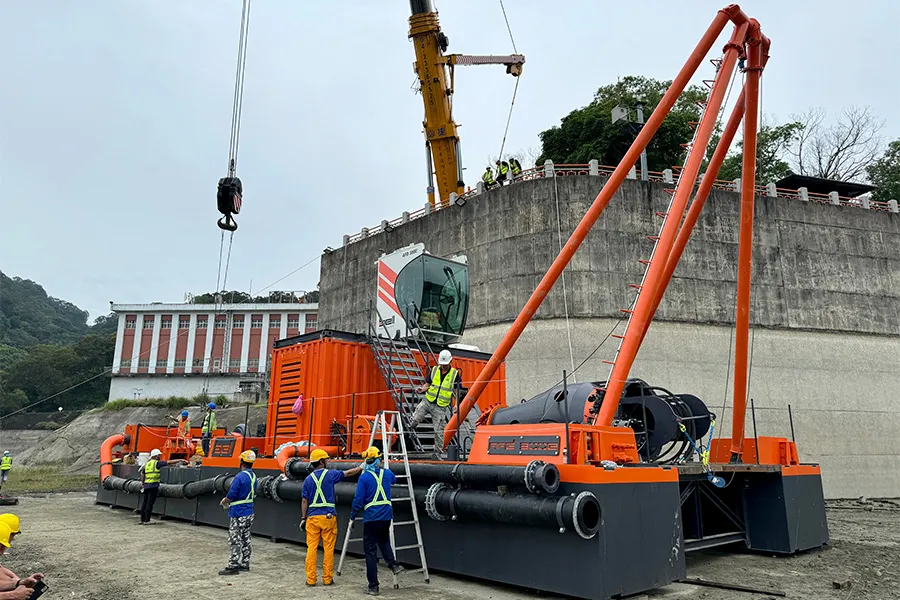
Bell Dredging recently assembled a Bell A-frame Dredger 300 at Liyutan Reservoir in Taiwan. The electrically driven hydraulic dredger is being used in the reservoir to remove sediment that has built up over the years, helping to ensure power-generation capacity and the drinking-water supply for the nearby city.
The reservoir has been providing green electricity and drinking water to Taichung, a city in western Taiwan, since 1992. “Because the dam was built in a valley and water from the mountains continually carries sand and sediment into the reservoir, it becomes shallower over time,” explains Thijs van den Outenaar, sales engineer at Bell Dredging Pumps. “This affects the drinking-water supply, and less water in the reservoir also means less power-generation capacity. To prevent this, the sediment that continually accumulates in front of the dam has to be removed. Initially, this was done using a dredging system from another manufacturer, but its reliability and capacity left much to be desired. We were therefore contacted to come up with a solution.”
Dual cutter head with water jets
The solution came in the form of a Bell A-frame Dredger 300. “Our system is powered by green electricity from the dam, supplied via a floating high-voltage cable. A transformer on board converts the 24 KV to 690 Volt, the operating voltage for the dredger’s electric motors,” says Thijs. “These in turn power the hydraulics for the Bell 300 dredge pump. The pump is suspended from a winch and fitted with a pair of rotating cutter heads to loosen sediment from the lake bed. This configuration keeps the pump balanced at all times, even when suspended from a winch at a depth of 70 metres, as it is here in Taiwan. Water-jet nozzles are also installed in and around the cutter heads to keep them clean at all times.”
Booster stations
The Bell A-frame Dredger 300 supplied has a capacity of 1,800 m3 per hour, at a water-to-solids ratio of 80:20. “That means we can remove 360 m3 of sediment per hour,” Thijs calculates. “The slurry is pumped horizontally over a distance of 2.5 kilometres, then over the dam with the help of two booster stations, one on board and one on shore in a 10 ft container. The great thing is that we can read all the dredger’s data remotely and even operate it remotely. If assistance is needed, we can log in from the Netherlands, monitor the system and troubleshoot. Our philosophy is that any excavator operator should be able to operate our dredgers easily, and that’s how we’ve equipped the cab.” This clearly inspires confidence. Bell is now building five Bell A-frame Dredger 250 units for the government in Thailand.
Question about this story? Ask your question
Keep following this
Get an email when a new story is published. No account needed.
- ThemeLower emissions and more reuse
- SubjectWater infrastructure







